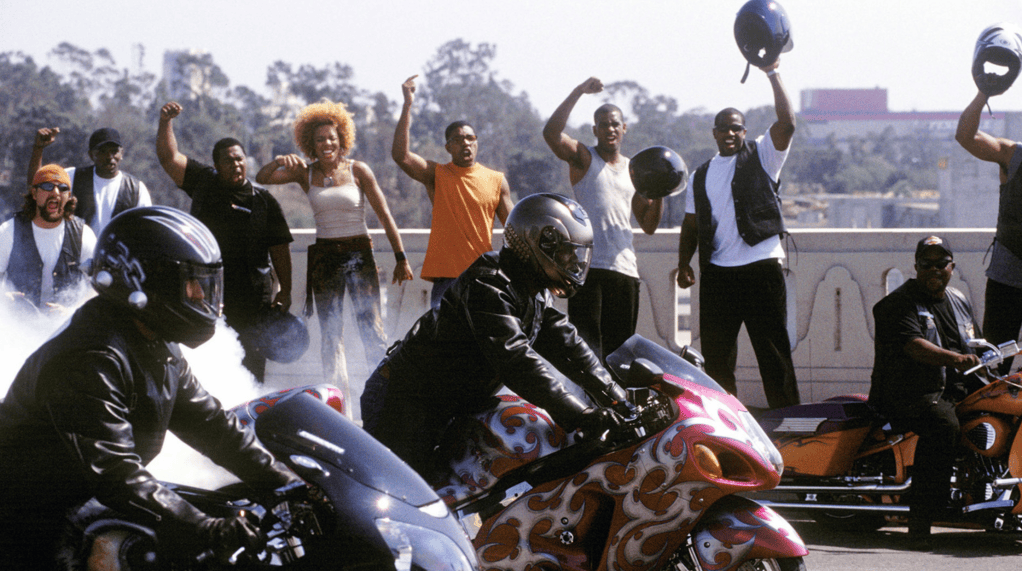
Biker Boyz’s fundamental problems don’t lie with its subject matter. It’s still just as intriguing nearly 25 years later. Unfolding from Los Angeles, the film charts the thrills and closely followed codes inextricable from one’s membership in an underground, all-Black motorcycle drag-racing group. (Though released not long after 2001’s The Fast and the Furious — a like-minded sleeper-hit blockbuster Biker Boyz’s distributor, DreamWorks Pictures, hoped their movie would inveigle the fans of — the film was not borne solely of trend-chasing but also of a thoroughly reported, same-named article by Michael Gougis that in 2000 splashed the soon-to-fold alt-weekly New Times LA.) The problems lie in its premise’s handling. Biker Boyz is weighed down by paint-by-numbers dysfunctional-family narrativizing and a leading Derek Luke performance so bland it’s a relief in the few-and-far-between moments when he isn’t in a scene. With him gone, the power of a better actor’s innate charisma zaps you like a defibrillator.
In Biker Boyz, Luke plays Jaleel. His dad, Tariq (Eriq La Salle), is a mechanic who’s heavily involved in the aforementioned drag-racing domain. Marked with trippy cinematography that suggests a dragonfly was passed a camera by director of photography Greg Gardiner, the movie’s opening race, encircled by hundreds of lovingly painted straddled rigs, goes from exhilarating to gasp-inducingly tragic in the span of a blink. A competitor’s hasty use of nitrous leads him to lose control. When he crashes through a storefront window, both he and the innocently bystanding Tariq are killed. The emotional whiplash instills in the viewer the life-or-death stakes that pervade every rally. It’s part of why the scene’s veterans — namely the so-called King of Cali, Smoke (a predictably solid Laurence Fishburne, who is himself a real-life bike enthusiast) — are revered by less-experienced group members as if they were gods made of flesh and blood and happen to stand at an average height. It’s part of why disregarding certain principles, like attempting bearings-testing tricks mid-race, is likelier to prompt wrist-slapping than celebration.
His father’s death makes inchoate racer Jaleel less inclined than ever to work his way up this particular faction’s hierarchical structure the conventional way. He arrogantly believes he’s more gifted than the decorated Smoke — a man Tariq had always idolized as the person the bikers beneath him should aim to become — so he sets out to start his own contingent. Inevitably, it shares the movie’s name. Its adherents wear bee-yellow branded jackets that inadvertently make the already-young members it recruits look even younger — less threatening than the older bikers who reluctantly approve, but approve nonetheless, the budding posse as legitimate competition in the drag races it organizes.
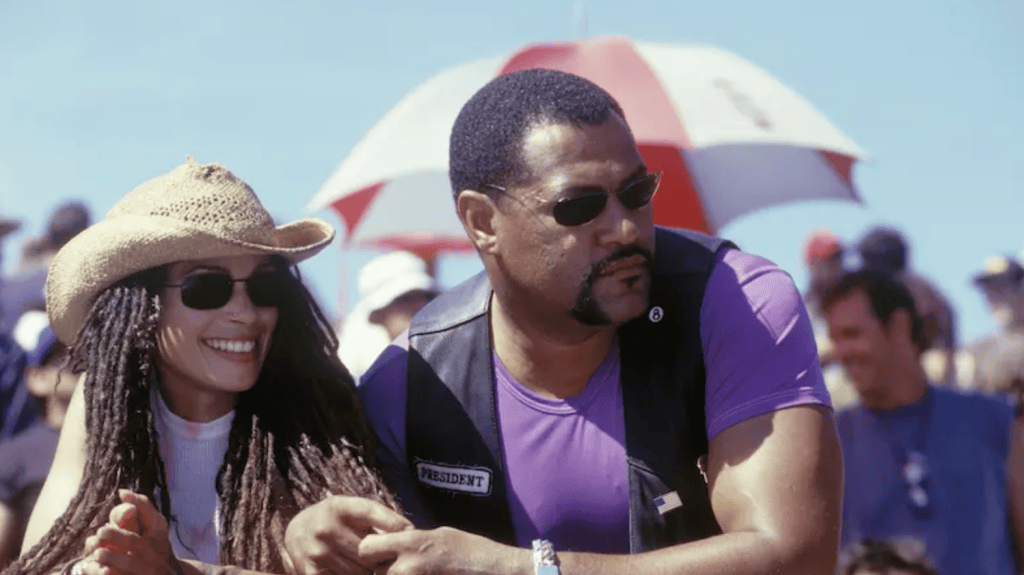
Lisa Bonet and Laurence Fishburne in Biker Boyz.
That fact hampers Biker Boyz’s dramatic tension, which already could use a heartier portion of generational clashing anyway. Jaleel and his cohort — whose relationships are barely given lip service by screenwriters Reggie Rock Bythewood, who also directed the movie, and Craig Fernandez — are immediately formally accepted, in a leadership-meeting way, as part of this world’s cabal of competition-eligible teams. They spend the rest of the movie trying to win respect from their elders — one of whom unfortunately includes Kid Rock, playing an out-of-place white member who goes by the apt nickname of “Dogg” — which isn’t as riveting a hurdle as being persistently and completely unrecognized. At heart, this community is loyal and supportive, even if its younger crowd resents much of its wizened protectiveness.
The lack of hard-to-overcome conflict would probably not be so striking if Luke’s performance weren’t so lethargic. It’s undeniable that Bythewood paints this world — which has more reach and history than a time-constrained work of fiction can accommodate — with real care, interest, and style. (He discovered it in person by chance, and cannily felt it should be aestheticized like a Western if to get the movie treatment.) And a later-to-come mistaken-paternity reveal adds some much-needed friction. But thoughtful filmmaking can only do so much when there’s a vacuum in the middle of everything.
Luke can’t be blamed for all of Jaleel’s vacancy. Bythewood and Fernandez ignore the foundation of his passion beyond it being passed down. They ascribe him few other characteristics besides cockiness, and we don’t have much of an idea of who he is outside the confines of drag-racing life. But Luke’s line readings trend toward inanimation, as if adequacy was all he was after. His face rarely capitulates to the embarrassment of emotion. Luke seems at a loss about why he’s here, and it spoils the film’s off-kilter appeal to a project-ruining degree. Here’s a movie with a fact-based hook no other film I know of can quite claim; that alone immediately draws you in. You want to know everything before Luke’s antipathy makes you think twice.

