Scarcely any time seems to have passed between Zach Cregger’s last project, August 2025’s Weapons, and his latest, last Friday’s Resident Evil reboot. Considering Weapons’ big box office and widespread acclaim — a lot of it of the “this man will save the horror genre” variety — the speed at which the comedian turned filmmaker’s next project is arriving efficiently tempers one’s expectations: There arguably hasn’t been enough time for them to get to the sort of perilously high place where a just-fine follow-up can feel like a crushing disappointment.
Cregger’s cinematic take on the namesake video-game series — itself famously adapted for screens in the 2000s for a sextet of dopey-but-fun sci-fi actioners starring a permanently glowering Milla Jovovich — is exactly what the company that poached him, Constantin Film, probably wanted. (It’s also Cregger’s first real “one for them”-style movie in a fledgling feature-directing career full of screwily funny “one for me” horror hits.) Like its predecessors, this Resident Evil is an amusing apocalyptic sci-fi thriller. But this time it’s more of a straight-to-the-point survival movie than a spectacle-heavy adventure. It has more pedigree, too, the Creggerian hallmarks among them dedicatedly natural lighting; a knowing but not glib sense of humor; a Raimi-like attitude toward gore and other bodily frights; and a general narrative shape that may objectively be improbable, what with its relentless attacks from hordes of zombie-like and zombie-adjacent monsters, but is played in a way that makes you think something along the lines of, This wouldn’t happen, but if it did it might look like this.

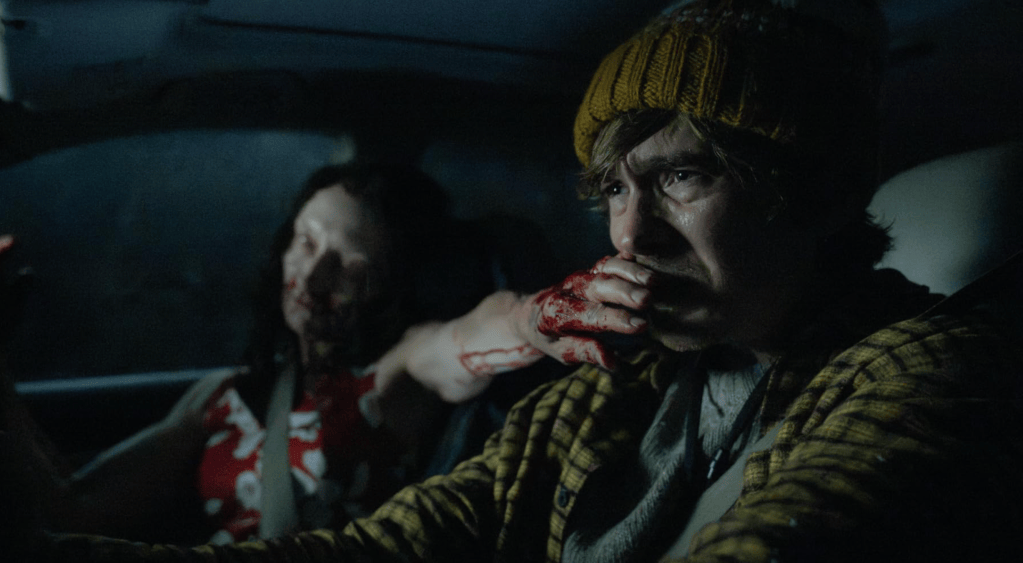
Austin Abrams in Resident Evil. All photography by Dusan Martincek/Columbia Pictures/Sony Pictures.
Case in point with its doing away with an unassailable action-heroine lead so that it can put at the front someone with more in common with an average ticketholder. Played by Weapons holdover Austin Abrams, Bryan is a rakish medical courier with relationship problems, his experiences with guns limited to video games. Nonetheless he’s unwittingly made into a chosen-one figure when the world begins descending into an end-of-the-world scenario brought about by a hazardously medically experimenting corporation. (The handful of scenes with said corporation’s craven representatives are among the film’s best, ticklishly sending up white-collar tactlessness.)
Resident Evil begins with Bryan making a delivery amid some pitilessly icy inclement weather his car is not equipped for. From there the storyline, promoted by another order, unrolls into a “one terrible night”-style storyline — refreshingly Cregger’s first not to use a cluttered time-hopping structure — where he’s forced to white-knuckle his way through one mortality-testing trial after another. His first is, while on the phone with his girlfriend, accidentally slamming his car into a freshly zombified woman while streaking down a snow-packed road. He almost sweetly treats his apparently still-alive victim as simply lost and a little worn down before it’s made clear that that’s closer to wishful thinking.
I couldn’t get the “this is exactly what Constantin Film probably wanted” thought out of my head while watching Resident Evil. In Cregger’s competent, good-time-at-the-movies handling of his material, I struggled to see the film as more than a state-of-the-art dethawing tool. A Resident Evil reboot was already attempted this decade — it happened in 2021, stamped with the subtitle Welcome to Raccoon City — but did not stick the landing; the swiftness of this new reattempt implies how desperately Constantin Film wants to shake its biggest cash cow for some spare change.

Austin Abrams in Resident Evil.
This particular incarnation of a nothing-new industry practice — using an au courant, prestige-associated name to bring new viability to a dusty property time hasn’t been especially kind to — wouldn’t rankle me so much, I don’t think, if Constantin Film’s aims weren’t so manifest, and if I didn’t have as much of a soft spot for the original franchise it’s being routinely praised as better than. I don’t disagree with the common complaints: that it was repetitive, unwieldy, clobberingly illogical. But it also had flashes of odd-duck brilliance that have aged rather well as mainstream action movies have gotten both slicker and harder to come by. The Paul W.S. Anderson era of Resident Evil was recklessly maximalist — singularly tacky and baroque in ways fatly budgeted thrillers aren’t often anymore.
Bryan’s skirmishes with danger playfully resemble “levels”: a tiptoe through a pitch-black tunnel where seemingly abandoned cars sit and untold terrors almost certainly await; an ascent up the compromised elevator of a rapidly deteriorating metropolitan hospital. Cregger summons well the gulping, paranoid feeling one gets while playing a horror-leaning video game; that’s further boosted by his movie’s generous helping of shots either taking its anti-hero’s direct POV or with the back of his head centering the camera’s field of vision. You’re filled with dread every time a new corner is turned or an unfriendly-looking passageway is entered only because what’s sitting in the adjoining room is almost certainly worse. But one’s eagerness to see how the clumsy and impulsive though not stupid Bryan will wiggle out of his latest tribulation can only lose steam, even if Abrams does a pretty wonderful job approximating a flustered everyman you want to cheer on — an archetype that in an action-movie context tends to be still pretty unusually superheroic. He does, given the circumstances, his best, and it gets him pretty far.

