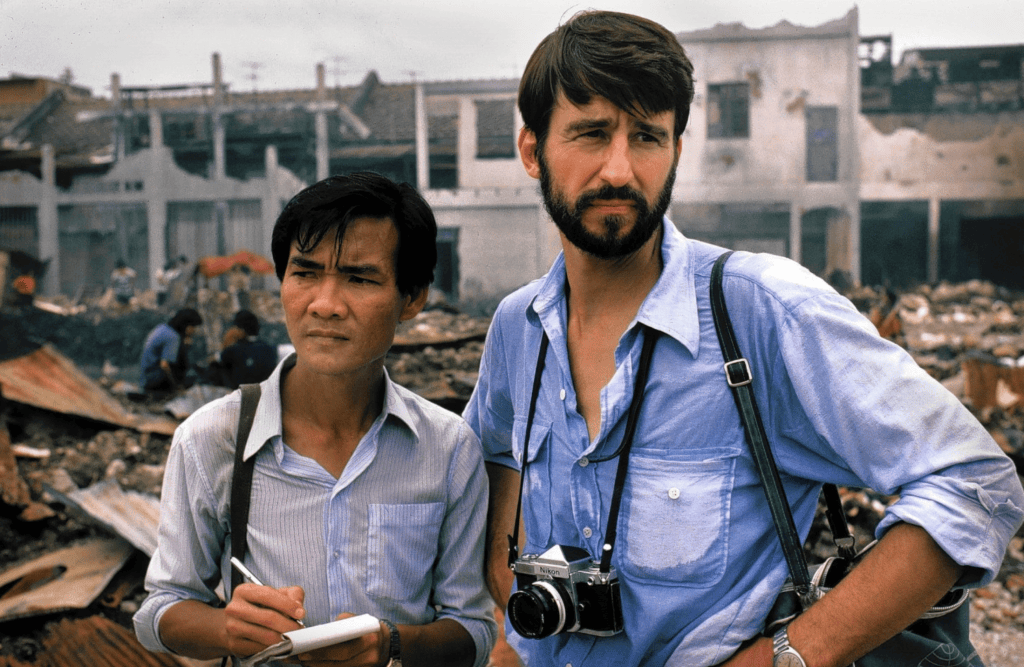
The Killing Fields’ screenwriter, Bruce Robinson, immediately relinquishes a chance to deepen his movie’s emotional contours; it has a lasting effect on the film. The movie, released in 1984, is about the horrifying rise and then totalitarian dominance in the 1970s of Cambodia’s Khmer Rouge regime, as seen through the eyes of an American New York Times journalist, Sydney Schanberg (Sam Waterston), and Dith Pran (Haing S. Ngor), a reporter native to the country who also becomes indispensable as a translator for Schanberg. Obliquely foreshadowing the wide narrative scope to come — the movie edges toward two and a half hours — Robinson leaves offscreen the genesis of Schanberg and Dith’s initial connection, which develops into something so personally meaningful to them both that Dith compares Schanberg to a brother. Instead it condenses their first few months of collaboration and friendship into a kind of mini-montage that serves as the film’s prologue, with Waterston, in voiceover, catching us up to speed in a little over a minute to set the stage for The Killing Fields’ proper August 1973 start.
In The Killing Fields, helmed by first-time feature director Roland Joffé, Schanberg and Dith’s movie-driving kinship is instantly understood more than felt. As I watched its version of Schanberg be, in successive scenes, domineering and incautiously bold, all at Dith’s expense, I started to see the film’s movie-opening act of “previously seen on”-like truncation as a major missed opportunity, robbing the viewer of a chance to get a better hold on a friendship that primarily looks like a lot of one-sided bossing around. It might have made a difference to see introductory scenes apportioned to Schanberg and Dith getting a feel for one another and building a rapport, making the increasing stress about the level of danger they and the Cambodian populace will soon be in — likely the main reason for Schanberg’s flintiness — starker and more interpersonally legible.
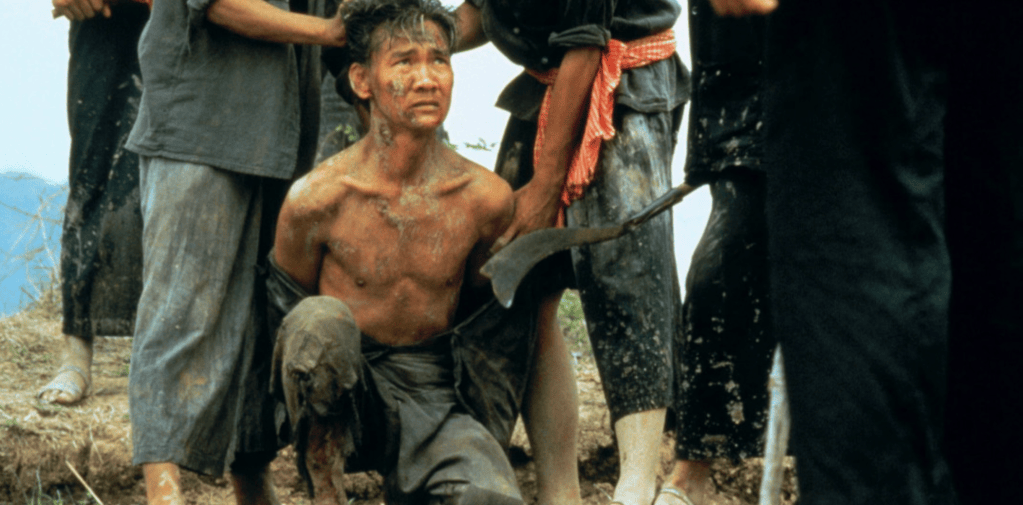
Haing S. Ngor in The Killing Fields.
The Killing Fields’ deficiency as a story of friendship also feeds into one of its strengths. Many movies of its ilk might attempt to more aggressively movie-heroize Schanberg, using what the film eventually frames as his ultimate failing — not doing enough to help Dith flee his war-torn country before it becomes too late — to motor a series of scenes where he raises melodramatic, self-redemptive hell to ensure his friend doesn’t become one of the many journalist casualties to be fatally targeted by the free-speech-stultifying Khmer Rouge. But the film allocates, after the two are separated, more time to dramatizing Dith’s prolonged, barely-holding-on survival in Cambodia. He’s forced to work for years in a labor camp, where days are swallowed up by back-breaking labor and wanton, hope-disintegrating acts of violence inflicted by the Khmer Rouge’s cadre of disturbingly young soldiers who handle guns like plastic toys. Food is so hard to come by that he takes to snatching up lizards for the spare meat and making small incisions on cows’ bodies to suck some of their trickling-out blood.
When the action returns to New York City-based Schanberg, it lingers over his pronounced guilt and the helplessness he feels without giving it equal narrative heft to what Dith goes through. (Dith’s characterization, by Robinson, nevertheless feels less full than Schanberg’s; he’s a little flattened into a resilient angel figure who will always be there when you need him.) Schanberg’s scenes back at home mostly feel like they could be jettisoned entirely. Dith, the movie is clear-eyed about, is the one facing the real horror; an indelible representative image sees him, post-escape, stumbling on and through a dirt path slick with water and, horrifically, the variously decomposing bodies of Khmer Rouge victims. His family life ought to have been drawn with more care and as much seriousness as his ghastly encounters as a prisoner and fugitive; mostly all we see is a brief, teary exchange with his wife, when they’re still considering fleeing Cambodia, during which the film maintains its aversion to subtitles and doesn’t give his spouse any dialogue to begin with.
The Killing Fields doesn’t so much condemn the ease with which people like Schanberg can remove themselves from international conflict — even when their intentions are valorous and their boots are on the ground, trying to productively leverage their privilege — as accentuate the cosmically unfair chasm between his and Dith’s experiences, augured by the sweat-on-the-skin, progressively terrifying immersion of its faux on-location shooting style. Most of the production happened in Thailand; cinematographer Chris Menges does a fine job apprehending the setting’s natural beauty, which only makes the unrelenting bloodshed it contains more surreal and nightmarish.
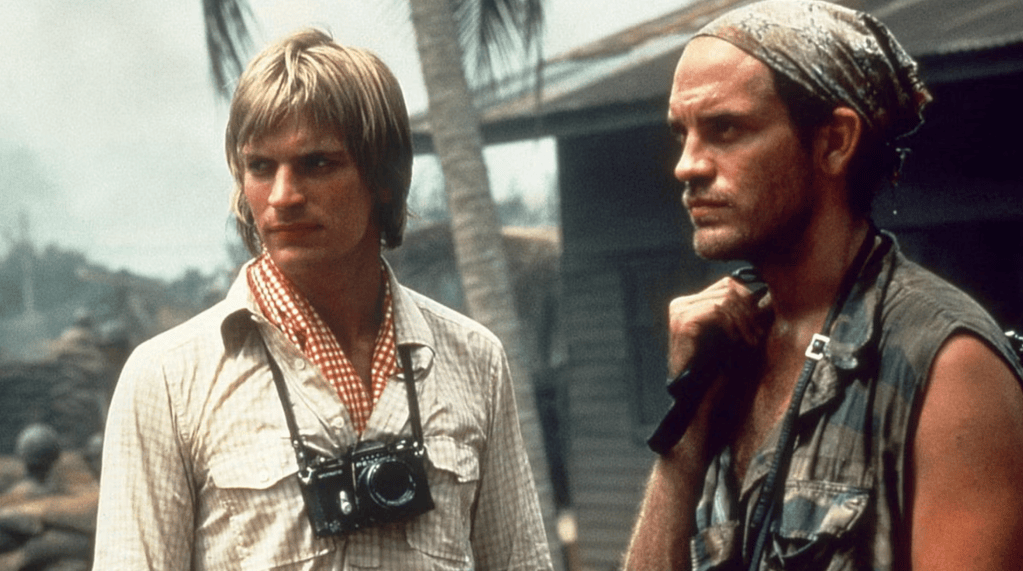
Julian Sands and John Malkovich in The Killing Fields.
Our distress is fanned by the casting of Ngor, a physician with no acting experience who was serendipitously plucked from the pomp of a Cambodian wedding in Long Beach by one of the film’s gimlet-eyed casting directors, Pat Golden. Just like the man he portrays with sensitivity and quiet command, he too survived the Khmer Rouge’s genocidal reign; his experiences weren’t far from Dith’s. Feature-narrative movies, even when adapting something that really happened, have a built-in partition safely separating it from immediate reality. Ngor, who won an Oscar for his work, complicates the tradition; the film’s most painful scenes are turned more excruciating by the knowledge that this restaging’s “rehearsal” directly pulls from personally defining traumas. Even a minor moment — Dith watching a young, female Khmer Rouge soldier cruelly yank out a still-inching-up tomato plant from the ground that he’d been growing — required multiple takes, Ngor so suddenly inundated with memories of his one-time tormentors’ faces that he broke down.
Despite reasonable “this isn’t quite what happened”-style protestations from some of the real-life people whose experiences the movie fictionalized, The Killing Fields’ steadfast on-the-scene naturalism and fairly open scorn for U.S. war-machine-yielded destructiveness sets it apart from many of its image-minded, propagandistic war-genre peers. Such is part of why its famous (or, depending on your purview, infamous) final touch — soundtracking Schanberg and Dith’s reunion with John Lennon’s simplistically idealistic “Imagine” — feels out of step with what precedes it. It reads as pat, putting too neat and sentimental a bow on a movie that spends nearly all its time illustrating how quickly the normalcy of everyday life can be frittered away when the wrong people have governmental muscle powering their twisted ideologies. A parallel song choice from earlier in the movie — Paul McCartney and Wings’ “Band on the Run” clamoring tinnily from a Khmer Rouge car radio as some of its young guns shoot new victims point-blank on a just-destroyed street — better fits The Killing Fields’ distressing power.

