Those unfamiliar with the movies of stand-up comedian Rudy Ray Moore probably wouldn’t believe that his third star vehicle, 1977’s Petey Wheatstraw, was particularly thought out. Scenes do not so much carry the story forward as continuously fidget with it, everything perpetually treated about as sacredly as the last color flung onto a splatter painting. Its comedy seldom obeys a conventional setup-punchline formula; instead it wallows in wall-to-wall absurdity. For Moore, though, that anything-goes battiness was not a byproduct of amateurish ineptitude but an intentional artistic ethos he took pride in. “I am a ghetto expressionist,” he declared in a 1997 interview with the Miami Herald.
Written and directed by recurring collaborator Cliff Roquemore — who, like Moore’s other cinematic wingmen, basically adapted the tenor of Moore’s onstage presentation for the screen — Petey Wheatstraw has the same charming spaghetti-on-a-wall spirit of Moore’s previous headlining projects released that decade. In the film’s predecessors — 1975’s Dolemite and its sequel, 1976’s The Human Tornado — Moore’s onscreen analog was a cocksure, gaudily dressed pimp great (in the film’s universe) at hand-to-hand combat and even greater at weaseling out of dicey situations. He remains in Petey Wheatstraw a charismatic anti-hero always getting into trouble he seems only sometimes ruffled by. But this time Moore breaks from formula by slightly sloughing off the screen persona he was associated with to play a character living off sheer talent.
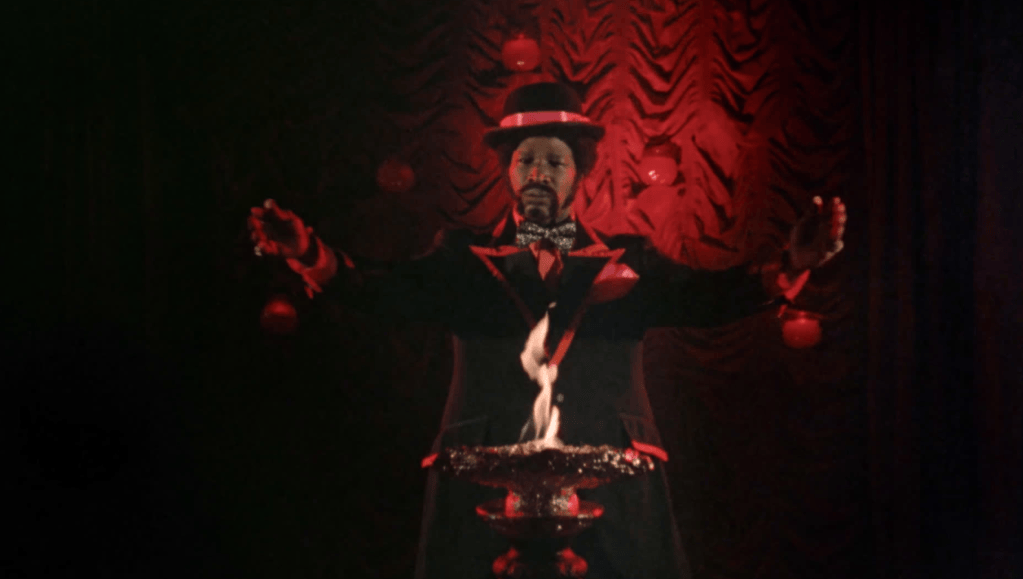
Inexplicably born as a full-grown 6-year-old joined in his mother’s womb by a watermelon, the title character is a martial arts-trained nightclub comedian who grows so locally popular that, early in the movie, a pair of rivals with always-plastered-on shit-eating grins organizes his death while he’s attending a family friend’s funeral. The murder plot works; most of the other mourners become casualties, too. But when Petey lands in the afterlife — depicted with a black-and-red overlay and soundtracked by the sounds of the damned’s screams and the River Styx’s gurgling — a disarmingly polite Lucifer (G. Tito Shaw) gives him the chance to opt out of death. There is, of course, a catch. Petey must marry, then impregnate, Lucifer’s daughter as a trade-off. Her face is largely kept hidden from the viewer but is disgustedly declared by Petey to be “so ugly, she could scare a hungry bulldog off a meat truck.”
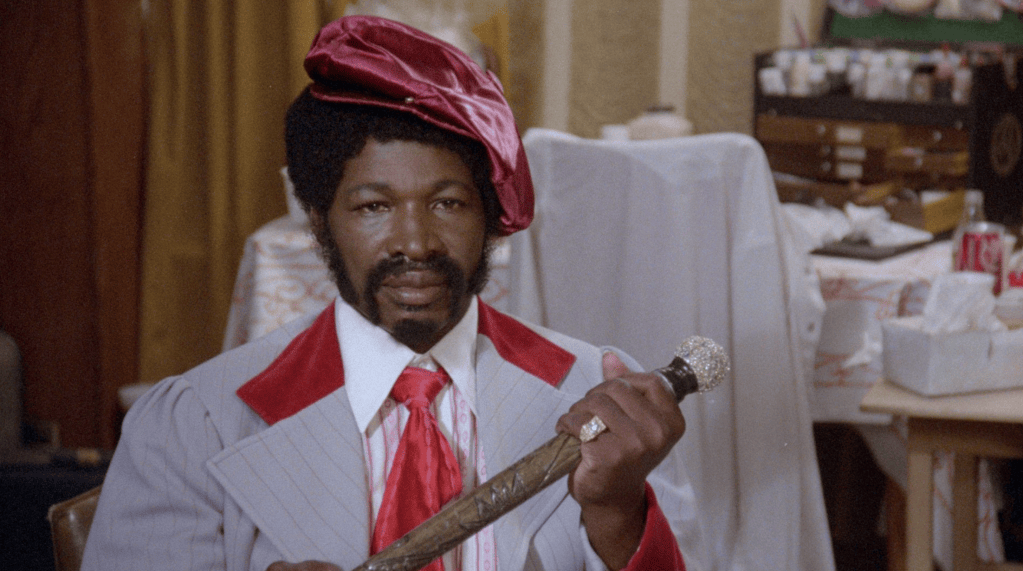
Rudy Ray Moore in Petey Wheatstraw.
Such is among many deliciously weird one-liners to dot this deliciously weird movie, which Moore’s character spends either trying to outsmart the devil or flesh-and-bone foes. He isn’t ready to die, and he isn’t ready to marry this unfortunate-looking demoness, either. (One of the film’s proudest ongoing gags comes when Petey gets his hands on a limitlessly powerful cane, which he’ll in one scene use to turn a stranger’s no-good boyfriend into a whimpering puppy and in another sabotage an adversary’s event by making sure something goes diabolically wrong with every person who attempts to take center stage.)
Moore’s appetite for outrageousness crystallized early in his career. After moving from his native Arkansas to Cleveland, where he eventually got into standup, he learned that you could win over an audience in no time with enough behind-the-mic audacity. He regularly performed shirtless; he adopted a turbaned stage persona he called Prince DuMarr. When he made Dolemite, a make-it-or-break-it chance at movie stardom, Moore exploited that formative impulse — as he would in his other onscreen projects — because he knew a limited budget would make it essential to lean into potentially ticket-attracting controversy and, in general, prove that seeing a Moore movie meant you’d be seeing something unlike anything else in theaters. He was committed to doing things his way. Aside from the frequency of his characters’ shared standup careers, there was much separation between Moore and the bold men he portrayed, demonstrating the self-preservational tactic — clearly demarcating private and public personae — adopted by many performers. Moore neither smoked nor drank; his disposition has been compared to a preacher’s.
Because Petey Wheatstraw’s goofiness is approached so joyfully by its cast and crew — the movie has an irresistible made-with-friends quality — that it’s always enjoyable whether or not it makes sense on a moment-to-moment basis. That’s true of Moore’s other movies, too. The trait was equal parts blessing and curse, paramount in setting him apart in a film industry unsure of what to make of him (his breakthrough, Dolemite, depended on self-financing to get seen) but also unsustainable in the long-term. Movies formed on vibes, even good, singularly strange ones, are unreliable for building a career on, likelier to alienate as cultural tastes change than continue winning over new fans. But though Moore’s cinematic fame was short-lived — it’s especially been bracketed in, in the years since, with blaxploitation, the 1970s film movement with a certain unspoken house style that his movies don’t completely fit — the pleasure he took in making brazen, unapologetically-his-own art is worth lastingly admiring and, for those who dedicate their lives to their creative passions, aspiring to.

