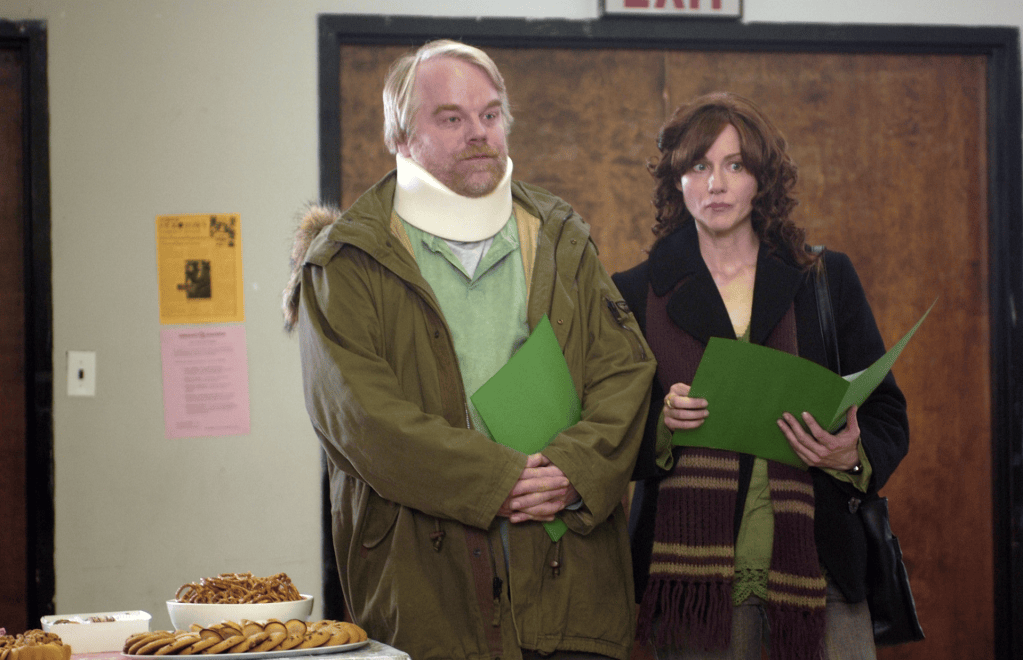
Partway through The Savages (2007), I started to feel bogged down by its unabating, seemingly directionless unease, wishing for something resembling a climax or, at minimum, like the turning of a new leaf. But the constancy of its everyday, unremarkable misery is, with hindsight, one of the things I most appreciate about it. The family drama, writer-director Tamara Jenkins’ second movie, spurns the treacly notes of redemption and exorcisms of trauma often expected from the genre. Jenkins has, since 1998’s Slums of Beverly Hills, released movies at an exacting, unhurried nine-year clip. Abstaining from sentimentality without seeming like it’s trying to, The Savages bespeaks the benefits of taking one’s time. I’m liable to believe Jenkins did inevitably run into many false notes while drafting but used the time between projects to carefully consider how to rejigger them into something more ordinarily life-like.
Laced with a style of slice-of-life humor that in the wrong hands could seem like contrived attempts at idiosyncrasy — an open-hearted conversation where one partner struggles to speak through a back- and neck-stretching contraption that puffs their lips and inhibits facial movements; some post-coitus, misremembered Marlene Dietrich trivia that doubles as a final straw — Jenkins builds The Savages around a barbed brother-sister relationship. Jon (Philip Seymour Hoffman) is a theater professor living in Buffalo who’s too anxious to commit to marriage to his longtime, Poland-bred girlfriend (Cara Seymour). New York City-based Wendy (a bad brown-wigged Laura Linney) is an aspiring dramatist who supports herself with temp work while restlessly applying for fellowships for a play she’s been contemplating for years: a semi-autobiographical tale she’s tentatively calling “Wake Me When It’s Over” about her and Jon’s abandonment by both parents while they were young.
Jon and Wendy aren’t as close as they once were — their bond forever remains tender at its core but externally hard-edged, a product of life-upending circumstances necessitating co-dependence for survival — but are brought back into each other’s day-to-day lives when they receive word that their estranged father, Lenny (Philip Bosco), has become a dementia-dazed nuisance to his also dementia-dazed girlfriend Doris’ (Rosemary Murphy) live-in nurse. The Savages opens with Lenny so incensed by said nurse’s request to be better about flushing the toilet that he pettily smears his shit on the bathroom wall, spelling out “PRICK” as he retches.
When Doris dies, her family refuses to give Lenny the house despite him and Doris living there for years, giving him time to erase his past under the Arizonan sun. Jon and Wendy work to get him into an assisted-living home, and despite the hatred she’s always harbored for her dad, Wendy continues to be nagged by guilt, one place settled on as a worthy-enough living option before she thinks it would be better to settle on something potentially less depressing.
The Savages provides no closure for Jon and Wendy’s fractured paternal relationship. The past is not as relitigated as you might expect for a movie with this premise and this set of characters. It wallows instead in the confusing feelings familial mortality can stir in a person — how you can suddenly empathize with someone you’d had nothing but horrible feelings for, who’ll greet you with messages like “where the hell have you been,” when it becomes truly impossible to heal your relationship with them. It’s also interested in what Jon and Wendy don’t want to admit about themselves and how it might relate to their formative childhood pain: their failed creative pursuits; their inability to commit to symbiotic long-term romances. (Wendy can’t stop wasting time with an older married man, played by Peter Friedman, who has no intention of getting a divorce.) The satisfactions of The Savages are largely not narrative, even if there’s much to admire about its persuasive quotidian rhythms. They mostly come from its realistically jumbled feelings and sublimely beaten-down leading performances that make you feel much affection for characters struggling to have much for themselves.

