Sliding Doors (1998) starts with a 20-something named Helen getting sacked from her public-relations job. Then, as if it had conspired with her boss to make a terrible day even worse, her train leaves without her. That fit of bad luck won’t get the final word, though; that’s Sliding Doors’ whole thing. The scene suddenly rewinds, and Helen (Gwyneth Paltrow, in her best British drag) manages to not only make the train on time but get to know the approachably handsome man (John Hannah) who picks up the earring she drops. “Sliding Doors” thereafter toggles between the parallel lives Helen leads after both train moments. We can’t confidently say until the movie’s conclusion which version of Helen is happier, and which, to us, is the real one and which the hypothetical.
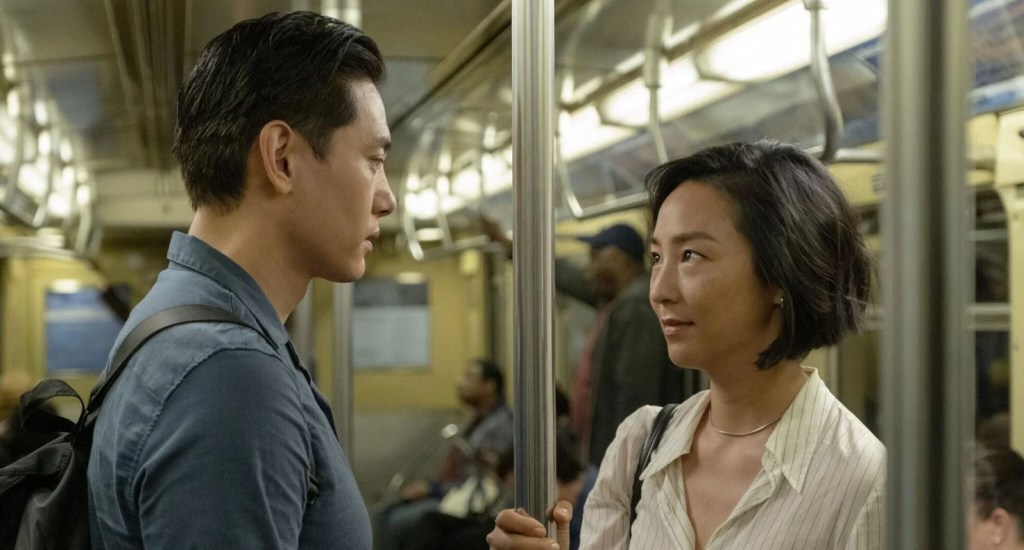
It’s been so long since I saw Sliding Doors that I can’t remember if I liked it. But its conceit stays with me, because I wonder all the time, as everybody does, how life would have unfolded had one choice not been made and vice versa, some “what-ifs” slick with the residue of regret and others the relief of avoiding something likely terrible. Sliding Doors is memorable because it actually shows us what might have been; Celine Song’s poignant, spiritually similar Past Lives isn’t quite as literal in its speculating, and is much more earthbound, but has a more tantalizing premise that’s perhaps richer with possibility. What might have happened had its playwright heroine, Nora (a tremendous Greta Lee), pursued a romantic relationship with the childhood crush, Hae-sung (Teo Yoo), she left behind when her family emigrated from South Korea to the states rather than marry the acclaimed novelist, Arthur (John Magaro), she met at an artist’s retreat a few years ago?
That question moves to the fore 24 years after Nora and Hae-sung first parted ways and 12 after they briefly resumed their friendship over Skype in college. Hae-sung has arrived in New York City for vacation. Though he wouldn’t say as much, it’s a trip that, of course, is motivated solely by the chance to see Nora in the flesh for the first time in decades. (He and his long-term girlfriend are currently on a break after some badly received marriage talk.) The estranged pair spend a few days together, ambling around Main Street Park and sidling up to the Statue of Liberty by boat; they talk of their lives and their pasts, albeit always with the respectful distance of people not wanting to do something destructive. Arthur, to whom we don’t doubt Nora is very happily married, is as patient and compassionate as someone in his shoes could be: he doesn’t mind it, or at least doesn’t make it a point that he minds it, when he’s third-wheeling at a bar and Nora forgets to translate the conversation for him for an extended period, for example.
But he understandably can’t help but be a little unnerved by everything. Arthur knows — and he especially would know, as someone who writes stories for a living — how romantic this reunion and what it could possibly engender sounds: if his wife, who as a child was telling her mother she’d marry Hae-sung if he asked, abruptly left behind her successful life in New York City to run away with the guy she was probably meant for but was torn away from because of circumstances she had no control over. There’s a lot less glamor to Arthur and Nora’s romance, which started at a countryside compound where there weren’t really other lonely single people, and to their marriage, which began hastily and without frills because of time-restricted green-card demands.
But by the time Arthur is bemoaning all this, aware of his status as a white guy in the middle, we can tell that Song, the type of filmmaker more appreciative of the meaning you can reap from an extended silence or a small gesture than a long-winded exchange of dialogue, is looking to complicate the expectations Arthur — and by extension viewers who’ve seen enough romantic movies with narratives of a piece with this one — has about where this all might be going. We never actually — or at least I didn’t — want Nora and Hae-sung to get back together. It’s dramatically fulfilling enough to ponder all the things that could have been, to sit in the heartbreak of the experiences that never were. Past Lives movingly evokes the reality — a hard-to-accept one — that it’s sometimes likelier that longing for something, truly aching for it, just may be more powerful than getting the tangible version of it.
IN TIM STORY’S VERY FUN NEW HORROR COMEDY THE BLACKENING, a weekend outing in a cabin in the woods becomes a death trap for the octet of reuniting college friends celebrating Juneteenth there. In the prologue, the first couple to arrive, Morgan and Shawn (Yvonne Orji and Jay Pharoah), are bloodily dispatched after deciding to play an unsettling board game set out in a way that practically forbids them from ignoring it. (It’s what the movie gets its name from; its equivalent of Mr. Monopoly or King Kandy is a grinning Sambo-style robot who giddily asks Black history-related questions — everything from who Sojourner Truth was to the total number of Black people who appeared on the lily-white Friends — and threatens that a wrong answer will equal death enforced by a guy hulking around the premises with a bow and arrow and other deadly weapons.)
Heavier on the comedy than the horror — a welcome balance here — The Blackening is a movie motivated to turn a long-running racist slasher-movie trope on its head. In the overwhelmingly white horror subgenre, it’s long gone that, on the rare occasion that there is a Black person(s) in the cast, they will be the first to die. But what happens when your cabin in the woods-style slasher movie’s primary ensemble entirely consists of Black people — “WE CAN’T ALL DIE FIRST,” promotional posters conclude — who themselves know and are tired of the cliché? (There is, naturally, an early reference from a couple characters to the cold open of 1997’s “Scream 2,” which itself was both a bald reference to and reinforcement of the trope.)
A common refrain I’ve seen in reviews is that The Blackening, which forces its cast to play the eponymous game, is a sort of mix of Scary Movie (2000) and Get Out (2017). That isn’t very accurate, though: this isn’t an outrageously goofy, joke-a-minute parody like the former, and it’s much cheekier than the latter. It’s more a meta, generally lighthearted riff on the stuff found in darkly comic survival thrillers like You’re Next (2011) or Ready or Not (2019), except we get the memo after a while that we needn’t worry about anyone in the charming cast — it’s made up of Grace Byers, Jermaine Fowler, Melvin Gregg, Dewayne Perkins (who also co-wrote the movie with Tracy “Girls Trip” Oliver), Antoinette Robertson, Sinqua Walls, and the particularly great X Mayo — actually succumbing to the blows and the arrows that will come flying their way. “The Blackening” is a how-will-they-get-out-of-this nail-biter consistently — and thankfully — relieved by sharp jokes and well-deployed physical comedy, from a character whose accidental ingestion of Adderall turns her into a combat whiz to another who hurls chunks whenever he’s really nervous. The Blackening is a good time with an appreciative audience; I left it thinking about how hospitable it’ll be to rewatches, where the scares can be better braced for and the laughs better appreciated.
This column originally appeared in South Sound.
 Peterson Reviews