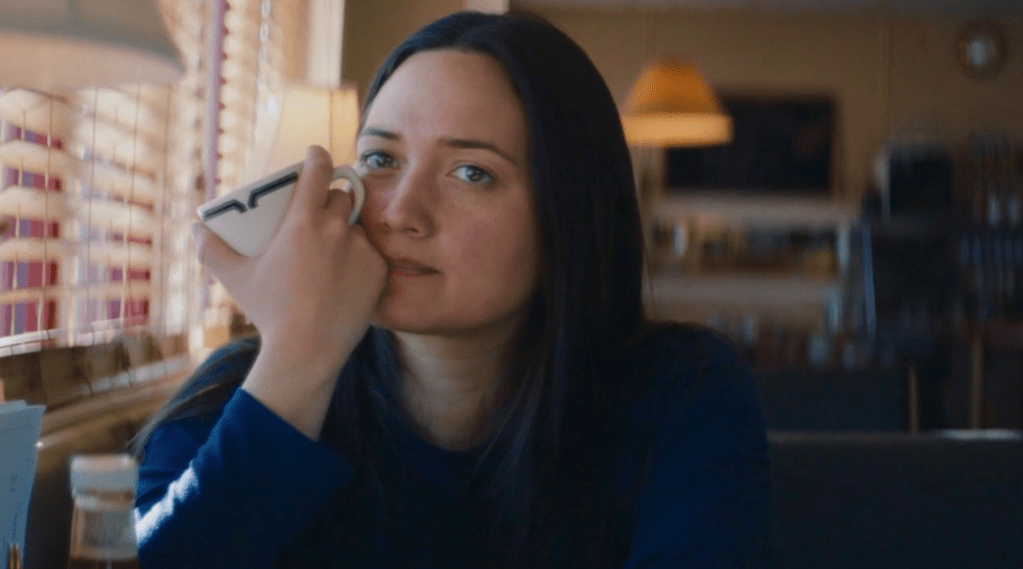
The Unknown Country, Morrisa Maltz’s narrative feature debut, begins with a bleary-eyed young woman named Tana (Lily Gladstone) setting off on a cross-country road trip in the dead of a snowy night. We will not know, for a long time, where exactly she is headed (“I’m just kind of floating,” she tells someone uncertainly) or what she is coming from until we do: Texas; the home of the late grandmother for whom she had, for years, been the primary caregiver and whom she now grieves.
The Unknown Country is notionally a character study, though it’s as interested in Tana as the places she’ll stop and the people she’ll cross paths with on her journey. The farther she gets, the sunnier the vistas become, in concert with grief’s way of relaxing its oppressiveness the better you get at living with it. She’ll find some levity connecting with, after some time apart, her Oglala Lakota family members on the occasion of her cousin’s (Lainey Shangreaux) wedding, and a group of strangers she meets in a bar late movie who take her out on an impromptu night out. Even as she cheekily deflects some of the personal questions she’d prefer to not get into, it’ll be the first time she will truly seem at ease throughout the movie.
Gladstone, predictably stunning in The Unknown Country, is a performer incapable of not being compelling, able to turn the banalities of lighting another cigarette or telling a goofy joke about whales to a crew of barmates transfixing. Gladstone has said that the movie, whose development began in 2017 and for which she signed up around 2019, was the first role after her breakout in Kelly Reichardt’s Certain Women (2016) where she felt appreciated for her talent purely as an actress, without her background unduly serving as a qualifier to her gifts the way it had often been in the uptick of roles she’d been getting offered. (Gladstone is of Blackfeet and Nimíipuu heritage.) The Unknown Country doesn’t snub Gladstone’s Native roots: her character, estranged from the family she visits who live in closer proximity to the reservation she grew up on, spends much of the film reconnecting with her heritage. But it’s a movie more motivated, Maltz has said, to explore the universality of working through recent grief.
The Unknown Country is best when it’s quietest, in the almost out-of-body stretches where Tana is driving in a kind of haze as the radio whirrs and her heavy eyes struggle to stay open — where she’s with family and feigning cheerfulness to mask the heaviness of her sorrow. This is a movie great at evoking the way long journeys on the road can make you feel beyond time and space but nonetheless hyperfocused on what you’re coming from and what might come — and who you’ll be — once you’ve arrived at your destination. But it’s largely ineffective elsewhere.
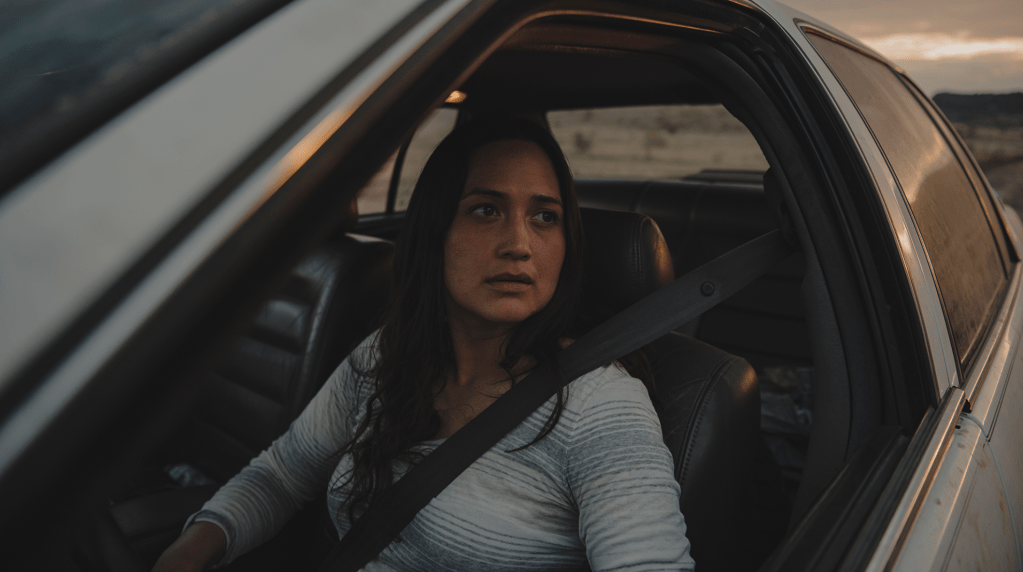
Lily Gladstone in The Unknown Country. All photography courtesy of Music Box Films.
The Unknown Country originated as a loose documentary featuring people Maltz had encountered while herself road-tripping in the areas where Tana travels in the movie. They become “characters” in the film that Tana (who, along with the fictional story, came later in development) will encounter. There’s a cat-loving diner hostess who’ll sing “Bohemian Rhapsody” if her patrons ask, a minute-mart teller who sweetly talks about how he practically dreamed the love of his life into existence.
Maltz inserts these people lovingly, awkwardly, into the main story. One of these figures will cursorily appear; then the film will cut to footage of them going about their routine while the audio of a testimonial recorded by Maltz plays over the action. There is potential in this approach: a reminder of how many fascinating stories live beneath the exteriors of people who may only fleetingly factor into our own lives. But the device ultimately functions more like an interruption than something patently bearing much meaning in league with Tana’s own journey. Outside this storytelling tool’s use on a few of Tana’s family members, who presumably play fictionalized versions of the people they are off camera, the ensuing substories bear nearly no overarching significance besides simply being nice to hear. (Where they fit in feels contrived; it’s like Tana is buying a few items from a store, for instance, simply so that we can learn more about the person serving her.)
It’s easy to wish The Unknown Country were split into two movies: one collecting the various stories of a community, á la Errol Morris’ Vernon, Florida (1981), the other a drama whose focus on Tana were tighter. The dyad of forms stitched together causes more mutual dramatic harm than enhancement. The Tana story makes the documentary elements feel like mere decorum, something engaged with little more than transiently for the sake of a nominally naturalistic texture; the latter only underscores the gauziness with which Tana’s story has been fleshed out. (There was no set script for the movie; the direction in which The Unknown Country moves was collaboratively decided as production progressed by Maltz, Gladstone, editor Vanara Taing, and Shangreaux.) By wanting to do and be so many things at once, The Unknown Country gets in its own way.
The Unknown Country is playing at SIFF Cinema Uptown through Aug. 24. Get tickets here.
 Peterson Reviews