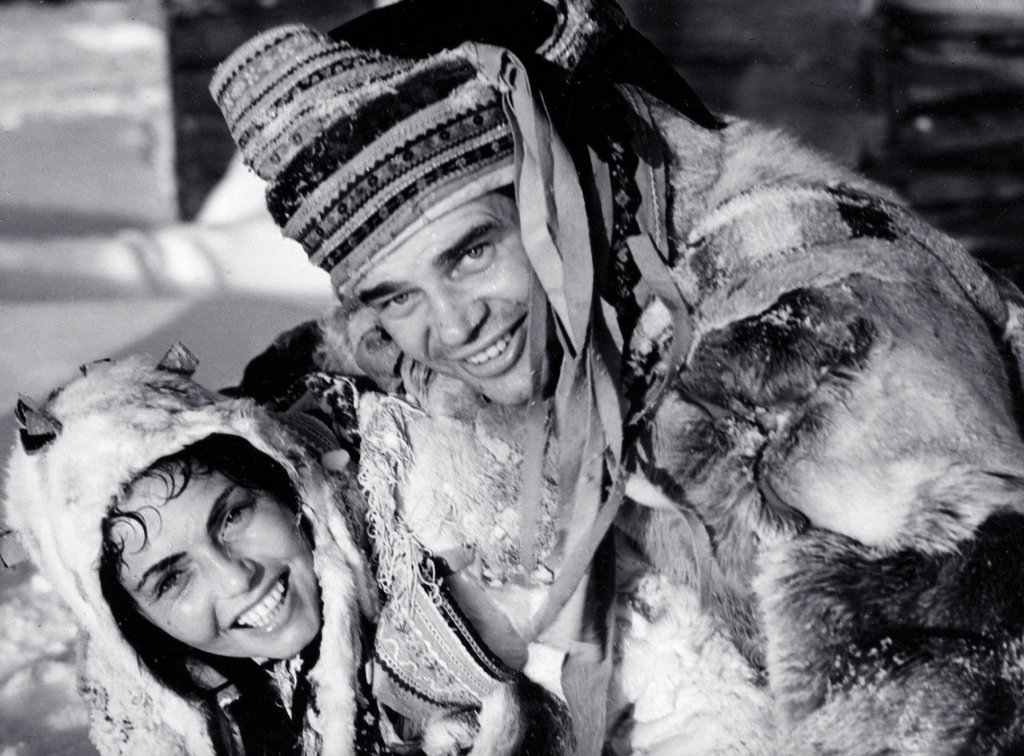
Properly for a fairytale-esque movie inspired by Finnish mythology, Erik Blomberg’s chilling feature debut, The White Reindeer (1952), tells us of its heroine’s backstory not through a traditional prologue but song. It sums things up tidily: that Pirita (Blomberg’s ringer-for-Barbara-Steele wife, Mirjami Kuosmanen), a girl of Lapland born in a snow drift, is in fact a witch with “evil in her belly” — something she will not discover until the ramifications are irreversibly deadly.
If not for its foreboding introduction, one would not think at first that The White Reindeer would move in the haunting direction it does. It properly begins with an ebullient, high-energy meet-cute between Pirita and her soon-to-be-husband, Aslak (Kalervo Nissilä), who are taking part in an impromptu, all-smiles reindeer race through the snowy Finnish Lapland landscape where the film is set. It’s love at first dash. A dowry with Pirita’s father to make their marriage official is being exchanged practically before we know it.
Aslak and Pirita seem so ecstatic in love — and are also living in an environment where we can’t imagine what else they could do to further substantiate their romance — that we don’t think of any of this as moving too fast. (Good thing, too, since this is a movie that lasts just a little over an hour.) What Pirita isn’t prepared for is how little she and her new husband will get to enjoy their new marital bliss. Aslak is a reindeer herder, and his job necessitates he be gone for unbearably long periods at a time. The first time he assures his new wife that “the weeks go by fast,” your stomach drops. What is Pirita to do in a time and location where there is basically nothing she can materially do to pass the time satisfactorily besides entertaining herself with the small white reindeer she’s been gifted as a pet?
After some time miserable in her loneliness, Pirita pays a visit to a local shaman in an effort to lure her husband to fall further in love with her so that he’ll be inspired to stay home more often. But her witchy heritage, no more explained than it cursorily is in the film’s opening, mutates the shaman’s magic into something scarier. Against her will, Pirita is now doomed to transform into a white reindeer that practically hypnotizes all the men in the area to be drawn to her whenever she appears. When they get closer, she reverts to her womanly form, mindlessly feasting on their blood when they lean in for a bewitched kiss. The predatory fangs eventually take up permanent residency.
Pirita’s fate feels inexorable once it comes; The White Reindeer, not long enough to develop into an emotionally substantive drama, is a stylish mood piece about marital malaise turned chaotic, an unsettling allegory for how one’s oppression through rigid gender roles can alter one’s sense of identity and place until they no longer resemble the person they were before marriage. The darkness of the story is turned starker by the pristine white defining the film’s visual palette; interruptions of shadow and spots of blood resultantly become eerier. (In look and feel, The White Reindeer has the lyrical painterly quality of a silent movie, which further extends to Kuosmanen’s expressive performance.) Gifted by the Cannes Film Festival a one-off Best Fairy Tale Film prize, The White Reindeer is a movie whose superficial beauty only makes the ugly places it will go scarier.
 Peterson Reviews