

onathan Glazer’s first movie in a decade, The Zone of Interest, is set in 1943, in Auschwitz. Never, though, do we see the horrors taking place within its concrete walls. Foregrounded instead are Commandant Rudolf Höss (Christian Friedel), his wife Hedwig (Sandra Hüller), and their five children, who live in a well-manicured home directly neighboring the camp. The film restricts its drama to the trivia of the Hösses everyday lives — Hedwig’s assiduous care for her ever-expanding garden; peaceful afternoons out picnicking by the water — with errant gunshots and screams hitting their ears with less concern than the hums of the bees pollinating Hedwig’s flowers or the haunting cries of a Eurasian gray heron roosting in a sea of grass. In The Zone of Interest, what’s directly in front of us only underlines what’s being willfully ignored, absence its own kind of presence.
As has been noted in much writing about the film, The Zone of Interest immediately calls to mind the philosopher Hannah Arendt’s idea of the banality of evil. It aims not to further elucidate rank ideology or motivation; instead it uses ordinary routine as a mechanism to ponder humanity’s capacity to tolerate ugliness if there is enough psychological and physical insulation from it, and, especially, if there is something to be gained from its conservation.
Hedwig, as frighteningly played by Hüller, is the movie’s most consistent case study. She happily shops not from stores but the troves of goods stolen from Auschwitz’s victims. (Among the movie’s most unnerving scenes relate to the practice, like when she vamps for her bedroom mirror in a swiped fur coat while gunshots audibly blast outside, or when she’s giggling with some girlfriends over tea and coffee about the resourcefulness of a prisoner who’d pressed some prized diamonds into a tube of toothpaste.) She storms past rows and rows of Auschwitz’s fencing one afternoon thinking not about what goes on the other side; of more concern is clarifying to her husband, whom she’s just discovered has been promoted and is slated to be relocated soon, that she will not be moving. She wants to stay at the beautiful home she’s worked hard to build — a place she’s dreamed of since she was a teenager.
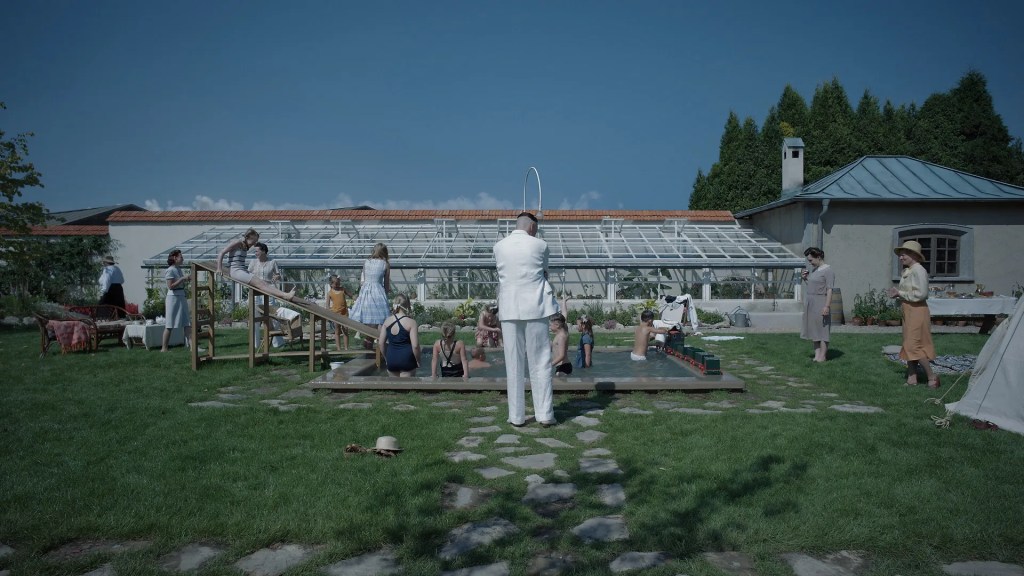
From The Zone of Interest. All imagery from the movie courtesy of A24.
In the rare moments where the Hösses are directly confronted by their monstrousness — Rudolf and a couple of his kids’ sunny canoe trip interrupted by human remains in the water; Hedwig’s visiting mother, who leaves behind a note, abruptly departing in the middle of the night, unable to withstand any longer the cruelties next door — they are not wracked with something akin to guilt but prone to acting like they’ve been insulted. Rudolf and the children race home to madly scrub off in the tub. Hedwig barely scans the letter before angrily throwing it into the furnace. Hedwig’s mother’s abandonment is one of a few glimmers of humanity seen in a film otherwise almost entirely devoid of it. There’s also a subplot where a young local woman sneaks into the camp at night to hide fruit in forced-work areas to do something to help by way of nourishment. One of the Höss children is seen regularly unable to sleep, ostensibly upset by the horrors she knows are happening so close to her bedroom. That these impactful details are marginal in the overarching movie only throw into relief compassion’s powerlessness amid the depravity du jour.
The Zone of Interest is set almost a century ago, but Glazer, who is Jewish, sees its guiding concerns as abidingly relevant, worthy of generational reexamination regardless of how well-mined they might outwardly seem. “For me, this is not a film about the past,” he told The Guardian recently. “It’s trying to be about now, and about us and our similarity to the perpetrators, not our similarity to the victims.” Part of his inspiration, he has said, comes from the growing popularity of right-wing ideology, a personal need “to restate our close proximity to this terrible event that we think of as in the past.” Decades separate the modern viewer from what’s being depicted, but “the road that so many people took is a few steps away. It is always just a few steps away” — a sentiment lent additional urgency by the timing of the film’s release, inadvertently concurrent to a moment where, currently, the death toll from the Israeli government’s post-Oct. 7 bombardment of Gaza inches closer to 25,000 people.
Some criticism I’ve seen leveled at The Zone of Interest springs from the question of its necessity — of the point of making a movie about people whose evils feel well-trodden. But The Zone of Interest is less about the personal idiosyncrasies of its subjects and more about how good one’s professional and domestic successes can be at silencing those whose destruction both are contingent on — an ever-present, adept-at-shapeshifting phenomenon whose crux is hardly confined to the Holocaust. Made more frightening by Mica Levi’s abrasive score, which sounds as if it emerged from the bowels of Hell, it’s an unsettling and blunt work, a good-bad binary too facile a way to classify the movie’s chilly effectiveness.

Aunjanue Ellis-Taylor in Origin. Courtesy of Neon.
What I took to most about Ava DuVernay’s nothing-if-not-ambitious Origin is how vividly it translates the feverishness — the obsessiveness — that propels the creative process to its completion. Not quite a biopic, it dramatizes the writer Isabel Wilkerson’s (Aunjanue Ellis-Taylor) research process behind her 2020 book Caste: The Origins of Our Discontents, which explores the caste-hierarchy interstices of America, Germany, and India. I haven’t read it. I’d like to after watching the movie, for one thing because DuVernay makes Wilkerson’s intellectual passion infectious, for another because a feature-length movie that is mostly dramatization of reportage is doomed to inadequately engage with ideas presented across a nearly 500-page book no matter how hard it tries.
DuVernay’s approach feels immediately off, and it never settles. I could never see why this movie had to be made when the bulk of what works about it can be found on a page. It feels too obvious to say that what it is — essentially a companion piece-slash-advertisement for a major work — would probably be better suited to documentary. Where else would it seem appropriate and not a little comical for this version of Wilkerson to at one point pull out a whiteboard to explicate to the audience the ideas forming her book’s backbone? And where else would chintzy reenactments — something DuVernay gauchely employs for a couple of informative historical anecdotes eventually included in the book — feel at home and not jarring? Still, I liked it. Its fervor and inelegance are part of what won me over, if not enough to make DuVernay’s decision to resurrect Trayvon Martin basically so that he can give Wilkerson a nod of approval not seem in poor taste.
 Peterson Reviews