Madeleine (Nadia Tereszkiewicz), the actress heroine of the prolific François Ozon’s frothy, 1935-set farce The Crime is Mine, is in such dire financial, romantic, and professional straits when the film opens that she’d agree to just about anything to free herself from one, though preferably all, of her founts of misery.
She and her aspiring-lawyer roommate, Pauline (Rebecca Marder), haven’t paid rent for the last five months and are due to be evicted soon. She’s just been asked by the boyfriend she expects to propose to her (Édouard Sulpice) if she’d be willing to settle for being his mistress while he attempts to marry for money. (Though he comes from a wealthy family, he’s neck-deep in gambling debt.) And a promising audition with a powerful theater producer, Montferrand (Jean-Christophe Bouvet), sours when it turns out that he’s only willing to give her the high-paying and high-profile gig if she sleeps with him. Madeleine says no, then gets the hell away from his luxe chateau after he tries forcing himself on her.
A few hours later, the police are knocking on Madeleine and Pauline’s door. Montferrand has been found dead — shot in the head, his cash-fat wallet missing — and Madeleine is the prime suspect. It’s not likely that she’s responsible (though Ozon keeps her culpability fairly ambiguous for a while), but Madeleine decides to take the rap anyway after learning what the sentencing might be like if she claimed self-defense. It potentially would raise her notoriety; it also would help, if she chooses to represent her friend, Pauline with her going-nowhere law career.

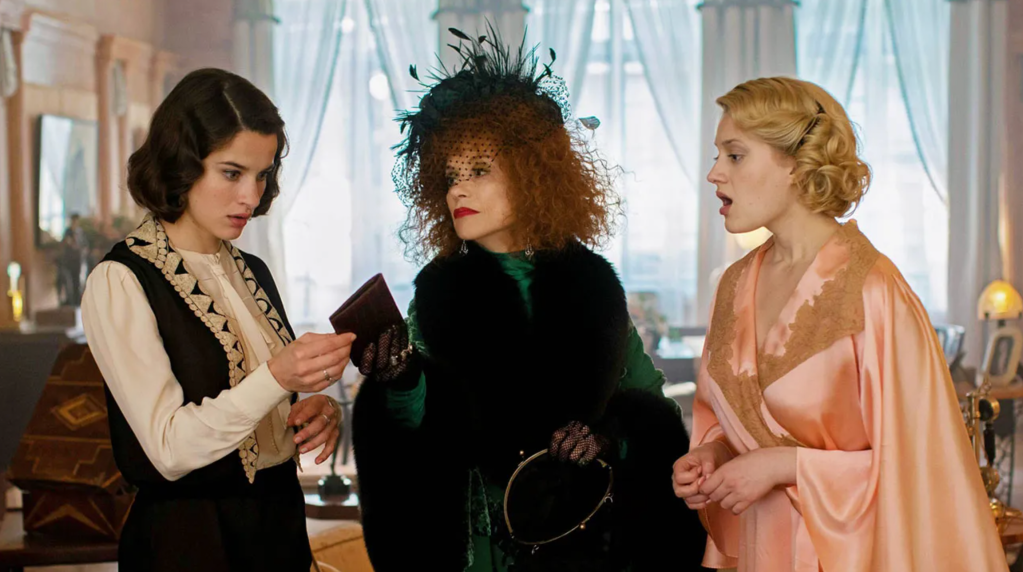
Nadia Tereszkiewicz, Isabelle Huppert, and Rebecca Marder in The Crime is Mine.
The risk rewards. The public, particularly women, is taken with Madeleine’s (pre-written-by-Pauline) impassioned framing of the act as a symbol of feminine struggle writ large. Madeleine becomes an unlikely toast of the town, drowning in movie and theater offers for roles cheekily capitalizing on her public image. But crime can only pay for so long. Madeleine and Pauline have just moved into a ritzy new abode, complete with a maid, when Montferrand’s real killer — a has-been silent-film actress named Odette (Isabelle Huppert) with a penchant for statement hats who speaks faster than she thinks — emerges. She’s jealous of the new notoriety Madeleine has received from her dirty work, threatening to expose the deceit if she doesn’t also in some way benefit financially and professionally the way Madeleine has. Madeleine and Pauline, though, don’t see Odette as someone to get out of the way; they see a chance for more sisterly solidarity.
Aesthetically of a piece with his other throwback pastiches, 2002’s 8 Women and 2010’s Potiche, Ozon’s stylistic and tonal approaches in The Crime is Mine harken back to the American screwball comedies of the 1930s, where the settings and costumes ooze with glamor and where the sexes are pitted against each other for laughs. (Usually the women have the leg up, at least until they’re climatically softened by romance.) One of the film’s modern twists is that it’s ultimately looking to celebrate female autonomy rather than stoop to acquiescence to a man as a means of “salvation.” Another is Pauline’s obvious yearning for Madeleine, a rare spot of true melancholy in a movie that, murder and duplicity aside, aims to above all be fast and bright — a farce that angles to be, and is often deserving to be, called a “delight.”
Ozon’s genre imitations are glossy and knowing, and the cast keeps up with the frenzied pace. Though Tereszkiewicz and Marder are solid, blessed with hard-to-achieve best-friend chemistry, they’re regularly outshone by the veterans in the cast, from Fabrice Luchini as a bumbling inspector to André Dussollier as a hard-headed magnate who turns out to be far softer than rumors suggest. Huppert, though, is unsurprisingly the reason to see the movie, doing a larger-than-life Sarah Bernhardt-inspired turn where every gesture is grand and not a word doesn’t come tumbling out like river water hurtling off a cliff. She transcends this fun but forgettable movie, but Huppert also wouldn’t have her reputation if she met it precisely at its level.
 Peterson Reviews