

n Problemista, Julio Torres’ inventive, semi-autobiographical feature-filmmaking debut, the writer and comedian plays Alejandro, a 20-something immigrant from El Salvador with a boyish cowlick who dreams of becoming a toymaker. (He wants to make oddball creations specifically for Hasbro: a Cabbage Patch Kid equipped with an iPhone and humanly insecurities; a plastic truck whose front tire deflates as you play with it.) Until he gets there — a DoNotReply message summarily rejects his most recent application to the corporation’s incubator program — Alejandro works a numbing job at a cryogenics lab that hasn’t yet figured out how to awake its clients and lives in a depressingly teensy apartment with a couple roommates. His only real friend is his designer mother (Catalina Saavedra), who still lives back in a verdant, remote part of El Salvador. She’s battling an artistic block, put there because she so badly misses her son.
Bushwick-based Alejandro’s stability is wobbly; an honest mistake throws it all out of whack. After he accidentally unplugs the chamber of the man he’s assigned to at work — a terminally sick artist named Bobby (RZA) who specializes in dreamy portraits of eggs — Alejandro is unfeelingly fired by his superiors, who are aware of the work Visa-related nightmares he’ll promptly face and don’t care. Torres, who also wrote the movie, goes to great lengths to make vivid, even expository, the bureaucratic cruelty and complexities finding a sponsor entails, with a little help from winningly deadpan narration from Isabella Rossellini. The journey is sometimes visually represented with short fantasies where Alejandro is forced to navigate a series of locked rooms, the keys to the other side always just out of reach.
Alejandro scours Craigslist for odd jobs to earn fast cash — untangling necklaces for $20, waiting in line for the new iPhone so that the lister doesn’t have to for a few more — and also, because of good (or bad, depending on your vantage point) timing, starts a chaotic working relationship with Bobby’s art-critic wife, Elizabeth (Tilda Swinton, in one of her best performances). Elizabeth wants to mount an exhibit of Bobby’s work to both keep paying the freezing facility’s steep prices and reinvigorate the legacy of an artist who’s never been respected. Unlucky for Alejandro, she seems almost determined to make everything in life as difficult as possible.
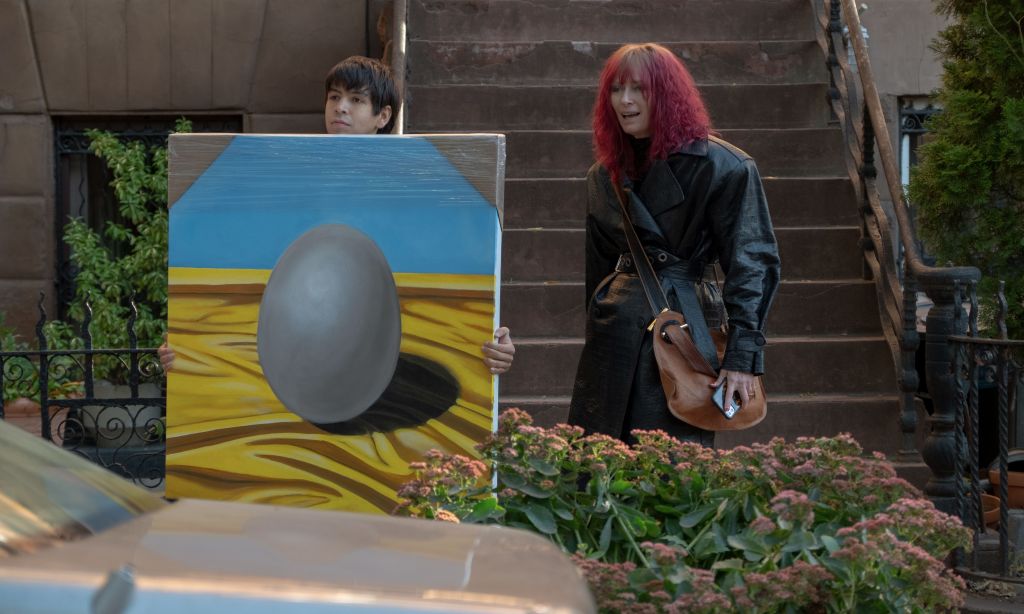
Julio Torres and Tilda Swinton in Problemista. All Problemista imagery courtesy of A24.
Elizabeth’s inner bedlam is made manifest by a messy tangle of hot pink hair with touchup-parched roots and outfits as coherent as a pattern wall at JOANN Fabrics; she talks at a screwball-comedy pace and always assumes the person she’s speaking with is ready to attack her. She’s unpredictable and exhausting, but she also promises Alejandro that she’ll sponsor him as long as he helps her successfully find a museum willing to host 13 of Bobby’s key works.
Alejandro comes to be fond of this impetuous, colorful quasi-Karen who, like him, is increasingly consumed with the kind of overpowering desperation it’s easy to worry might never be allayed. Problemista seldom stops being absurdly funny, regularly in a cry-with-laughter way, yet its comic shrewdness doesn’t undermine the consistent intrusions of darkness and its serious impacts on the people whose lives it touches. You never can’t feel the high anxiety its pair of pushed-to-their-limits characters struggle to weather — the weight of a world whose callousness hurts more because of the indifference with which it’s dependably delivered. Torres makes a point of the wounds that can be created by people who think they’re only making small cuts. There’s a woman who doesn’t speak English at the immigration office at the same time he is who might not have gotten a simple need met had he not coincidentally been there to translate for her. There are the ludicrous penalty fees Bank of America tends to impose on those who are the least financially equipped to deal with them.
Torres ultimately offers a fantastical happy ending discordant in a film that has thus far ably balanced the surreal and the stark. It too tidily wraps up things that, just beforehand, had already gotten in a satisfying last word whose narrative too-good-to-be-trueness worked well despite itself because it sees Alejandro displaying true boldness for the first time. (Spending the rest of the movie so mild-mannered, walking around so demurely that his strides recall a tiptoeing pony, Alejandro practically stomping his feet and making demands for what he knows he deserves is refreshing.) But like Problemista writ large, the originality it’s delivered with keeps ill feelings mostly at bay.

Simon Rex and Talia Ryder in The Sweet East. Courtesy of Utopia.
Lillian (Talia Ryder) is a high-school student from North Carolina on a class trip to Washington, D.C. She’s not having any fun — her love interest of the moment only sometimes gives her the time of day — and gets a scary, unforeseen way out while her tour group is dining at a pizza restaurant. A gunman (Andy Milonakis) announces himself while she’s in the bathroom, bloodthirsty because he thinks something akin to Pizzagate is going on below the restaurant’s main floor. Lillian makes it out of the establishment with a left-wing punk also eating there through a secret tunnel — whose littering of trikes and other day-care ephemera suggests the conspiracist wasn’t totally off — and sets into motion the narrative of a sometimes Alice in Wonderland-weird picaresque, divided into chapters introduced with silent movie-style intertitles with names like “Fancy a Trip to Charm City” and “I’ve Never Even Been to Hollywood.” (Its heroine’s name almost certainly nods to Lillian Gish, another woman deployed often as a filmmaker’s beautiful projection of choice.)
In The Sweet East, written by venerated film critic Nick Pinkerton and directed by longtime cinematographer Sean Price Williams (it’s his feature-directing debut), Lillian goes on a wide-ranging journey around the Eastern Seaboard. She leaves behind her phone in the grimy pizza-place bathroom she escaped from; she makes no great effort, because she knows there’s nothing that special waiting for her, to get in touch with her family and most of her friends. (She’ll at least send a letter early in the film to her closest pal, assuring her that everything is OK and that a kidnapper is not making her write as much.)
Lillian falls in with people with whom there will certainly not be a longtime connection. There are the born-wealthy punks she falls in with in the immediate aftermath of the Pizzagate 2.0 incident. There’s a white-supremacist scholar (Simon Rex) constantly prattling about beliefs for which he jumps through academic hoops to find some kind of literary legitimacy. There’s a pair of Black filmmakers (Ayo Edebiri and Jeremy O. Harris) who spot Lillian ambling around New York’s streets and cast her in their not-very-planned next project: an epic about the construction of the Erie Canal starring a hot young item played by hot young item Jacob Elordi. There’s a guy who’s part of a religious brotherhood (Rish Shah) whose escalatingly aggressive insistence that Lillian lay low in a barn on the leader’s property becomes quickly suspicious.
Lillian’s pinballing seems meant to, and at its best does, evoke the increasing social disjointedness felt in American life; her human-eye-roll posture can make The Sweet East sometimes feel like the movie-length equivalent of an aimless scroll through social media, where you can be greeted at random by a certain unseemly ideology or disposition, engage with it out of morbid interest, and then get away once you’ve gotten enough. The Sweet East is very good at harnessing the feeling of — and the regular interruptions of bleak, accidental comedy coming from — living in an incoherent world without saying much more beyond that. If the movie has a message, it seems to speciously be that perpetually unimpressed apoliticism like the kind Lillian practices is one tactic to minimize some of the damage, psychic or otherwise, that can be done by a world that’s mostly only interested in you when it sees an opportunity for exploitation.
The Sweet East distrusts sincerity, though the film’s most memorable moment is one that feels the most imbued with it: when Lillian unexpectedly performs a low-key musical number in the bathroom — she’s singing a lovely original song written for the movie, “Evening Mirror,” by Paul Grimstad — while the opening credits play. There are a lot of fun, enjoyably showy performances in the film (the finest come from Harris and Edebiri, who talk like they’re playing a game of ping pong where the paddles are their fast-moving mouths). But as the gorgeous, self-serving cipher whose most pronounced traits are that she’s preternaturally gifted at lying and narrowly escaping situations in the middle of getting out of hand, Ryder is the movie’s revelation.
 Peterson Reviews