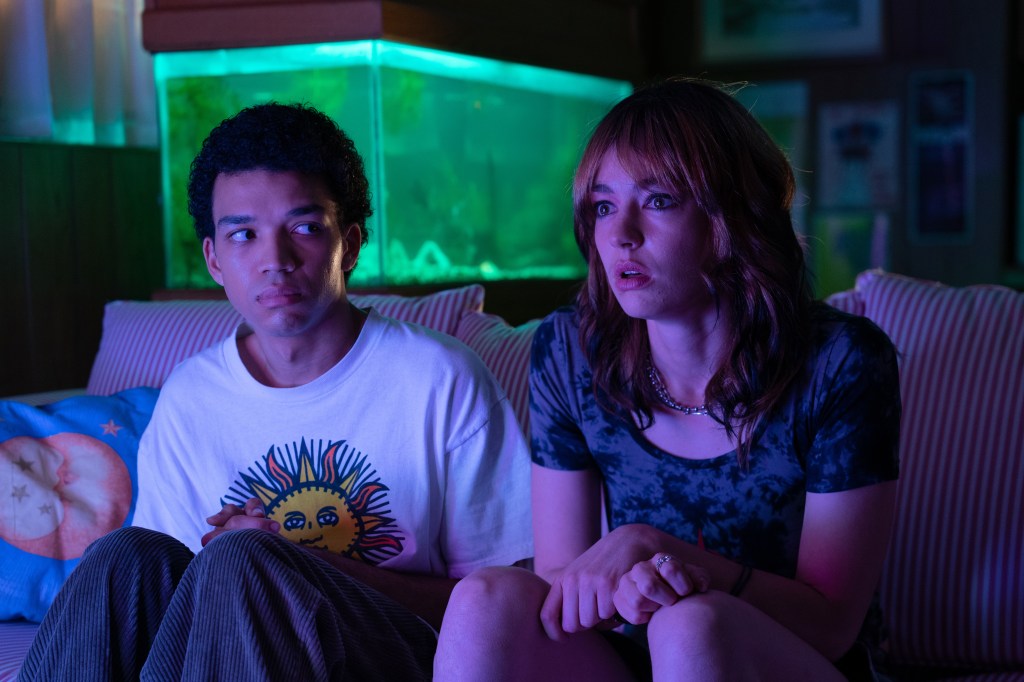

ew spaces in writer-director Jane Schoenbrun’s new movie, I Saw the TV Glow, are untouched by the kind of implacable dread that saps colors of their joy and shadow-fringed beacons of light their hope. A reliable respite is The Pink Opaque, a Buffy the Vampire Slayer-The X-Files hybrid the movie’s main characters are obsessed with that runs on a WB-style network on Saturdays at 10:30.
The show stars two young women played by Helena Howard and Lindsey Jordan who are telepathically linked and weekly fight the latest forces of darkness terrorizing the all-American county they live on the opposite ends of. I Saw the TV Glow’s teenage leads, Maddy and Owen (Brigette Lundy-Paine and Justice Smith), find the sort of solace in the series that eludes them in their painful real lives. Some of its escapist comforts are easily graspable. Maddy’s stepfather is physically abusive, breaking her nose at least once; Owen’s mother (Danielle Deadwyler) is dying from a terminal illness, and his father (Fred Durst) is emotionally distant. A labyrinthine mythology in which to get lost and a predictable villain-of-the-week conceit respectively provide fun and control in a real life largely devoid of both. But more of The Pink Opaque’s comforts are still, at this point, unconscious. Maddy and Owen are strongly intimated to be trans. With its championing of secret identity-having leads and its all-seeing big bad determined to suppress that side of themselves, the show provides an unintentionally resonating venue in which the truths Maddy and Owen don’t yet have the words for can be channeled.
I Saw the TV Glow begins in 1996. The series has been on for a few years now; when the film starts, Maddy is in ninth grade and Owen seventh. The movie spans decades, though Maddy is nowhere to be found for much of it. She tears off on her own without a trace one night early in the film, the freeing possibilities of high-school graduation too far away for her to want to wait for. Throughout it all, The Pink Opaque remains inextricable from both Maddy and Owen’s lives and conceptions of themselves. But its centrality only becomes more toxic, as much of an instantly accessible embrace in times of need as a hindrance in their full development as people. There is often more power in the feelings nostalgia summons than in the actual substance of the media from which it originates. There’s much possibility for universal poignance in that idea and the bleak way I Saw the TV Glow dramatizes it, though the movie is less about that than being young and trans and with the only place you see yourself reflected, and in some ways even accepted, in the entertainment you consume.
Fiction bottomlessly accommodates different projections and interpretations. In a recent interview with The Guardian, Schoenbrun, who is transfeminine and nonbinary, said that, like the characters, much of their upbringing was also defined by their relationships to pop-cultural products, and that they too did not know for a long time that they were trans, their gender dysphoria “a much more oblique and much more internal experience” rather than something that could be straightforwardly understood. “It was this feeling of unreality, this longing to exist in a liminal, dreamlike space, because the space of the world felt limiting in a way that I didn’t understand at the time wasn’t normal,” they said. The movie might elicit comparisons to David Lynch because of its purgatorial aesthetics and, most directly, the time it affords live musical appearances, a trait that particularly recalls 2017’s Twin Peaks: The Return. (In one hypnotic scene, a Phoebe Bridgers-assisted Sloppy Jane and King Woman entrance a noirishly lit hole in the wall where the characters catch up.) But Schoenbrun’s touch isn’t derivative; their marrying of the abstract and the personal is singular enough to prematurely warrant a generational-talent honorific.
I Saw the TV Glow isn’t a belatedly uplifting story of delayed self-acceptance, vindication from others: it’s a study in suffocation. Like Schoenbrun’s last movie, the tricky, more budget-restricted We’re All Going to the World’s Fair (2021), it could be designated as a horror film, but it too commitedly eschews genre customs for the characterization to not feel simplistic. Its claustrophobic horrors are soul-deep in a way the genre is rarely prone to, not triggered by superficial, shock-inducing bursts deriving from provocative violence or jump scares but the enveloping darkness of a life gone unrealized, steps toward self-actualization chronically untaken. The right time never comes, the right place forever uncertain, for its characters to liberate themselves from their personal binds. I Saw the TV Glow is one of the great evocations of the closet’s oppressiveness and the measures one might take to allay the pains of a hold that won’t stop tightening.
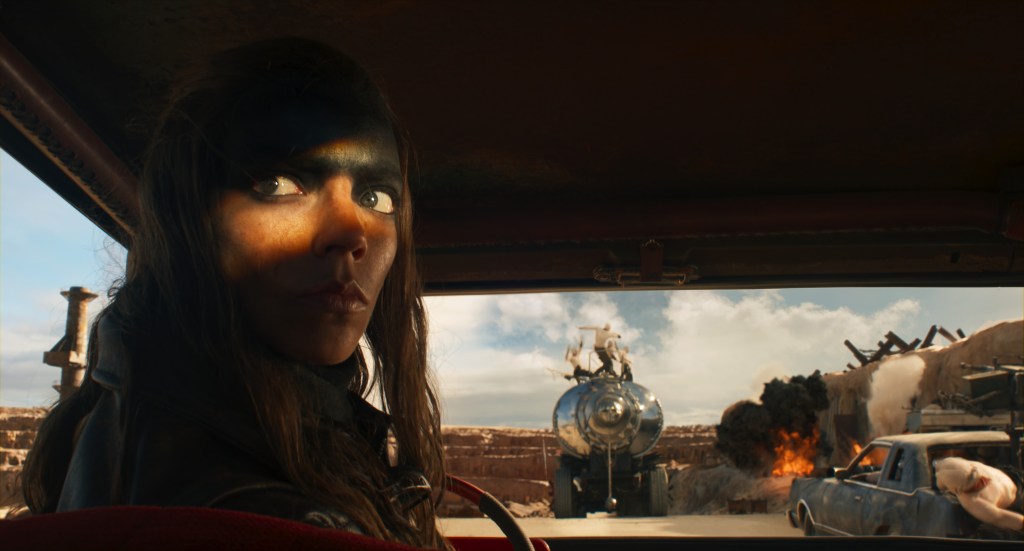
Anya Taylor-Joy in Furiosa. Courtesy of Warner Bros. I Saw the TV Glow photo courtesy of A24.
Sequels and prequels are rarely as cursed with high expectations as George Miller’s Furiosa. What ought a director do when the movie they’re following up on isn’t simply beloved but susceptible to effusive “one of the greatest action movies ever made”-style praise? The long-in-the-making Furisoa turns out not to be a retread of 2015’s franchise-resetting Mad Max: Fury Road preoccupied with living up to the “bigger and better” ideal sequels are often animated by. It’s less action-oriented — though still dazzling in a practical effects-prioritizing, how-did-they-do-that way when it is — and more inclined to get off the road and dig into the backstory of the title character Charlize Theron indelibly originated.
Furiosa is a very good movie that can’t escape the shadow of its forebear, not just because the latter is more dramatically convincing — the revenge story and romantic subplot Furiosa advances are proficient but rote — but also because Anya Taylor-Joy, as the younger version of the eponymous character, is, like the movie she’s starring in, also very good but immutably outshone by what came before. Theron was so ferocious as a woman relentlessly determined to save herself and a throng of others that she practically made your teeth chatter. Lithe and catlike, Taylor-Joy is physically persuasive in the film’s action sequences, but her character’s pitless rage has traces of slightly cautious studiousness — indebtedness.
Max Rockatansky stand-in Praetorian Jack is too one-dimensionally tough and taciturn to ever feel very distinct either as his own character or as a love interest-slash-mentor to Furiosa, though the actor who plays him, Tom Burke, looks cool with his forehead daubed in slick war paint. Chris Hemsworth, as savage warlord and revenge object Dr. Dementus, fares best, but the playful Captain Jack Sparrow-esque flourishes of his performance are a touch too indulgent for us to feel the fullness of the character’s brutality. We’re less apt to fear him than, again and again, meet the more shocking expressions of his barbarity with a little surprise. Hemsworth sometimes doesn’t seem to quite believe it either.
For an action movie as imaginatively constructed and impressively mounted as Furiosa, though, deficiencies tend to have bug-bite smallness: the overarching spectacle is too consistently astonishing to be so easily spoiled. Miller turned 79 in March; with age he’s only become more admirably audacious, another recent example the outré (for better and for worse) A.S. Byatt-inspired Three Thousand Years of Longing (2022). Even when it’s least successful, Furiosa exemplifies what he’s best at: making movies that infectiously turn their nose up at notions of the impossible — that feel larger than life.

Ryo Nishikawa in Evil Does Not Exist. Courtesy of Film at Lincoln Center.
Mizubiki, a small, perpetually snowed-in village in Japan, has fewer than 6,000 residents if you don’t include its vacation-home owners and the city slickers who’ll stop by for days at a time to soothe the stresses of their metropolitan lives. Mizubiki’s peaceful remoteness has made it a gimme for a glamping company that, shortly before Evil Does Not Exist opens, has successfully gotten permission to build its latest site there. Naïvely, its CEO believes Mizubiki’s folksiness means an equally simple populace — a township that won’t mind if there isn’t a regular caretaker at the site or that the placement of the septic tank, already inadequately sized for the number of people the property can hold at a time, will result in the contamination in the wells from which the population drinks. (One of the company’s representatives, played by Ryuji Kosaka, brazenly suggests that there is such a thing as consuming a safe amount of polluted water during an excruciatingly tense town hall meeting.)
One could call Evil Does Not Exist an environmental drama. The movement of the narrative — the film oscillates between the perspectives of some of the town’s residents and glamping-company reps whose hearts will soften over the course of the film — initially suggests the kind of arc eventually climaxing in a high-stakes faceoff that will engender optimism or depressing profit-over-people pragmatism. But convention-shirking writer-director Ryusuke Hamaguchi ultimately pursues something more ambiguous and hard to classify. An overly tidy ending would be too facile, anyway, for something as wide-reaching and complex as ecological devastation. (The characterizations are slippery, too: no one is unduly villainized, heroized.) Evil Does Not Exist lingers by not telling us what we think we might hear.
 Peterson Reviews