

had fun watching Alien: Romulus, but not enough to help stomach what most people seem to also be struggling with: the use of deep-fake technology to bring back from the dead, in more senses than one, the late Ian Holm, who played a duplicitous robot thought last seen in the 1979 movie that kicked off the now-45-years-running franchise.
Romulus’ events are wedged between the latter movie and 1986’s Aliens, and it does a lot of calling back to other films in the series. Some of it’s palatable; some of it dares you not to roll your eyes. Holm’s revivification, though, thickly smears a glaze of contemptible cynicism over a movie that feels at odds with at least one part of the story it tells. All the Alien movies have been horror films whose terrors wouldn’t have happened were it not for corporate avarice. Yet here arrives a sequel putting forward the same idea while also surrendering to corporate conceptions of novelty, an actor’s inability to consent to their image’s exploitation not enough to stop impulses to crassly cater to nostalgic consumption or refresh a brand.
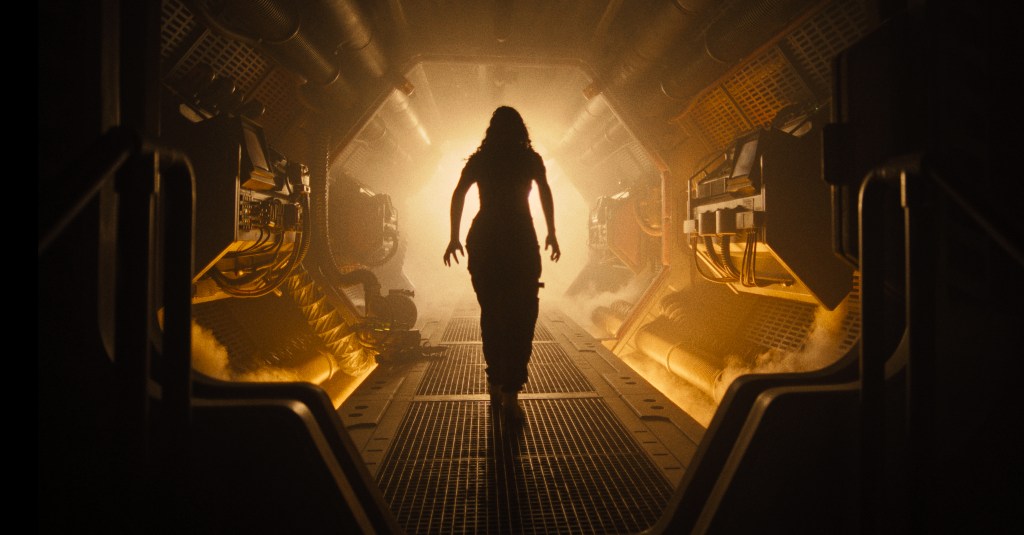
Isabela Merced in Alien: Romulus. All Alien: Romulus imagery courtesy of 20th Century Studios.
Romulus was directed by Fede Álvarez, a filmmaker who’s only been involved with one feature-length movie not sprung from a generations-older property. I really liked his debut, a 2013 reboot of Sam Raimi’s The Evil Dead trilogy that set itself apart from its predecessors by imagining what it would be like to watch an Evil Dead movie that wasn’t darkly fun and instead just dark, violent in a way that might strike you as more in poor taste were there not something a little admirable about a mainstream horror movie so hell-bent on innovating new ways to be nasty and mean-spirited. (That approach was deployed perhaps better in last year’s Alvarez-less, even more no-holds-barred Evil Dead Rise.)
Romulus’ setup unexpectedly feels not that unlike Evil Dead. Instead of seeing a band of young people sneaking off to a cabin in the woods, it’s a band of young people absconding to an apparently abandoned spaceship. They’re living in the future at a space colony where the sun literally doesn’t shine and there are no other jobs besides mining for a corporation that has cannibalized all its competition. Comprised of Cailee Spaeny, David Jonsson, Archie Renaux, Isabela Merced, Spike Fearn, and Aileen Wu, this varying-degrees-of-bland group that inexplicably knows how to operate every piece of galactic machinery that comes its way plans to take advantage of the ship’s state-of-the-art cryostasis chambers. They aim to fly off to a years-away planet they conceive of as a paradise away from the hell they’re living. The trouble is that this spacecraft is the one from Alien — the one that went through a lot of horrible stuff about which this sextet will soon be well-acquainted.
Romulus has a promising first act, introducing a new intrigue-posing angle of its franchise’s ever-expanding world and using an entry point unlike anything the series, which tends to prefer spotlighting adult scientists on clearly spelled-out missions, has offered thus far. (It doesn’t go far enough with one provocative new element: casting a Black actor as a robot who’s explicit about having no other purpose besides the well-being of a woman, who’s white, he’s been programmed to treat as a surrogate sister.) Otherwise, the film largely goes where its predecessors have before narratively. These people get on a spaceship and quickly cross paths with an alien species that couldn’t be freakier, what with their creepy-crawly tentacles, layers of teeth and tongues, and methods of violence violating in a too-intimate way that prompt much more of a visceral reaction that one is typically used to watching a horror movie.
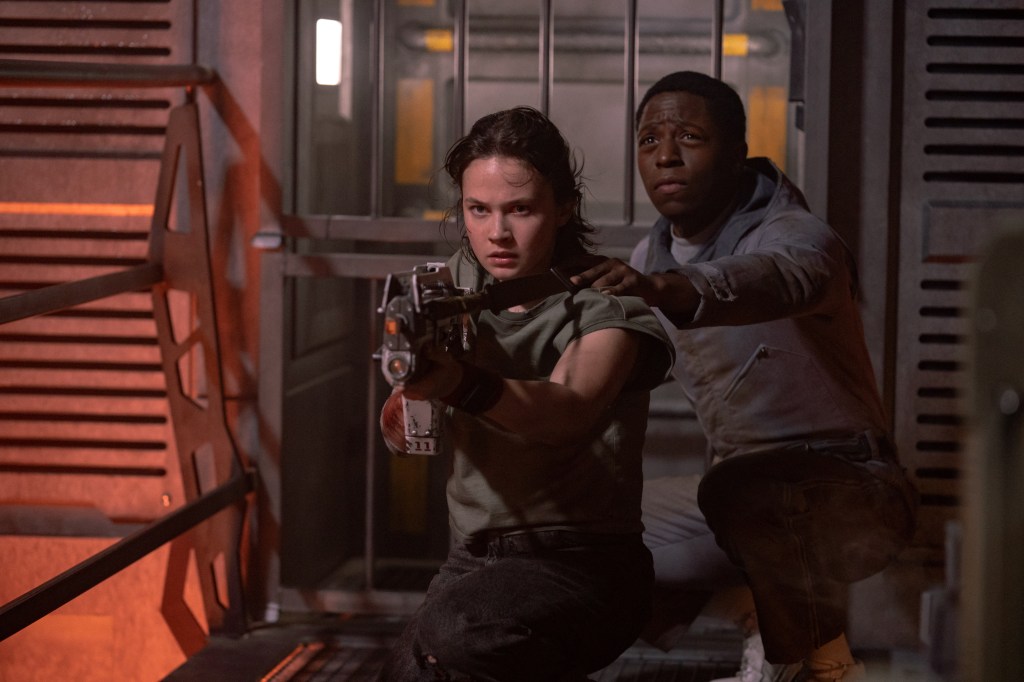
Cailee Spaeny and David Jonsson in Alien: Romulus. Photo by Murray Close.
This franchise has arguably retained much of its appeal because the nightmare it proposes has a mostly immovable knack for being consistently horrifying in a way mainstream horror generally isn’t. An audience member’s love for these films could be seen as a bit masochistic: one keeps returning to the Alien movies in part because there are few properties so good at offering its same strain of bad-time thrills. These are horror movies that, at their most fine-tuned, can make you want to take a shower after watching. There’s power in scariness that feels like it’s getting into your pores, too.
As it is in its first act, Romulus is most engaging when it’s treading new ground, from an action sequence that cleverly fuses a lack of gravity and floating streams of skin-and-bone-melting acid to a requisite “one last scare” that does something new with the series’ commitment to maternal terrors. When it’s not — and when it’s doing tasteless stuff like forcing Holm out of the grave — the mind wanders to the days when the series more comprehensively felt, excluding Mario Bava’s pioneering Planet of the Vampires (1965), unlike anything else.

Jason Schwartzman and Carol Kane in Between the Temples. Courtesy of Sony Pictures Classics.
Between the Temples, co-writer and director Nathan Silver’s new movie, is a touching but not mawkish testament to the healing properties friendship — or maybe it’s love — can have on a cracked-open life. It’s a new, unexpected one, and it’s between Ben (Jason Schwartzman), a man in his 40s, and Carla (Carol Kane), a woman in her early 70s. Both are in a transitional time in their lives more purgatorial-feeling than laden with possibility. It’s been about a year since Ben’s wife, a popular novelist who was battling alcoholism, slipped on a patch of ice in their front yard and died. Ben, a cantor at his synagogue, hasn’t been able to sing since, and he carries himself around so miserably that he can’t even slam mudslides alone at a bar without overhearing drunk patrons giggling about how depressed he looks.
Carla’s long-time husband recently died, and in the wake of his passing she’s been beset less with grief than the realization that she put much of herself on the back burner in service of his beliefs and desires. One thing he discouraged Carla from doing was exploring her Jewish heritage — something also foundationally challenged by Carla’s no-nonsense Russian-communist parents — and it’s something about which she’s curious. She’s especially regretful that her 13th birthday was celebrated not with a bat mitzvah, but with a period she wasn’t expecting.
Ben and Carla have a history: she taught music at his elementary school, and once her memory is jogged, she remembers him as a standout student. Soon they’re reconnecting, first by chance at a bar, then when she’s showing up for a class she misread the name of at his synagogue. She’s here because, even though she might technically be too old, she wants more than anything to have the bat mitzvah she never got. Ben sees Carla as a pest before he starts to warm up to her, finding it hard to resist her newfound refusal not to live exactly how she wants to.
This all might make Between the Temples sound somewhat syrupy. The film doesn’t avoid sweetness: it wants you to be moved, and it’s happy to home in the endearingly pipsqueak-voiced Kane’s room-lighting smile and fits of laughter. But its warmth and intimacy are tempered by welcome interruptions of the antic and the slightly surreal, things in no small part boosted by Sean Price Williams’ wondrous, golden-hued and grainy cinematography. Williams loves a close-up, to have a lens move around the room shakily. He at once evokes the emotional immediacy of John Cassavetes while heightening how everyday flourishes of comedy can turn a moment funny and strange: burgers being chowed down with hungry aggression at lunch, a door that needs 409 so badly that its creakiness is starting to sound more like a shriek. Between the Temples achieves a mixture of solemn and silly just right for a movie about characters working through tragedies and disappointments that have a touch of the absurd. You’re glad to see Ben and Carla find each other.
 Peterson Reviews