

ia Anger’s first properly distributed movie, My First Film, opens with a series of iPhone-shot images of the writer-director goofing off. She clacks a pair of silver-strapped high heels together like they were hand cymbals; she dances in a living room wearing nothing but blue jeans and an oversized breastplate. These short videos, Anger clarifies in some title cards quickly typed out on Google Docs, aren’t meant to be seen as part of My First Film proper but as a way to ease into a project that will soon be primarily defined by pain. “I thought the first thing you should see should be ‘joy.’ Beacuse [sic] I am really happy you are watching,” she explains.
This brief introduction is actually, of course, an indispensable part of My First Film, a movie that with much self-referential flourish finds Anger relitigating, through dramatization, the nightmare it was to make her first project as a filmmaker. Always All Ways, Anne Marie, a semi-autobiographical short, was produced in 2010 with an unwieldy skeleton crew, with an unwanted pregnancy lurking in the background, and without the kind of eventual film-festival acceptance that would have made the whole enterprise feel totally worth it.
The final part of that last sentence hasn’t totally gotten the final word, though: the aftermath of Always All Ways, Anne Marie has now provided Anger with enough fodder to fuel three projects. Before the 2024 iteration of My First Film, there was a 2010s performance piece of the same name, then a COVID-era, all-remote adaptation of that piece that made clever use of newly ubiquitous Zoom’s screen-sharing option. There was a therapeutic quality for Anger trying to make sense of, rather than file away in a box, the early failure that would soon give way to a successful career in music-video direction. “When I started doing the performance, it came from a place where I was not able to talk about being in a lot of pain about where my life was and my career and the ways that things hadn’t worked out,” she told Elephant last month. “I think that all these projects have been coming from the same place, and each version of them is maybe slightly less obscured.”
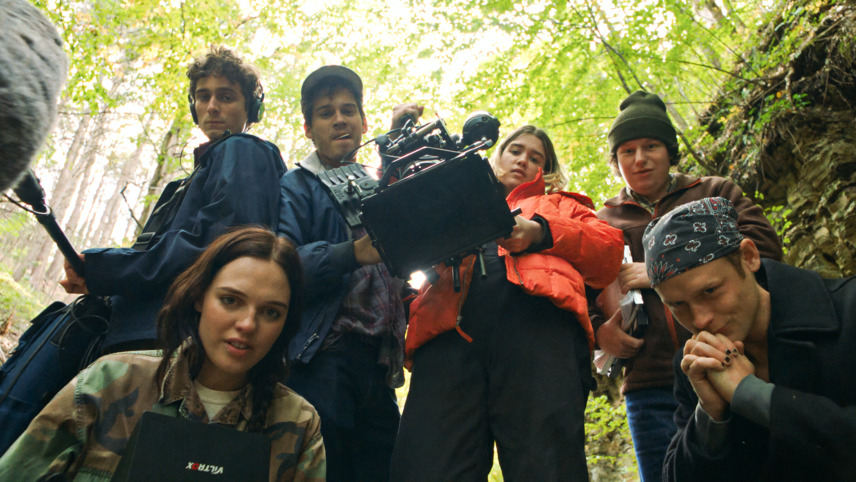
From My First Film. All imagery courtesy of Mubi.
Anger’s avatar in the 2024 My First Film is named Vita. She’s played by the Australian actress Odessa Young, who gives an evocative performance that smolders in a probably recognizable way to someone young trying to make it in a creative field. It’s the smolder of someone whose experience and talent are not yet as developed as the drive and hunger building inside someone who has known more than anything who they’d like to become for years.
Anger doesn’t approach her stand-in’s characterization with the image-preserving tendencies of a hagiographer. She doesn’t need to: unsparing recreations of fuck-ups and bursts of immaturity are instruments of endearment. Part of My First Film seems built on the idea that we ought to be more forgiving of ourselves, not just in real time but also as we were in the past. We had only been trying to navigate previously uncharted territory.
Anger is refreshingly unwilling to condemn failure, something that in My First Film is framed more as a useful tool for growth and forward motion even if it’s unbearable to live through. There’s value in a movie about the creative process that doesn’t quite culminate in a triumph. We almost exclusively see polished finished products as consumers, and the pleasure often found in them can belie the difficulty it might have taken to get them there. (And on the flip side, when one might take issue with an inadequate finished product, the focus usually goes to the finished product’s defects as opposed to what might have happened to arrive there, whose details are typically shrouded to the audience.) My First Film finds power in staring directly at something from which most creators would rather us look away. It’s an oblique celebration of the act of creation itself. The probability of failure shouldn’t arouse hesitance in a young and inexperienced artist: you can’t get anywhere without starting somewhere. There’s strength in vulnerability.
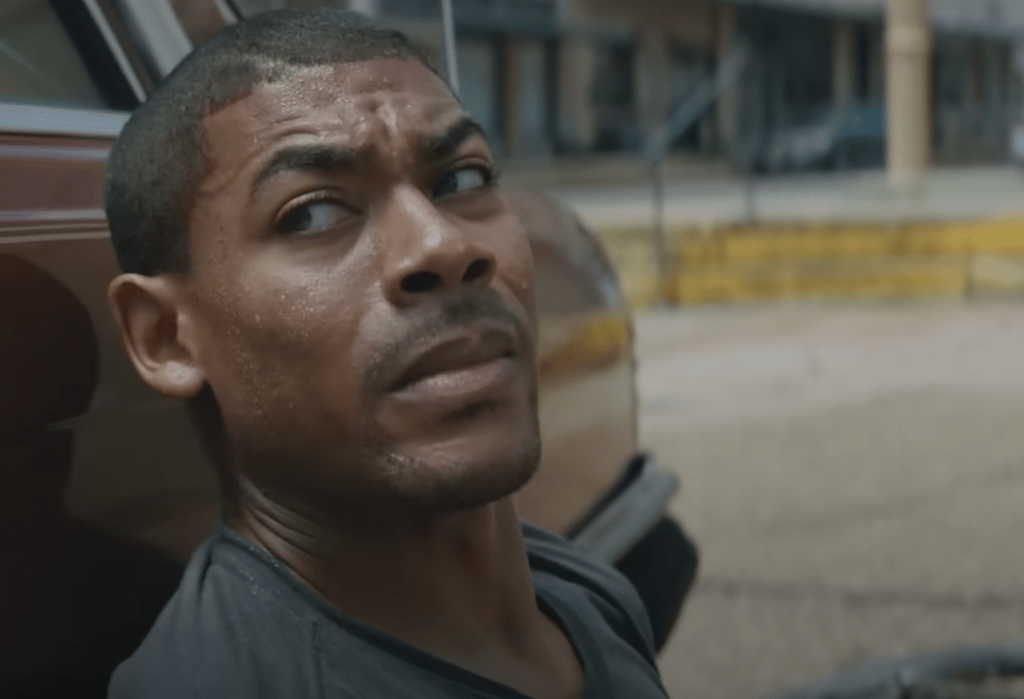
Aaron Pierre in Rebel Ridge. Screenshot from trailer.
Terry (Aaron Pierre), the enigmatic combat-expert protagonist of Jeremy Saulnier’s Rebel Ridge, is so committed to nonviolence that when he finally shoots one of the corrupt white police officers who’s been testing his limits all film long, the gun is loaded with bean-bag rounds designed to incapacitate, not kill. This Batman-esque hero at the center of Saulnier’s fifth film marks the second time a Black character has fronted one of the writer-director’s movies, which have largely been about, if to be overly simplistic, white characters whose buttons are pushed until they violently snap.
His Black heroes, though, have thus far been positioned as bastions of comparative decency encircled by majority-rotten, majority-white ensembles. Lethal catharsis is dependably more in reach for Saulnier’s white characters, though that isn’t to say he treats violence sensationalistically or without sensitivity. A point about how racial privilege would make white and not Black characters think less about an outburst’s legal and existential consequences would feel sharper if it didn’t feel, a little, like Saulnier was unconsciously capitulating to more conservative white audience members who might revoke their sympathy for a Black protagonist if they were to justifiably lapse into the kind of violence from which they have made it a point to steer away. The reform-minded messaging of Rebel Ridge’s finale — quicker to uphold one-bad-apple rhetoric than indulge ideas of policing as a flawed system whose generations of misconduct cannot so easily be cured — in particular is in keeping with the credulity-stretching neoliberal-style compromising of its character work.
The short-sightedness of the script can’t so easily undermine the great work from Pierre, who, in a performance that rightfully has repeatedly been described as “star-making,” is a wonder of quiet storminess, struggling to maintain composure in a maddening situation in which a solution is not within close reach. (His character will spend the movie trying to get back the $36,000 he’s legally amassed for his cousin’s bail and other big purchases some corrupt cops in a small Louisiana town called Shelby Springs have stolen from him under pretenses of civil forfeiture.)
You’re unwaveringly with him even as the character is undercut by the clunky directions in which the writing will go. That problem also extends to AnnaSophia Robb, who’s as good as she can be in a part that requires not a lot more than long-winded exposition dumps of legal clarity, and Don Johnson, who seems to almost be restraining himself in a role that never fully commits to being the sort of mustache-twirling villain Saulnier seems to half want it to be. Though it has a tense, promising first couple of acts, Rebel Ridge is doomed by self-consciousness.
 Peterson Reviews