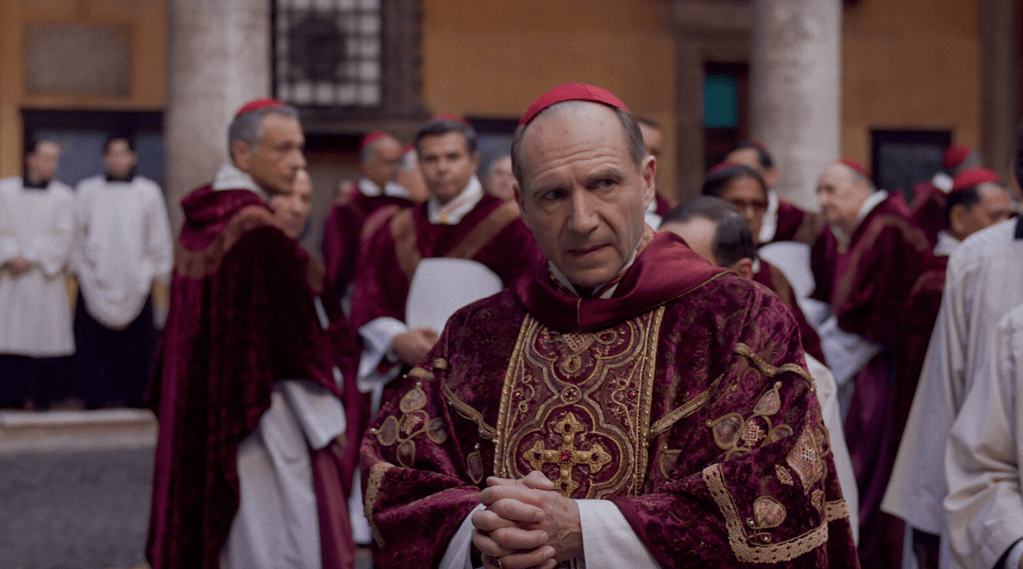

onclave, Edward Berger’s new movie, gives a melodramatic, inside-baseball look at a top-secret, rarely occurring tradition: a papal conclave to elect a new pope. The man who’d had the job for decades — an unflagging progressive credited for getting the Catholic Church more in line with modern liberal sensibilities — has a fatal heart attack just before the film opens. Cardinal-Dean Thomas Lawrence (Ralph Fiennes, staying at a controlled simmer) is to oversee the proceedings for a cause about which he’s recently begun having second thoughts. He says as much to the peers who think he’d make for a good successor. He also said as much to the last pope, who, probably aware his time was running out and wanting a steady hand for this high-stakes task, flatly declined when Lawrence offered to resign.
Lawrence will continue to get votes even as he tries to dispel those who give them to him with growing assertiveness. But there’s such a lack of early-voting decisiveness that it doesn’t seem clear, until the very end of the movie, which cardinal in the running will get the job. It would be ideal to elect the even-keeled Bellini (Stanley Tucci), whose ideologies align with the last pope, but there’s much danger that the reactionary, rigidly conservative Tedesco (Sergio Castellito) or the similarly old-fashioned — and pronest to playing dirty — Tremblay (John Lithgow) could garner the majority vote.
Adapted from a 2016 Robert Harris novel by Peter Straughan, Conclave never takes the days-going process too seriously — with unduly reverence. It has a dishy, twisty quality of something like TV’s Succession or Industry, just without the stylized, explanation-prone dialogue we might associate with both and with similarly understated comic flourishes that succeed the most when they’re unexpected. (What is a cardinal to do when one of his colleagues is dramatically told off in front of the whole group but suck on his vape?) It’s much more inclined, though, to almost laughably soap-operatic contortions of plotting, from a terrorist attack too perfectly timed to a crucial vote to a late-movie gender-related twist that’s probably the most misguided thing about it. A concrete identity is treated with all the seriousness of a gasp; the barely-dwelled-on aftermath of the disclosure seems to flatteringly suggest that the Catholic Church could be more accommodating to progressivism than it really is.
For a movie that makes a mostly entertaining spectacle out of evincing the boundless egos of so many characters — and the implicit parallels between institutionalized religion and politics, with their self-inflating pageantry and the kind of lusting for power that tends to supplant ideological convictions — you might wish Conclave, unsubtly released in the U.S. so close to the presidential election, were ultimately more biting that it proves to be. It’s still nice to see veteran actors given quality-but-not-too-self-important material to chew on; it would have been nicer, though, to give Isabella Rossellini, as a sister character relegated to mostly looking at these men with quiet dismay, more to do. We can offer plenty of withering stares on our own.

Aurora Ribero in The Shadow Strays. Courtesy of Netflix.
Timo Tjahjanto’s The Shadow Strays wastes no time getting to its two dominant modes: relentlessness and propulsiveness. The thrilling, if increasingly grueling, action movie begins with the extermination of an entire Yakuza clan, seen through by the assassins Umbra and 13 (Hana Malasan and Aurora Ribero) and choreographed with an almost balletic sense of movement and unflinching embrace of over-the-top violence by Muhammad Irfan and Trisna Irawan. The mission, which makes up the entirety of The Shadow Strays’ extended opening, is successful, but it’s stained by a career-disrupting flub. Thirteen, only 17 years old and still new to fieldwork in the cabal of assassins she’s part of, hesitates before killing the one innocent person — a sex worker — in the home being ambushed. In this line of work, sparing anyone in the line of fire is a no-no.
Thirteen is put on leave — though her handlers won’t explicitly say so— and soon becomes fixated on using her skills in the name of revenge with all her newfound free time. She gets acquainted with an 11-year-old boy, Monji (Ali Fikri), whose mother is killed by the crime syndicate she was involved with, her death made to look like an accidental drug overdose. The bond 13 soon forms with the boy is touching — she knows all too well, as we’ll see through cryptic but clear-enough blink-and-you’ll-miss-them flashbacks, what it’s like to have a mother violently taken from you. But most of The Shadow Strays’ narrative feels like window dressing for a series of incredibly staged and shot action set pieces seamlessly edited by Dinda Amanda. By cutting away as little as possible, she avoids the long-persisting problem of choreography-heavy action films being edited with the sort of chopped-salad mercilessness that obscures rather than underscores the technical bravado of all the simulated fighting.
The two-and-a-half-hour-long movie eventually gets enervating: the final stretch, after a fake-out ending, is as kinetic as everything coming before it but, because it’s the film’s umpteenth how-much-can-the-human-body-take onslaught of gore, feels much more like a chore to sit through. But in a genre that seldom feels as genuinely pummeling as The Shadow Strays, I don’t fault it too much for not being able to help itself from giving us too much of a good thing.
 Peterson Reviews