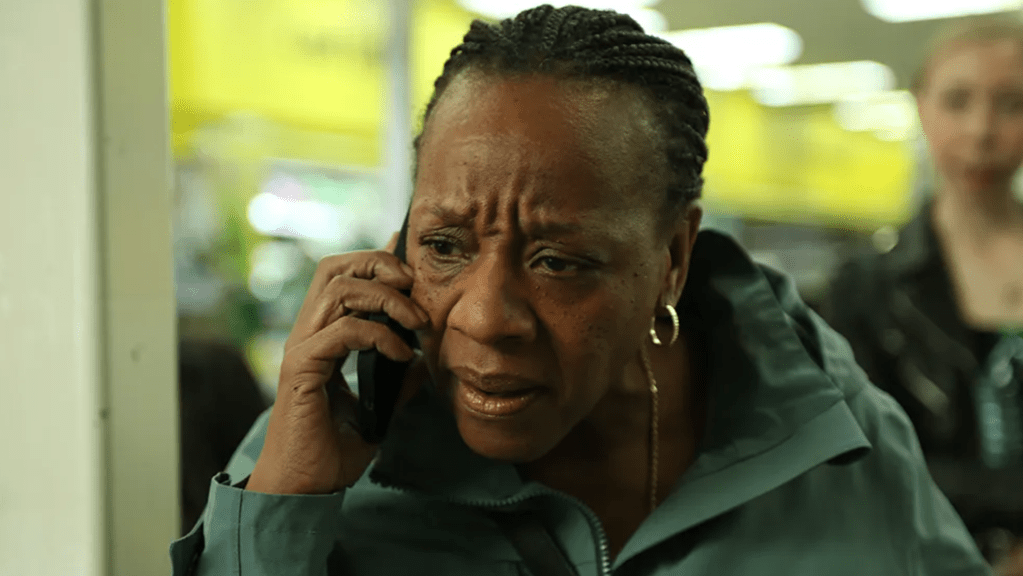
The Mike Leigh movie I most recently revisited was Happy-Go-Lucky (2008), an instant-classic comedy about a 30-something-year-old schoolteacher named Poppy (Sally Hawkins) whose indefatigable sunniness might get on your nerves if her sincerity and compassion weren’t so obviously real. Pansy (Marianne Jean-Baptiste), the protagonist of Leigh’s new Hard Truths, just might be Poppy’s opposite, a woman so cranky and tormented that she’s liable to wake up huffing and puffing.
Pansy has long been married to Curtley (David Webber), a plumber who has his own successful company, and they have a 22-year-old son, Moses (Tuwaine Barrett), who hasn’t left the nest and aimlessly spends his days playing video games and leafing through aviation picture books. Both men move through life in weighted-down silence, and after spending only a few minutes with Pansy, you can tell why. When not berating them — Moses can depend on daily, hissing inquiries into what he’s doing with his life, which he never indulges a response to — Pansy is ranting about the latest things to get on her nerves, from the oversized pink bow she saw the other day on an otherwise ambiguously gendered baby’s head to the “cheerful, grinning” types who dally outside businesses jingling bells for donation money for their causes. “Can’t stand ‘em!” seethes this character whom the filmmaker John Waters recently described as the “most unpleasant sourpuss woman in the history of cinema.”
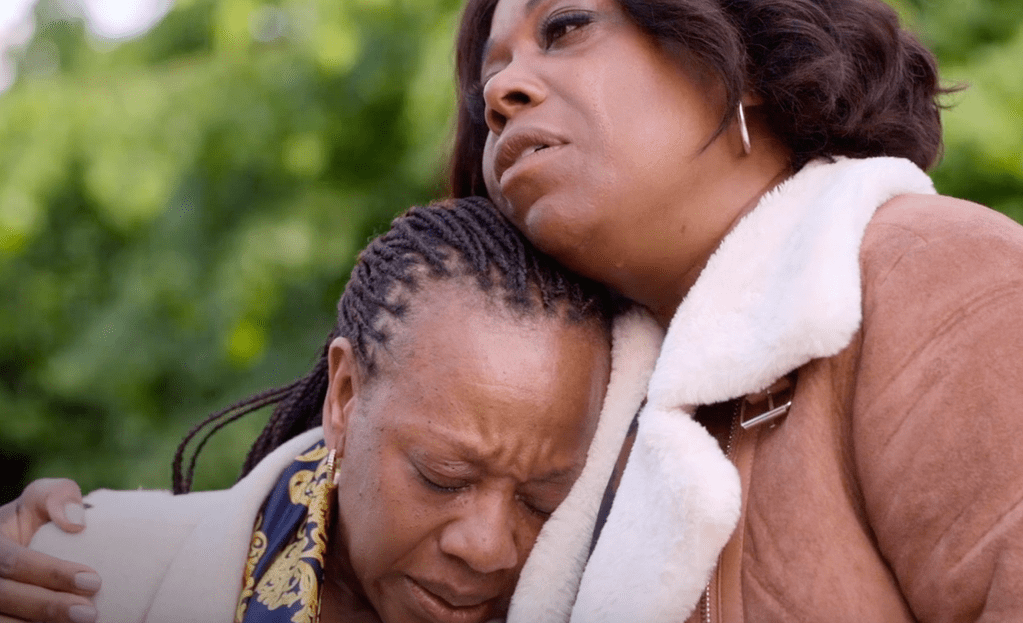
Marianne Jean-Baptiste and Michele Austin in Hard Truths. All Hard Truths imagery courtesy of Bleecker Street.
Perennially speaking with an outdoor voice before something softens her mid-movie, Pansy would seem more like a caricature of everyday fury were her core not so clearly, and sympathetically, elucidated by Leigh. This is a woman who’s been suffering from some form of extreme, undiagnosed, and unworked-through depression for so long (she recounts her late mother exhaustedly questioning her inability to enjoy life at a young age) that a monster has grown inside her. She no longer knows how to contain it; the closest she comes these days to not letting it get the best of her is cravenly scampering away when a furniture-store worker she unjustifiably chides storms to the back of the business to grab the manager for meditation purposes.
The few people in Pansy’s life who haven’t given up on her are at a loss about what to do; you can especially see it in Curtley’s pained eyes. But she does at least still have her ever-patient sister Chantelle (Michele Austin), who’d probably get along well with Happy-Go-Lucky’s Poppy. She’s a hairdresser who listens to all her clients’ stories with rapt attention and what seems like genuine relish, laughing easily and often. She also has a great relationship with her two adult daughters (Ani Nelson and Sophia Brown), who’re introduced with a feet-on-the-coffee-table morning-after living-room debrief of a night out over fits of giggles in their mother’s apartment.
The scene feels so cut from life that it seems improvised. But nothing in a Leigh movie is ever as off the cuff as it might appear. The filmmaker has so consistently offered such perceptive slice-of-life works for the last several decades because of a painstaking rehearsal process that helps him refine characters with the help of the actors who play them. Abrams, Nelson, and Brown have persuasive familial chemistry, and in their scenes with Pansy they vividly capture the fraught task of navigating conversations with a family member you care for as much as you have to be careful with. “I don’t understand you, but I love you,” Chantelle says frankly to her sister in a rare moment when Pansy has put her proverbial weapons down.

Marianne Jean-Baptiste and Michele Austin in Hard Truths.
There are no real catharses or resolutions in Hard Truths — no be-all and end-all emotional breakthroughs or explanations for a woman whose anger and sadness come out in a never-ending waterfall. (Whether they’ve been exacerbated by the pandemic’s isolation is alluded to in the film, but its characterological importance has also been discouraged by Leigh.) Anything so schematic or expository would be out of place in one of Leigh’s movies, which tend to spark empathy and understanding for even the most difficult characters by simply showing them for who they are — not turning away long after we might have run off if we were to encounter them in real life.
Hard Truths is a quietly powerful, richly observed drama about the first- and secondhand tolls of depression, bolstered by a superb performance from a darkly funny — but finally devastating — Jean-Baptiste. A lesser actress easily could have played Pansy with the kind of indulgent bluster that would cloud the hurt on which her endless tirades are founded. (You still can’t help but laugh as she criticizes a dental office for not lining up with her conception of clean, or for calling a young stand-in for her regular doctor as a “mouse with glasses squeaking at me.”) But Jean-Baptiste’s Pansy beams such emotional exhaustion, such weariness living with this side of herself she doesn’t know how to explain, that it’s those things, not the confrontational contempt she heaps on to others, that stay with you.

Lily Rose-Depp in Nosferatu. Photo by Aidan Monaghan/Focus Features.
Nosferatu: A Symphony of Horror (1922) was formative for Robert Eggers. After seeing the unsanctioned silent adaptation of Bram Stoker’s Dracula (1897) as a 9-year-old, the filmmaker was struck by how the original film’s director, F.W. Murnau, had transformed Stoker’s indelibly dark-hearted work “into a very enigmatic and simple fairy tale,” to the point that as he came of age as a director, he found himself wanting to reinvigorate the material himself, not just remain a fan. (He toyed with the idea of following up his debut, and still best, feature-length movie, 2015’s The Witch, with his own Nosferatu remake before moving on to 2019’s pitilessly funny two-hander The Lighthouse.)
Eggers’ passion project — whose development began in earnest in the summer of 2017, when regular collaborator Anya Taylor-Joy was cast in a key role that eventually went to a very good Lily Rose-Depp — at long last came out on Christmas Day. It turned out to be the kind of revival to leave me colder than one taking big swings that don’t ultimately pay off. Eggers’ star-studded take is competently made, meticulously detailed, and dutiful to its source material, but what it achieves pales in comparison to what Murnau and Werner Herzog (who directed a sumptuously Gothic redux in 1979) have already done.
It’s almost impossible to watch Eggers’ movie without thinking about its predecessors, from which it sets itself apart with a larger budget and scale, a chillier and grayer aesthetic, and excessively kept-in-the-shadows creature design that eschews the evil-rodent look of previous iterations for something more grounded in reality. (Earlier versions of the villain were as under-the-skin scary as they were because of the thoroughly transformative work of Max Schreck and Klaus Kinski; in Eggers’ Nosferatu, where the demonic Count Orlok is played by Bill Skårsgard, it feels like the sallow, distended makeup is doing most of the performance, with Skårsgard’s affected baritone sometimes veering into the comical.) None of these things is enough to sustain a movie that doesn’t thematically or narratively refresh a very familiar story in ways that feel worthwhile; Nosferatu feels like it exists purely so that Eggers could get it out of his system.
 Peterson Reviews