
My first instinct watching Presence, a haunted-house movie daringly shot from a ghost’s point of view, was to feel sorry for its unseen phantom protagonist. The first few moments of Steven Soderbergh’s new movie find the specter floating aimlessly around the empty, two-story suburban house in which it’s ostensibly stuck, Zack Ryan’s piano-forward score pensively playing as it seemingly pines for a family to keep it company. Given how ghosts are typically portrayed in haunted-house movies, paranoia will slowly dull our initial sympathies over the course of a film that never parts from its vantage point. Uncertainty around the ghost’s intentions — and whether it’s the reason why the previous residents vacated — is too persistent for us to feel completely at ease.
One might be more surprised that Presence doesn’t ultimately move into the expected theatrics of haunted-house movies like The Haunting (1963), Poltergeist (1982), or even the recent The Conjuring (2013) if Soderbergh weren’t at the helm. The 62-year-old director, working from a script by David Koepp, has only gotten more eager to toy with formal conventions and audience expectations with age, recurringly shooting genre-diverse movies with fleets of iPhones and confidently willing to narratively arrive at places that initially feel anticlimactic before you’ve had some time to process. Presence, which Soderbergh also shot and edited, might get asses in seats to see what its ingenious visual shtick might entail, but it audaciously refrains from going anywhere traditionally haunted-house-movie-scary. Its horrors are less grounded in the supernatural than the darkness that has been festering in its central family unit long before it’s hastily moved into this piece of too-good-to-be-true real estate.
That family, whose surname is unspecified, comprises parents Rebekah and Chris (Lucy Liu and Chris Sullivan) and their two teenage kids, Chloe and Tyler (Callina Liang and Eddy Maday). They move into Presence’s antique New Jersey home because Rebekah wants Tyler, whom she pretty much openly favors (“I’ve never felt so close to another human,” she tells him after she’s had enough liquor one night), to be in a better school that will bolster his athletic and collegiate prospects. Steamrolling Rebekah is entirely unconcerned that two of Chloe’s friends have recently died, under strange circumstances, in a two-month span. (“Time is what she needs,” Rebekah says dismissively when Chris suggests therapy and new medication.) Rebekah is more consumed, when not foregrounding Tyler’s future above everything else, by the fact that she’s committing potentially soon-to-be-discovered financial fraud at work, something worrying Chris so much that he’s covertly calling lawyer acquaintances in the evenings obliquely wondering what the legal ramifications could be if he — or “a friend,” as his cover goes — were to remain married to someone he’s well-aware is breaking the law.
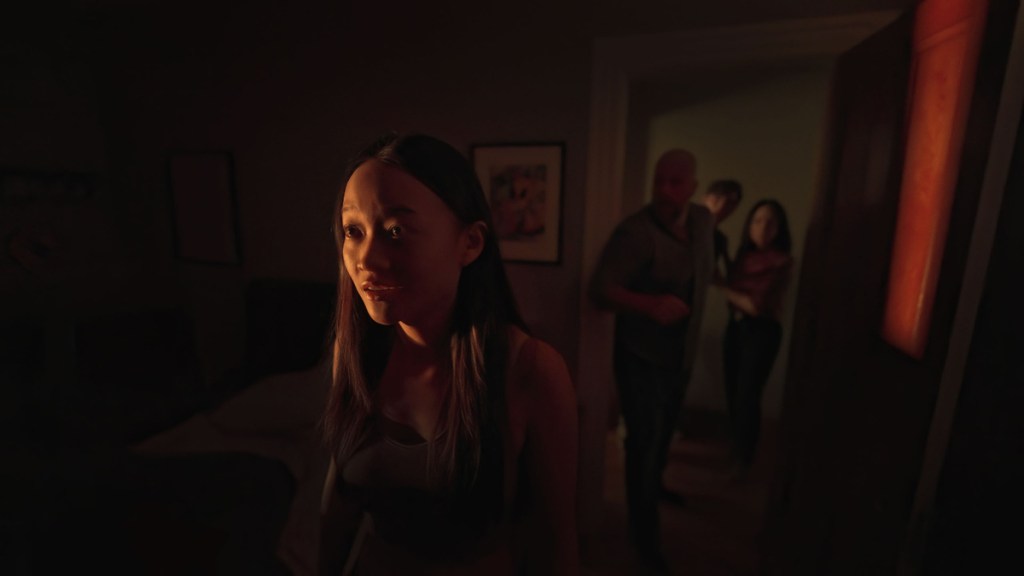
Callina Liang, Chris Sullivan, Eddy Maday, and Lucy Liu in Presence. All imagery courtesy of Neon.
Outside of its ghostly troubles, the house is becoming increasingly divided, everyone barely pretending like something isn’t fundamentally wrong. Good-natured Chris is bothered by how much sensitive and suffering Chloe has become an afterthought to her mom and brother. He’s appalled, too, by how self-centered and entitled Tyler has gotten, in no doubt egged on by his mother’s can-do-no-wrong coddling and the preferential treatment star student-athletes are accustomed to at school. The ghost, who follows the family members around with a speed and curiosity reminiscent of an eager-to-please puppy, implicitly seems to side with Chris and especially Chloe, whom it unsolicitedly cleans up after and who it almost exclusively lashes out on behalf of. (The majority of Presence’s scenes unfold in long, sometimes meandering takes that refreshingly welcome the kind of naturalistic mundanity haunted-house movies forgo in favor of goosebump-baiting paranormal action.)
The entity trashes Tyler’s room in apparent disgust after he brags about cruelly pranking a female classmate in front of a chagrined Chloe; it knocks over a mixed drink that’s been secretly spiked by a fluffy-haired love interest of Chloe’s (West Mulholland) whose objectives, the more he comes over to talk and make out, seem escalatingly sinister. Once the family has no doubt that there’s an uninvited fifth inhabitant in the home, Chloe theorizes that the spirit is her late best friend trying not to be forgotten, though a psychic phoned mid-film (Natalie Woolams-Torres) for a house visit isn’t so sure. Between nervous gasps, she postulates that the ghost may exist in a world where the past and present blur and that it’s learning its own motivations with every passing day. “There’s something it needs to do, but it doesn’t know what,” the medium enigmatically offers.
Presence’s fairly action-packed genre ancestors can’t help but make its climax feel unsatisfying — a little rushed — in comparison. But I like it more the further I get away from it, its abruptness chillingly reinforcing the (ghosts aside) true-to-life underscoring that the things that can conclusively undo a family can happen in only a surreal second. Presence still made me hungry for a version readier to adhere to haunted-house-movie beats (what might it be like to see the world as a ghost with comparatively ill intent?). But if anyone is going to subvert expectations, I’d prefer it to be someone like Soderbergh.
 Peterson Reviews