
Arriving a little more than six months after Longlegs, a creepy-but-anticlimactic riff on The Silence of the Lambs (1991), writer-director Oz Perkins’ The Monkey is another film haunted by the frightening randomness with which death claims its latest victims that also prominently features an evil talisman. In Longlegs, it was an alarmingly human-like doll that could suddenly turn happy households into gruesome murder sites. In the Stephen King short story-based The Monkey, it’s a wind-up chimp toy with bottomless pits for eyes and a wide mouth frozen in an ominous grimace. Twist the knob on its back and the primate, first using the drum in its lap to bang out a sort of death march, is suddenly bestowed with the ability to kill someone either central or peripheral in the life of the turner, who never has a choice in its selectee. The monkey can make someone die from what could be seen as natural causes (e.g., an exceedingly rare kind of aneurysm) or, more typically, a shocking freak accident (e.g., getting stampeded by wild horses while on a camping trip, getting decapitated via chef’s blade at a hibachi restaurant).
Its origins wisely never explained, the jinxed toy falls into the hands of identical twins Hal and Bill (Christian Convery as tweens, the almost surrealistically hunky Theo James as adults) when their deadbeat, tchotchke-collecting father (a cameoing Adam Scott) leaves it behind. The knob’s turning, and the disasters to follow, aren’t linked at first. Then both brothers realize what it’s capable of, with the meek, nerdy Hal fantasizing about using it to off Bill, a cocksure bullying sort who dresses like Eminem.
The monkey turns Hal and Bill’s childhood into a hellscape; it’s no surprise that, when the film jumps 25 years into the future, when the two think they’ve finally figured out how to escape the object making their lives harder, both are stunted messes. Hal is incapable of bonding with his growingly distant teenage son (Colin O’Brien) out of loss-related anxiety. Bill is a paranoid type who now chiefly blames Hal for the tragedies that defined their childhood. You probably can see where this all is going — that the wicked chimp, who has a knack for showing up precisely where he’s not invited, will return and force this family to face head-on the traumas from which they’ve tried to run away. But there’s nothing particularly cathartic about where The Monkey goes because it never feels fully formed in anything it attempts.
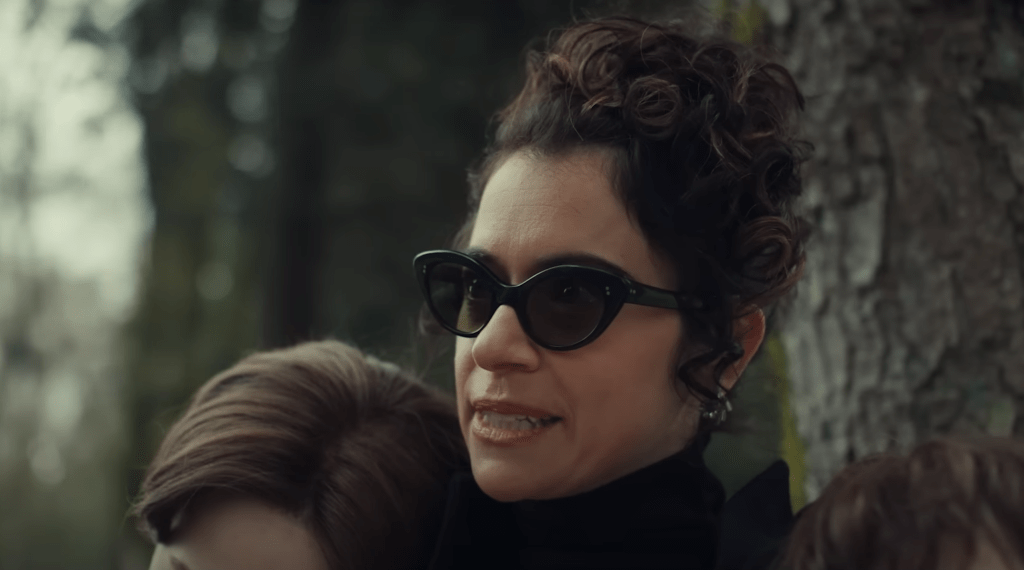
Tatiana Maslany in The Monkey. All The Monkey imagery screenshots from YouTube trailer.
Longlegs had a smattering of unexpected laughs; a standout was when its grotesque, white-makeup-caked villain (Nicolas Cage) tried unsuccessfully to scare an unamused teenage hardware-store clerk who thankfully maintained the upper hand in the interaction. But it was more straightforwardly a horror movie good at effecting deep-tissue dread. The Monkey is more concertedly a dark comedy, undermining whatever sense of tragedy could be felt from its wall-to-wall “accidents” with a don’t-take-this-too-seriously slapstick approach. It’s like if Three Stooges pratfalls ended with a lethal injury (or several). (In case we were unsure how we’re supposed to react, Perkins more than once inserts an aggravating stoner priest character to lead a local funeral, the guy offering wide-eyed dude, that’s so crazy-style yuks instead of comforting words that make you wonder why no one attending seems moved to politely ask if he could keep his mouth shut.)
Straining-to-be-edgy The Monkey isn’t very funny outside of its comically tinged deaths, which aren’t very funny, either. They come and go too quickly, good for little more than a nasty jolt. Perkins ought to have taken a page from the Final Destination movies, which for the most part work so well as horror comedies because their one-after-the-other freak-accident set pieces unfold so slowly. (In those movies, the never-seen Grim Reaper acts like a slasher-movie villain, vengefully coming after people who had collectively cheated death one by one.) Almost Rube Goldbergian, the lethal buildups in the Final Destination films in themselves were capable of inspiring laughs. An inevitable death almost felt like the belaboring of a point; these movies understood how to have morbid fun with the universe’s unflinching unfairness without ever letting us forget how awful that unfairness can be.
The Monkey wants to be a black-hearted force; it also wants to spark a genuine emotional reaction from the family turmoil at its center — get us invested in the slow-to-heal bond between Hal and his son. But the more traditionally dramatic thrusts of the narrative are just as rote and one-note as the deaths decorating them, and the otherwise glib tone immediately makes you feel suspect around anything that’s maybe meant to be truly heartfelt. The tonal evasiveness is disappointing, because The Monkey’s and Longlegs’ preoccupations are obviously personal for Perkins and you want him to interrogate them with more than just life-is-fucked-up joking around and superficial family-drama beats. Both his parents died cruelly and suddenly, tragedies that have understandably altered how he sees the world. It’s clear, now that he’s gotten his first fully fledged comedy (for him) out of the way, more straight-laced horror is where he most excels as a filmmaker. It’s a little bit of a relief that Perkins’ next movie, due out in just a few months, was written by someone else.
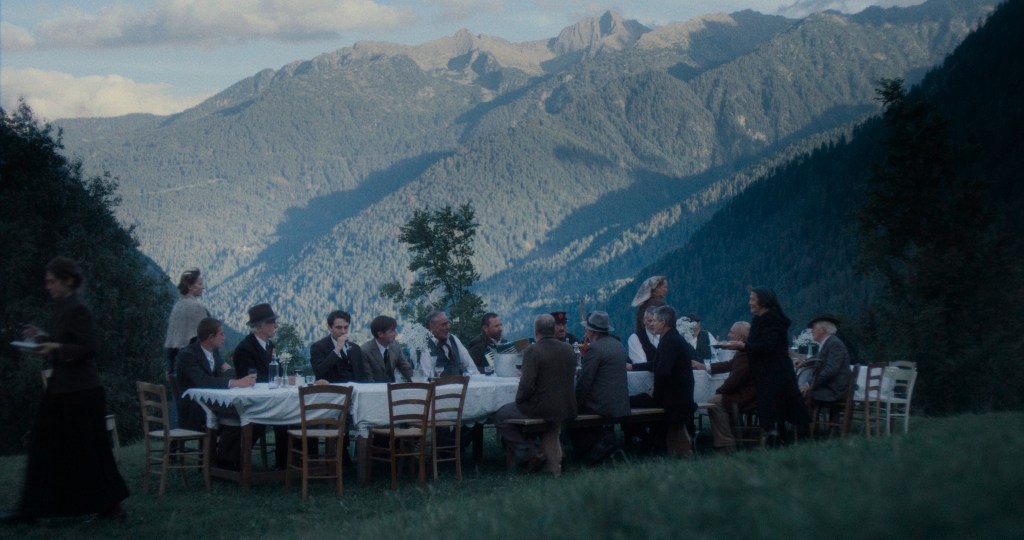
From Vermiglio. Courtesy of Cinetic Marketing & PR.
Vermiglio, written and directed by Maura Delpero, begins in the waning days of World War II in the stringently Catholic Italian mountain village it’s named after. Much of the rarely left hamlet’s tiny populace is made up of the Graziadei family, whose matriarch, Adele (Roberta Rovelli), gives birth to her 10th child a little more than halfway through the movie. The head of the rustic household, Cesare (Tommaso Ragno), is something of a de-facto leader in Vermiglio: he’s been, for what we can presume are decades, its sole educator, teaching everybody including his own kids. (That doesn’t mean he goes slightly easier on the latter than his other pupils: he’ll bluntly make it clear to one of his tween daughters, played by Rachele Potrich, in front of her classmates after a big assignment that she shouldn’t hold out hope for an intellectual future.)
Based on stories from Delpero’s own family lineage, Vermiglio diverges from expected family-drama conventions by seeming less interested in the potential dramatic juiciness of interpersonal spats and narrative twists than in conjuring the claustrophobia of a precise, gender line-affirming family dynamic in which it might feel hopeless to depart from a predesignated role. The decision of the eldest daughter, Lucia (Martina Scrinzi), to marry a visiting Sicilian deserter, Pietro (Giuseppe De Domenico), comes with gasp-inducing, family scandal-style consequences, but that, too, is not seized on by Delpero as an excuse to drum up the film’s intensity. It’s a chilly, elliptical movie that upends the stereotypical dreaminess of bucolic life, its intermittent pleasures most often found in the snatches of moments free of big-picture duty.

