
If one were to consider it a critically thinking entity, Death is a nasty piece of work. Even those among the rare few to have an ideal kind of demise — of painless natural causes, deep into old age — are probably being rather excruciatingly made to live a little longer than they’d like to by forces beyond their control.
Since its start 25 years ago, the Final Destination franchise has used that outlook to power gallows-humored horror movies where Death is as actively vindictive as a flesh-and-bone, knife-toting killer, donning its spiffiest Rube Goldberg drag as it creatively comes back for people it had fated to die in gory, mass-casualty freak accidents that, at the last second, they manage to avoid. All the movies — with the widely-agreed-on exception of the fourth entry, unseen by me but popularly deemed the series’ low — impressively managed to one-up each other, consistently refreshing a premise vulnerable to redundancy and keeping steady a tonal balancing act the films wouldn’t work without. They’re squeamishly funny; they’re also genuinely suspenseful and, every time a new victim is claimed, rattling.
Final Destination Bloodlines, the series’ first new installment in nearly 15 years, wisely avoids reinventing the wheel. And aside from a few callbacks — a brush with a logging truck, a clever visual transition from a stomach-churning death scene to an overhead shot of a coffin, and the return of the late Tony Todd as a sagacious mortician — it doesn’t rest on past glories, either. In keeping with how the franchise has largely shirked narrative interconnectedness, the film, directed by Zach Lipovsky and Adam Stein and written by Guy Busick and Lori Evans Taylor, introduces a fresh set of characters and institutes a new, genetics-forward conceit. What if Death were also to ravenously stalk the descendants of those who were meant to horrifically perish in a disaster?
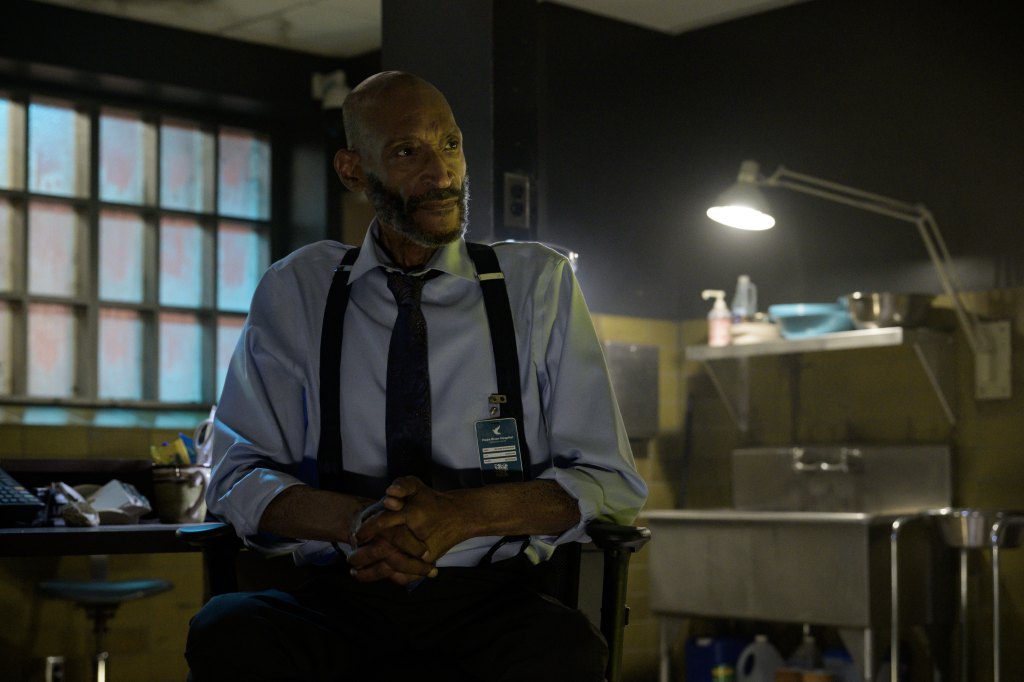
Tony Todd in Final Destination Bloodlines. All Final Destination imagery courtesy of Warner Bros.
In Bloodlines’ case, the inciting incident is a late-’60s, precredits collapse of a ritzy Space Needle-like structure a grinning elevator operator worryingly boasts was completed several months ahead of schedule. In an era where conspiracy-mindedness is more mainstream than ever and inevitably passed down generationally, inherited paranoia is an interesting, germane wrinkle. Only in Bloodlines, where one of the people who skirted that accident (Gabrielle Rose) traumatized her now-middle-aged children — and by proxy the grandkids whom she’s been carefully kept from — by aggressively warping their perceptions of life as they came of age, there’s a little more credence to illogical-sounding fixations on being “targeted.”
Much of the Final Destination movies’ on-edge fun comes from how uneasy they make you when a character simply walks into a scene. Should we worry about a pet turtle gingerly held by their owner, a blender mixing a summery cocktail, a rake set down supine beneath a trampoline, an MRI machine unknowingly switched on in an unattended hospital room? Most of the time the answer is in the affirmative; what remains novel across these movies is that the only thing that’s ever predictable about them is that if a supposedly doomed character appears to survive the climax, the epilogue will more than probably mortally betray them. “He’s a relentless son of a bitch,” one-fed up character observes of Death early in the film.
The Final Destination franchise’s silliness doesn’t counteract its unusual-for-horror ineligibility for the classic “it’s only a movie” line — a go-to adage for unnerved audience members attempting to self-soothe into a good night’s sleep. Its overarching narratives are far-fetched, but no one is ultimately safe from falling victim to a horrible accident technically propelled by as many Rube Goldbergian steps as one of these movies might showcase with lip-licking giddiness. To exist is to submit oneself daily to a reality where tragedy can strike at any time. The Final Destination series has functioned as a mechanism to laugh in the face of what’s frighteningly inescapable. Characters go before they’re ready, and we could be next within moments of the closing credits starting their crawl.
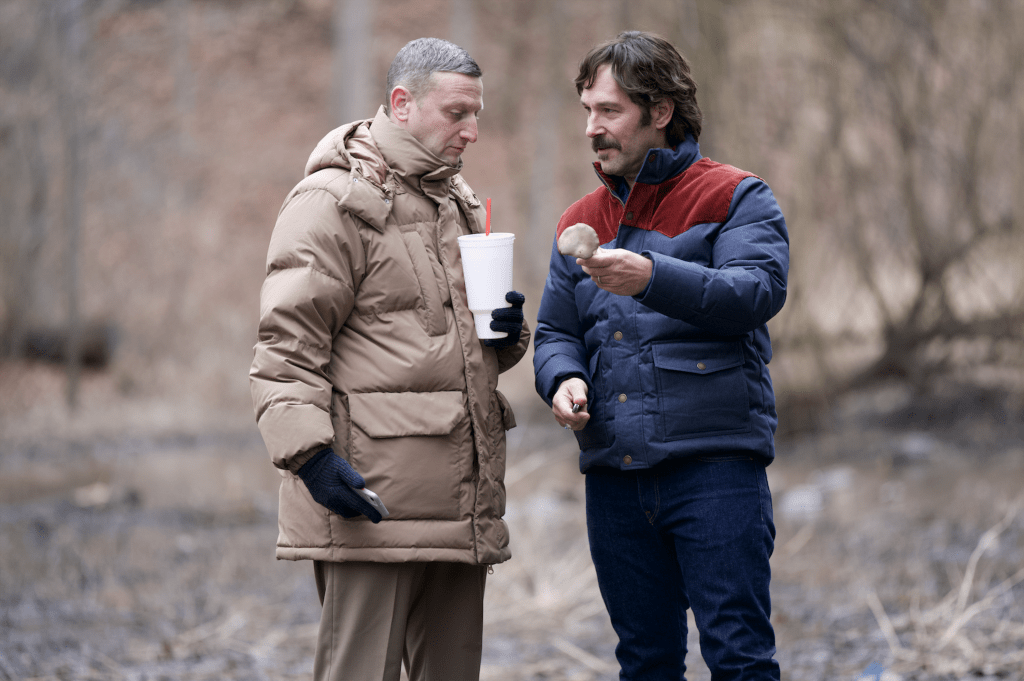
Tim Robinson and Paul Rudd in Friendship. Courtesy of A24.
In Friendship, a comedy for the era of the so-called male-loneliness epidemic, Tim Robinson plays Craig, a socially clueless marketing exec whose life is undone when life gives him a chance at the titular kind of relationship. It’s with Austin (Paul Rudd), a handsome, mustachioned new neighbor who by day is a weatherman and by night the frontman of a Motörhead-imitating rock band. Despite Craig’s astounding awkwardness — he’s someone whose nose bleeds when he gets too excited, for instance — their first few hangout sessions go well enough. Then everything falls apart when Austin attempts to introduce Craig to his larger friend group, whose initial meeting will be marred by Craig accidentally crashing through a screen door and, to make a long story short, sucker-punching the host amid some horseplay and effectively ending the gathering prematurely.
Craig will only continue spiraling as he attempts to win back the first real friend he’s had in years (or maybe ever, as his social obliviousness makes a plausible possibility). Friendship, written and helmed by first-time feature director Andrew DeYoung, pretty expertly ramps up its well-conceived cringe-comedy while impressively preserving a fundamental sympathy for the never-introspective, tactless Craig and the ever-widening gap between what he desires and his profound lack of understanding of how to attain it. (Even though his clumsiness is exaggerated, it’s unlikely his struggles won’t trigger some pained recognition in audience members, who probably also know well what it’s like to discreetly give a pep talk to themselves before a new-territoried social outing or want to connect with someone who might always remain out of reach.) But the movie is above all a showcase for Robinson, whose willingness to look like a blundering fool for even the slightest laugh inspires a certain awe.
 Peterson Reviews