
Whether or not you were among the probably very few people who itched, while watching Cinderella (1950), to see the story from the perspective of one of its titular princess-to-be’s less-conventionally-attractive siblings, writer-director Emilie Blichfeldt’s horror-comedy The Ugly Stepsister makes for delightfully grotesque fun. Played by Lea Myren, the eponymous 18-year-old is not, for what it’s worth, especially hideous. But she and her social-climbing mother, Rebekka (Ane Dahl Torp), think she is compared to Agnes (Thea Sofie Loch Næss), the earthy blonde daughter of a man named Otto (Ralph Carlsson) Rebekka marries at the beginning of the film for his money.
Rebekka is suggested to poison Otto during the newly joined family’s first dinner; it’s a little too convenient that he’d be lethally coughing up rivers of blood before his plate has even been cleared, after all. But his death, to Rebekka’s chagrin, won’t end up making much of a financial difference. An inconsolable Agnes unwittingly clarifies that the marriage’s motivations were equally shady: Otto wed Rebekka because he thought that she was really the wealthy one. The Ugly Stepsister sustains the time-worn Cinderella narrative from there but puts the vantage we’re used to on the side. Instead it focuses on Elvira’s queasy efforts to become just as pretty as her stepsister, who looks lovely even when she’s sweaty and smudged with the chimney soot responsible for her demeaning nickname.

Lea Myren in The Ugly Stepsister. First photo courtesy of Lukasz Bak/IFC Films /Vertigo Releasing; second photo courtesy of Marcel Zyskind.
Elvira’s quest is triggered by an announcement from the nearby prince (Isac Calmroth) that he’s hosting a ball, and that one of its young women attendees will be picked out as his new wife. Rebekka doesn’t want Elvira to attend because she thinks she has much to offer — her younger sister, Alma (Flo Fagerli), who detests Rebekka’s rapaciousness anyway, is too young at 13 to be offered as another option — but because she still craves the money and status Otto failed to bring her.
Elvira subsequently goes through several excruciating rituals to refine the features she’s been led to believe are off-putting. Her nose is broken in several places to give it a daintier slope. Her braces are prematurely ripped off. Her undereyes are bloodily stabbed through for Twiggy-like lash extensions. She gulps down a tapeworm egg so that she can feast all she wants while her figure slims. I would more confidently say that the bloody lengths Elvira will climactically go to to fit her foot into the slipper Agnes leaves behind at the ball needed to be seen to be believed if I didn’t spend much of those lengths with my eyes partially covered with carefully placed hands.
Blichfeldt frames it all as darkly funny. She revels in bodily grossness, zooming in on a big blackhead getting squeezed, vomit hurled by the gallon. She’s tacitly critical of the internal and physical pain for which beauty standards are responsible while accentuating their essential absurdity, which is heightened in The Ugly Stepsister not just by our knowledge that the efforts will be for nothing, but also that they’re all in service of an isn’t-shit prince. He’ll see Elvira pre-ball, when she still has on a face-obscuring nose cast and her head of hair is still distributed in unflatteringly tight curls, and say to her face that “I don’t want to fuck that.”
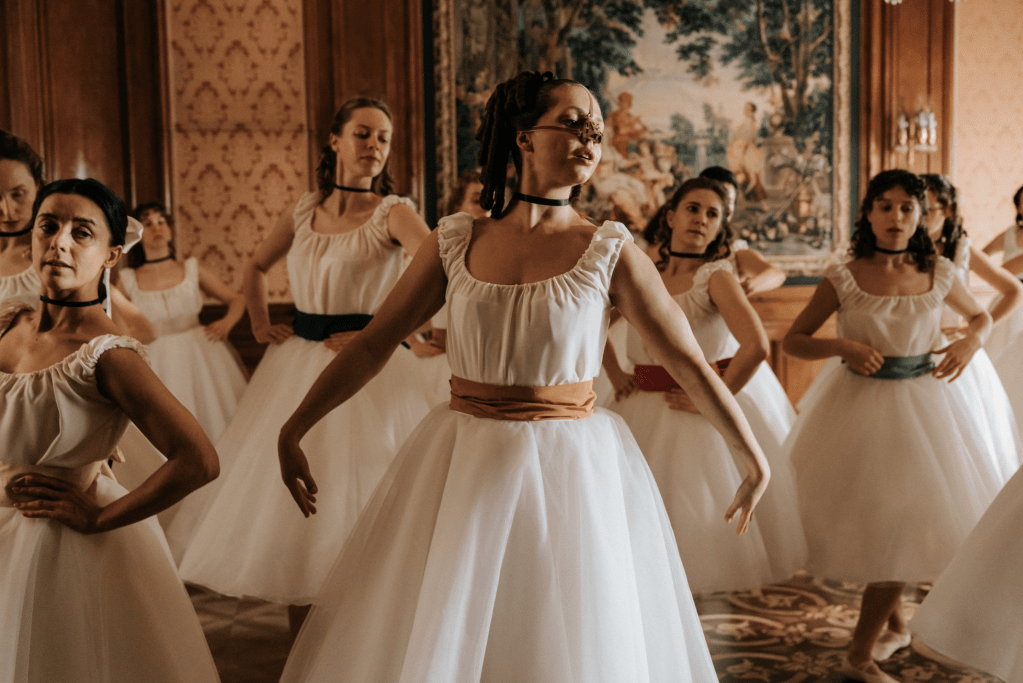
From The Ugly Stepsister. Courtesy of Lukasz Bak.
You can tell how Blichfeldt was influenced by the directors she cites as inspirational on The Ugly Stepsister — Lucio Fulci, David Cronenberg, Dario Argento, and her closer-in-age peer Julia Ducournau — in its sometimes playfully over-the-top violence. But she manages not to diminish Elvira’s fundamental, and foundationally common, feelings of patriarchally born inferiority that can only manifest nastily the more they’re obsessed over. (You can also feel Walerian Borowczyk — another filmmaker whom Blichfeldt has credited — in the movie’s menacingly sensuous period visuals.)
Myren is magnetic without her character having to say that much. The trait might pose more of a problem if Myren and Blichfeldt didn’t make Elvira’s internal life — a purgatory unendingly tormented by her desires and what it might take to achieve them — clear. When she goes to the ball and the only things that can be said of her are that she’s 18 and the fib that her favorite food is vegetables, it’s tragically funny, broadcasting her being in better touch with her shortcomings than her true self. We feel for her, wish we could shake some sense into her, and probably have sometimes felt like her.
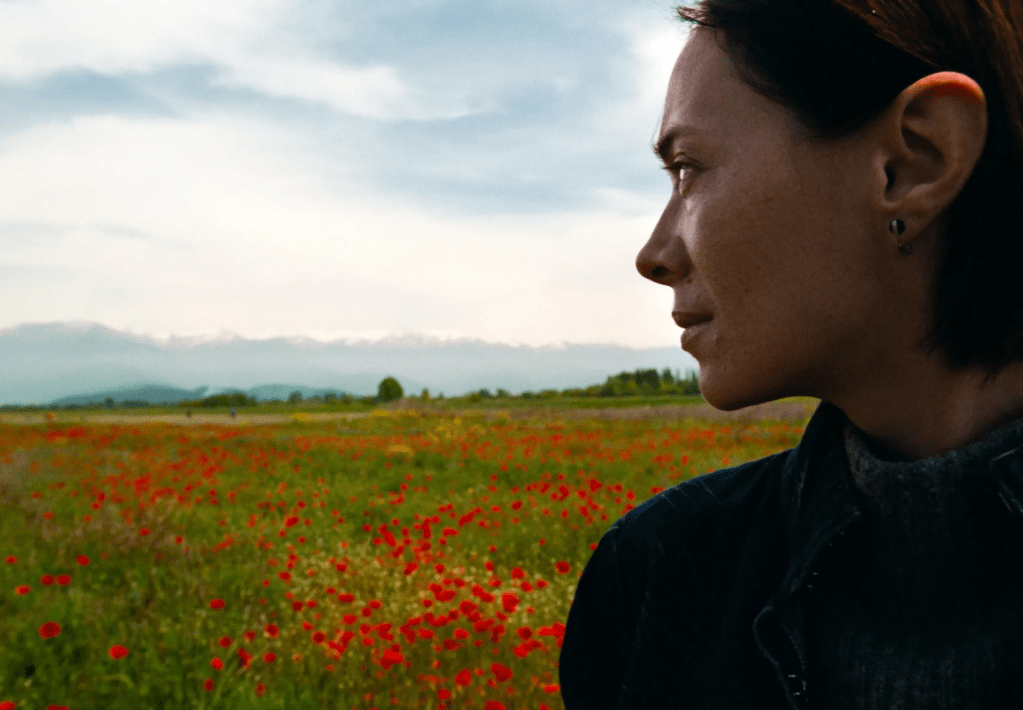
Ia Sukhitashvili in April. Courtesy of Cinetic.
Georgian writer-director Dea Kulumbegashvili shot her new movie, April, in Lagodekhi, the rural, Caucasus Mountains-surrounded town where she grew up. It’s a place with which she has a tortured relationship, her love vexed by the conservatism running rampant there. We can assume the movie’s protagonist, Nina (Ia Sukhitashvili), feels similarly. She works in Lagodekhi as a much-respected obstetrician; she also surreptitiously performs abortions for women around town and other neighboring villages, risking her reputation and well-being because she’d rather put herself than someone else on the line.
Its atmosphere made especially tense and unsettling given Georgia’s own gradual descent into authoritarianism — something which has made Kulumbegashvili pretty much certain that she won’t be able to again make films in the country until something changes — April foregoes traditional narrative and story to immerse us in how Nina must feel in a world where she objectively makes a positive difference but is inevitably increasingly consumed with dread and despair. The disquiet is turned up when, as the film starts, a baby she delivers — among the literal thousands she’s brought into the world — is stillborn. Looking into whether that was the result of negligence, the investigation to follow drums up scrutiny and the rumors already trailing her.
Nina’s punishing alienation is telegraphed in long, handheld takes whose tableaux contain very little except for, in a lot of cases, the dark, austere natural environment: a thunderstorm brewing malevolently over a field, rain pummeling a body of unfriendly-looking water. Nina is sometimes abstractly portrayed as an old crone hungry for personal touch; her conclusion that she has no “space for anyone in my life” is a professional asset that also eats away at her soul. April isn’t without tenderness, though: an extended depiction of one abortion stresses how the patient grasps her family member’s hand throughout the procedure. Though it comes at a great personal cost, Nina’s work is also an act of love.
 Peterson Reviews