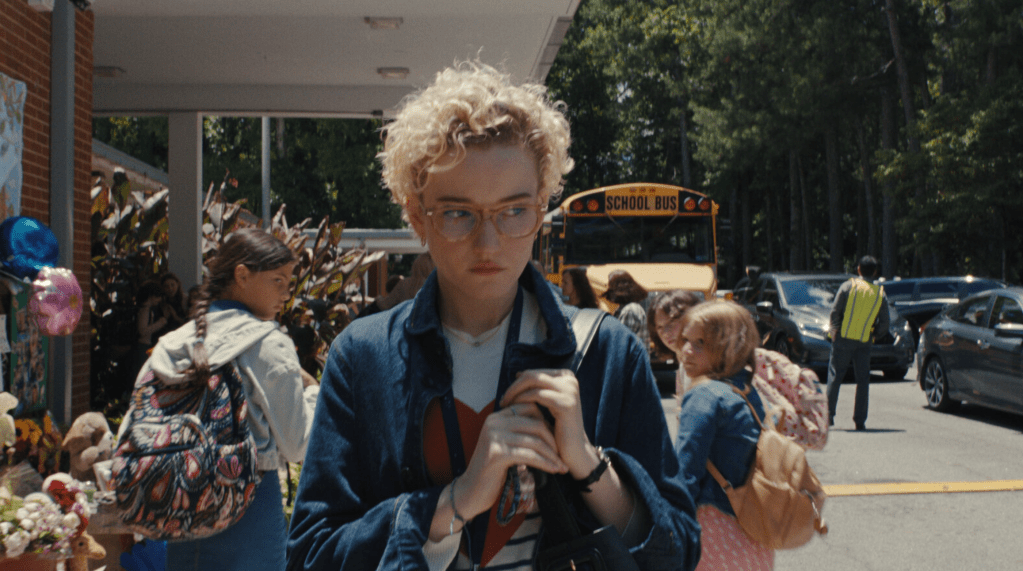
Weapons, writer-director Zach Cregger’s follow-up to 2022’s very good Barbarian, reiterates its predecessor’s insistence on creepy houses and villainous old crones as vessels for scares while only notionally building on its narrative ambition. Tightly cast Barbarian relied on a few characters to nudge its storyline forward. Drawing some comparisons to Paul Thomas Anderson’s Magnolia (2000) specifically and the ensemble films of Robert Altman, Weapons achronologically probes the sometimes braided perspectives of a larger panoply of miserable people. That misery is given some scene-setting context by some sinister, sing-songy voiceover from an unseen and unnamed child that plays over the film’s introductory montage. The crux is that all but one of the students of third-grade teacher Justine (Julia Garner) don’t come to class one morning. The subsequent investigation reveals that their parents’ assortment of always-on Ring doorbell cameras captured the children, at 2:17 a.m. sharp, bolting out from their houses’ front doors and into the black night, their arms outstretched like airplane wings.
Suburban Pennsylvania-based Weapons starts from the vantage of the chronically rattled Justine, who might have skirted much of the psychological and physical pain she’ll suffer by skipping town. Parents seem to have fairly universally decided that she knows more than she’s letting on. It’s become common, in the weeks following her students’ strange vanishing, for her to get breathy, threatening calls from burner phones and cars maybe or maybe not trailing her own so that they can eventually vandalize it. (She can only cope by dutifully replenishing her reserves of vodka.) Cregger quickly moves on, though. He’ll next visit the points of view of an erratic, beleaguered dad, Archer (Josh Brolin), who obsessively theorizes and is having, like Justine, guilt-ridden and maybe clues-laden dreams; idiot cop Paul (Alden Ehrenreich); homeless junkie James (a standout Austin Abrams); and harried school principal Marcus (Benedict Wong).
The viewpoint saved for last is the one belonging to sole “survivor” Alex (Cary Christopher), which Cregger naturally has, storytelling-wise, do double-duty. It’s the one with the strongest emotional hook — horror movie-style dread is far harder to sit with when raveled with a wide-eyed child’s well-being — and it also subliminally promises to be the one to deliver hopefully sufficient long-teased answers. An all-but-required horror-director duty, Cregger loves, to a fault, to tantalize. Every one of his principal characters’ vignettes concludes with cliffhangers, the first few of which are perhaps unintentionally, in a movie that has its fair share of definitely on-purpose dark humor, sillier than they are scary.
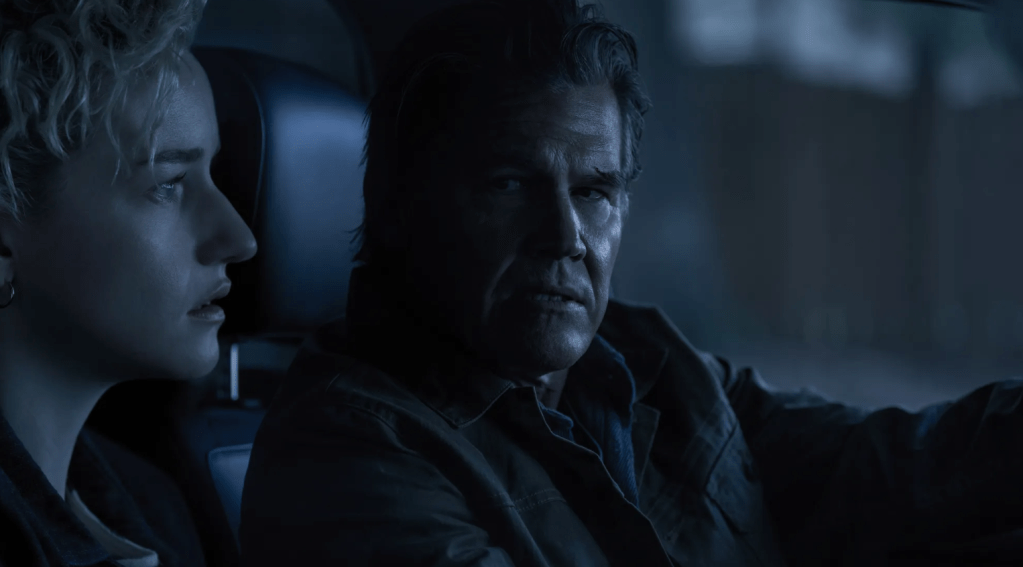
Julia Garner and Josh Brolin in Weapons. All imagery courtesy of Warner Bros. Pictures.
Weapons courts real-world resonance in its couldn’t-be-anything-else allegorizing of school shootings and the doomed-to-be-unsatisfactory investigative answers following them, and in its periodic foregrounding of conspiratorial thinking, which only continues to be encouraged with TikTok and its endless platforming of hobbyist detectives who can go a long way with flawed oration as long as it’s performatively authoritative enough. And it’s generally evocative to release a movie, without giving too much away, about forced zombieification into a climate where artificial intelligence and an aggressive presidential administration work in different ways to nullify critical thinking and resistance.
Horror and science fiction have long been lauded for their ability to cleverly remix political and cultural fears and frustrations into popcorn-friendly entertainment. Weapons’ continuation of that tradition is probably what’s best about it. But it’s an ultimately flimsy movie. The reveal that its evils spring from an ill-intentioned outsider rather than something long-festering in the community voids more interesting thematic possibilities in favor of something more discordantly, considering the other real-world fears on which it capitalizes, conservative. The shuffled narrativizing doesn’t so much strengthen thematic and characterological intricacy as suggest a creative awareness that this story, if to unfurl linearly, might strike one as a little underwhelming in a genred sense. (The appearance of an awesome Amy Madigan, doing her best Bette-Davis-in-her-hagsploitation-era drag, still manages to give Weapons a late-film lift; I do concur, though, with the oft-lodged complaint that Cregger’s now-repeated use of an aging woman’s body as something worth screaming at is rather misogynistic and lazy.)
A proud puzzlebox movie, Weapons transforms everything within it into another piece. I could not, the way I could in Barbarian — which too narratively hinges on methodical perspective-shifting — get that attached to any of the key characters. With a smaller cast, Barbarian had enough room for the viewer to know them better. Weapons is already switching over to the next thrill before you’ve gotten a firm handle on anybody or how trauma has transformed them beyond what’s immediately seen. The film is, for what it’s worth, a basically compelling, well-engineered horror movie that’s a few notches more inventive than most of its contemporary peers. It’s more than capable of leaving you a little rattled. But some of what had seemed novel in Barbarian now comes across as crutches Cregger would benefit from dropping.
 Peterson Reviews