
Luca Guadagnino’s long-running fascination with characters who follow their hearts with devastating results continues with the 2019-set After the Hunt, a movie that admirably but rather stiflingly only operates in gray areas. Its proclivity for provocation immediately announced by the opening credits’ use of white, Windsor Light Condensed typeface — a font most associated with the disgraced-but-still-working Woody Allen — After the Hunt takes place in a scandal-beleaguered version of Yale’s philosophy department. Ph.D. candidate Maggie (Ayo Edebiri, not given enough to do), a favorite student of a frosty professor up for tenure named Alma (Julia Roberts), alleges that Hank (an over-the-top Andrew Garfield), Alma’s best friend and a teacher of Maggie’s, came up to her apartment after a department party and, as she puts it, “crossed the line.” Maggie first takes her claims to Alma, owing to her reputation for championing other women in academia and Maggie generally looking up to her as a worldlier mentor. But Alma freezes, too evidently distracted by her friendship with Hank — and the potential optics of not supporting the Black, queer, and wealthy Maggie — to give her wide-eyed pupil the sympathetic ear she’s looking for.
Its cynical-seeming title alluding to the years following the influx of post-Weinstein-exposé #MeToo narratives in the media, After the Hunt is eager to cast aspersions without confirming what Maggie purports to have endured. Perhaps we shouldn’t trust her for reasons we’ll hear from some of the movie’s other characters: because she comes from a rich family responsible for financially supporting much of Yale’s infrastructure; because she’s a putative plagiarist trying to cover her tracks, possibly using her identity and financial backing as “cultural moment”-capitalizing tools for scholarly ascension; and because she conspicuously imagines herself in the future as an Alma-like figure. She paints her snipped-short nails the same night shade, wears similarly soft-and-creamy clothes, and even gesticulates comparably. (At a gathering at Alma’s tony apartment, Maggie uses the bathroom not to relieve herself but dig around in the medicine cabinet and other cupboards, leaving with a photo- and news clipping-stuffed envelope she finds secretly taped in one of the compartments.) But a privileged upbringing and youthful ambition don’t mean, screenwriter Nora Garrett allows, that Maggie wasn’t assaulted. Harder to foist skepticism onto is Hank’s out-in-the-open flirtatiousness with his female students, and it’s suspect enough that he’d think it would be appropriate to visit Maggie’s apartment for a nightcap in the first place.
After the Hunt grounds us in Alma’s doubtful perspective, which has partly been made more brittle because of a teenage incident whose particulars the movie does not divulge until the last act. She will have done quite a bit of foreshadowing self-destruction by then, popping pills and then forging prescriptions to deal with a cluster of ulcers whose flare-ups make her sporadically double over in pain. (One wonders if a long-term professional hiatus that’s alluded to but never unpacked was health-related.) Her haircut reminiscent of Gena Rowlands, a grand dame of the woman-unraveling narrative, Roberts gives one of her finest performances as a woman whose own struggles prevent, rather than encourage, her from embracing solidarity, having internalized gendered grin-and-bear-it resolve and the petty competitiveness success in higher academia can foster.
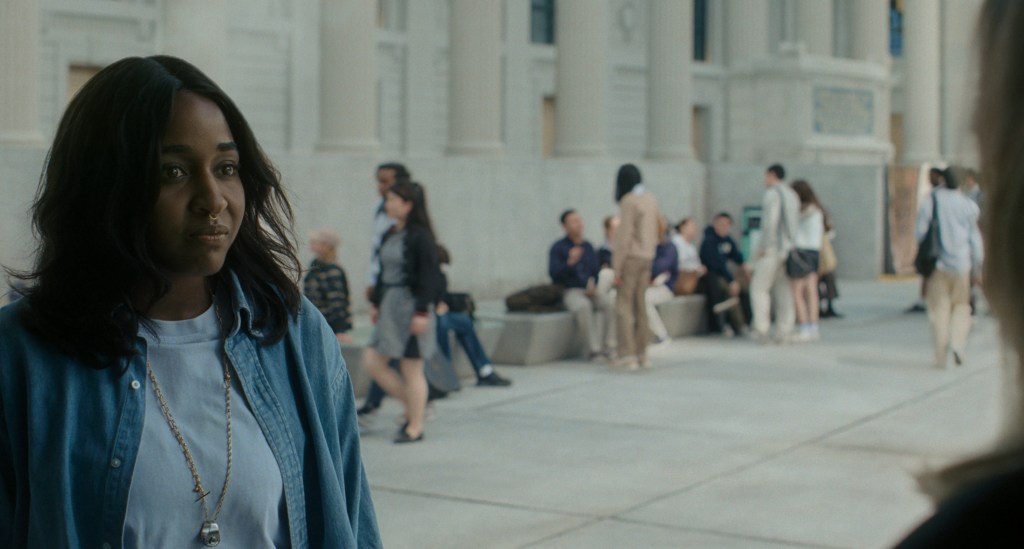
Ayo Edebiri in After the Hunt. Courtesy of Amazon MGM Studios.
If the preternaturally charismatic Roberts were not After the Hunt’s star, though, the aloof, distance-maintaining character would be less obvious as a center of gravity. My mind kept wandering to other wanting-for-attention characters: Alma’s sardonic psychiatrist husband (Michael Stuhlbarg), who’s so much the long-suffering type that he counts a night of sleeping in bed more cozily than usual as a kind of breakthrough, and to Maggie, who is written with too much intentional opaqueness to make her fully seem like a person.
Beset with a feeling that it’s been released a few years too late, After the Hunt’s willful lack of good-bad binaries and digestible answers is superficially easy to appreciate. But it ultimately mistakes chronic doubt and what-abouting for a substantial position as it contemplates the effectiveness of so-called cancel culture and whether the possibility of marginalized-identity-possessing people weaponizing it for personal gain is purely right-wing paranoia. All the purposeful obfuscation and indistinct character motivation come to feel empty; as it moves north of a two-hour runtime, one feels like After the Hunt has mostly just spun its wheels, so fixated on maintaining an atmosphere of dubiousness that the characters feel beaten down, disallowed until the 11th hour from saying anything that could lead a viewer to a conclusion. (After the Hunt has drawn comparisons to 2022’s excellent Tár, another movie about a powerful, self-serving middle-aged woman in a creative field it pales in comparison to in large part because it was readier to be messy and had a sharper sense of what, exactly, it was diagnosing and targeting.)
The prolific Guadagnino has spent the last decade trying to prove his elasticity, periodically deviating from the sumptuously shot style of melodrama in which he reigns supreme and is arguably most associated with (2009’s I Am Love, 2015’s A Bigger Splash, 2017’s Call Me By Your Name, and 2024’s Challengers) for horror (2018’s Suspiria and 2022’s Bones and All) and erotic abstractions (2024’s Queer). The hardened tenseness of After the Hunt is another attempt at self-expansion that reaffirms that Guadagnino, for all his formal prowess and good taste, has a particular lane in which he dependably excels, not several.
 Peterson Reviews