
From Stella Dallas (1937) and A Woman Under the Influence (1974) to Tully (2018) and last year’s Nightbitch, maternal malaise is hardly a new subject of cinematic interest. But the sort of all-encompassing nightmarishness put forward by the loosely autobiographical, very dark comedy If I Had Legs I’d Kick You, writer-director Mary Bronstein’s first movie since the 2008 mumblecore touchstone Yeast, feels novel for the everlastingly resonant subgenre. Belaboring the self-hating claustrophobia of her struggling-mother character’s world, cinematographer Christopher Messina’s cameras are almost always uncomfortably tight on the face of Linda (Rose Byrne), the anguished, profoundly sleep-deprived mom at the film’s center. Irritating everyday sounds — the squelchiness of jelly fingered on lightly burnt toast, a medical monitor’s incessant beeps, an upset baby’s howls — are pitched up like gnats circling one’s ear.
If I Had Legs I’d Kick You covers a short time in Linda’s life that comes across as at best an apex and at worst a simulacrum of all the motherly unhappiness child-rearing is destined to bring her. Her ship-captain husband (Christian Slater, mostly heard over hissing, judgmental phone calls) often away on extended assignments, Linda is, when we first meet her, facing another temporary period of what amounts to single motherhood, this time with an at least two-month-long stint away. Her and her unnamed spouse’s elementary-school-age daughter (Delaney Quinn) requires more attention than is typical for her peers. She’s suffering from an undisclosed illness that requires a hiatus from school, persistent medical check-ins, and nightly hook-ups into a bedside feeding tube that nourishes her while she sleeps.
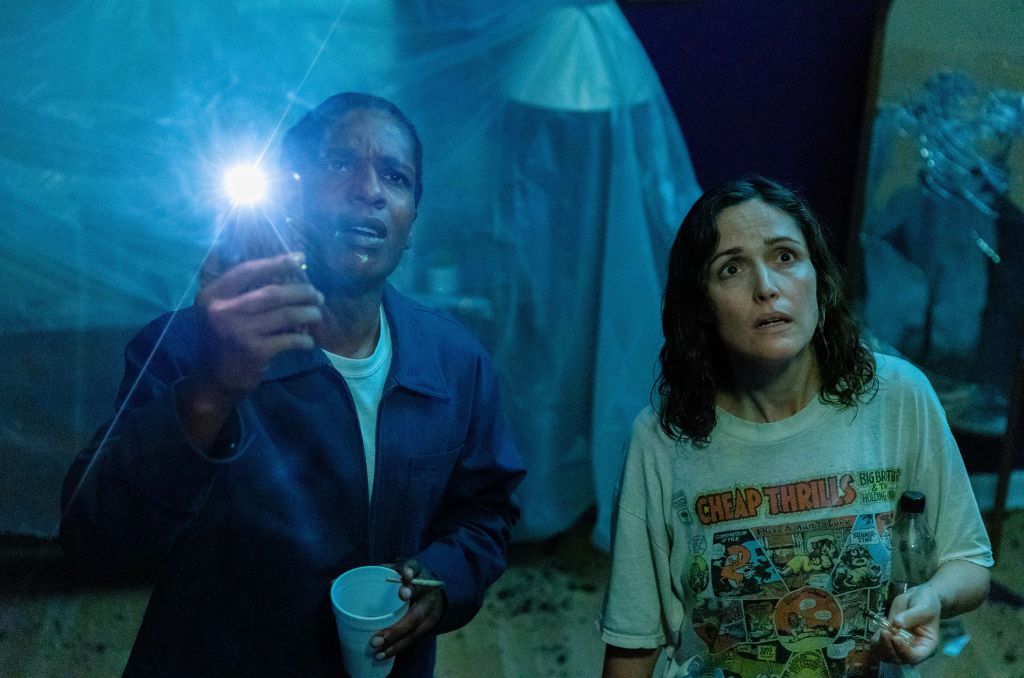
ASAP Rocky and Rose Byrne in If I Had Legs I’d Kick You. All If I Had Legs I’d Kick You imagery courtesy of A24.
Taxing full-time work as a psychologist, coupled with single-handed at-home responsibilities, had obviously been wearing on Linda before If I Had Legs I’d Kick You starts. Her daughter’s neediness has fostered a maternalistic alienation in her, signaled by Bronstein’s decision to have Quinn, save for a few glanced-at body parts, near-completely remain just out of the frame, her character’s unabating whine made more grating by its disembodiedness. Then Linda’s fragility is dealt a major blow when a pipe in the family’s Montauk apartment bursts, flooding its rooms and leaving the bedroom ceiling with a giant, orifice-like hole prone to drippage.
Linda and her never-named daughter provisionally move into a beachside motel whose unfriendliness is partly drilled in by its usually being depicted past midnight. Already crazy-makingly famished for alone time, Linda stays up well into the hours of the night. Baby monitor at her side, she sits alone on benches outside her room while listening headphone-less to music, sipping wine or getting high. It’s simultaneously a much-needed break and anathema to anything like recharging — though the unending chirps of her kid’s feeding machine would make a real attempt at a good night’s sleep difficult anyway. (“The delineations of night and day are so stark that, at times,” Justin Chang recently wrote in The New Yorker, “[Linda’s] adventures take on an almost vampiric quality: when the sun is out, she seems drained, boxed in, and all but immobilized by her schedule.”) The apartment seems like it’ll never get fixed. The contractor takes bereavement-related time off early on in the process, then remains impossible to get in contact with after his break was supposed to end.
Linda, a woman who wonders aloud whether she’s meant to be a mother, doesn’t seem to have any friends she can turn to. The closest thing she has is her therapist (a dry, perennially unsmiling Conan O’Brien), whose office is a few doors down from hers. But he betrays no warmth toward her and refuses to give in to her entreaties to cross a professional line — i.e., explicitly tell her what to do to fix her purgatorial situation rather than more appropriately give her tools to emotionally ease its pains. Linda’s stressed-out prickliness — and what seems to be an internalized pressure on herself to handle everything with brave, tough-mama posture — makes it hard to connect with anyone: other moms in a quasi-support group her daughter’s facility offers; a no-bullshit neighbor at the motel (ASAP Rocky) who takes a liking to her despite her hostility; a new-mother client (Danielle Macdonald) who too is at a maternal breaking point, hers inflamed by postpartum depression fomenting increasing paranoia and a loosening hold on reality.

Rose Byrne in If I Had Legs I’d Kick You.
Bronstein’s adherence to a close-up shooting style makes Linda’s woozy, hopeless state of mind feel vivid — close to achieving a stated goal of wanting the viewer to feel as though they could see behind Linda’s eyeballs. But If I Had Legs I’d Kick You wouldn’t have its same first-person lucidity if the camera were looking at someone other than Byrne, a comedy-associated actress whose never-predictable agility with dialogue — which she can render from absurdly funny to tragic in a lightning-strike instant — is proportionate to her expressiveness. She seems to even have control of the lines on her face — a vein that might briefly pop out during one of Linda’s many belligerent conversations.
If I Had Legs I’d Kick You doesn’t say much that hasn’t already been in movies chronicling maternal despondency: that in two-income households women are still likelier to take a larger portion of child-raising, that society fetishizes mothers who can do it all without providing enough resources to make the juggling that manageable, that moms are usually more expected to supplant their personhood for their children than dads are. But you’re also unlikely to finish it feeling like it’s been done before. The way the movie treads water through its frustrations — how it waves away optimism or sentimentality, welcomes a night terror-esque presentation, and takes advantage of Byrne’s emotionally ragged performance — is what sets it apart.
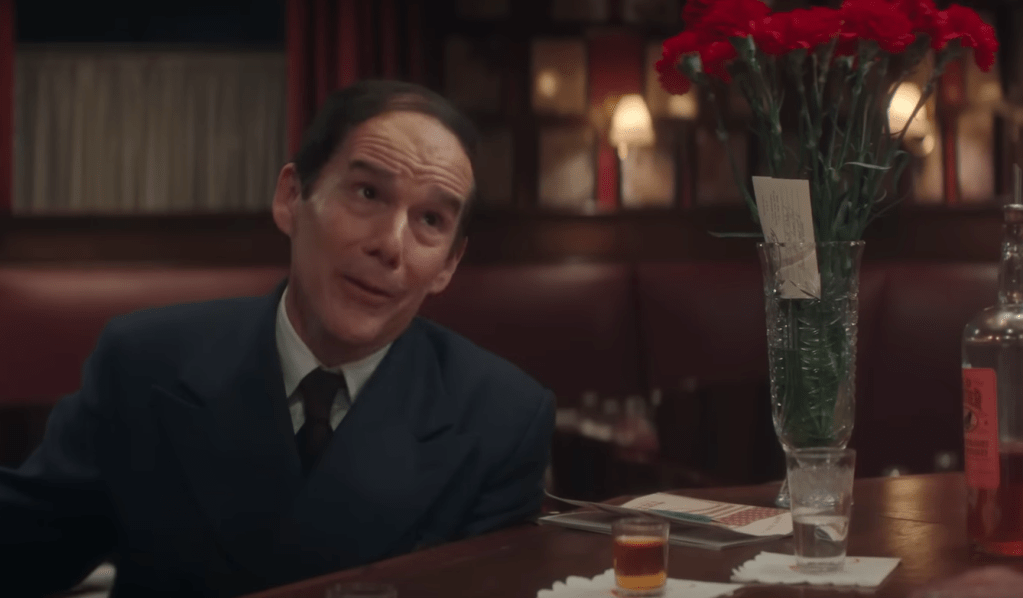
Ethan Hawke in Blue Moon. Screenshot from trailer.
Director Richard Linklater and longtime muse Ethan Hawke do the time-warp for their ninth collaboration. One of two Linklater period pieces being released this fall, Blue Moon sees him and Hawke going back to the spring of 1943 to probe an artistic partnership that, unlike their still-going-strong one, is on the wane. In the wistful but lovely-in-its-empathy Blue Moon, an excellent Hawke, his height shortened with movie magic and his hair darkened and thinned into a barely-hanging-on combover, plays the lyricist Lorenz Hart. The movie takes place on the opening night of Oklahoma!, the first production on which Hart’s long-term creative sidekick, Richard Rodgers (Andrew Scott), worked with Oscar Hammerstein II (Simon Delaney), whom he’d later find more success with than he would with his erstwhile right-hand man. The charming, garrulous-but-witty Hart feigns that he’s not hurt about being on the outs. (In a handful of pitch-perfectly affectionate-but-weary exchanges, it’s clear that though Rodgers still adores his friend, Hart’s debilitating alcoholism and attendant deadline-aversion are what’s led Rodgers to move on to a different artistic partner.)
Blue Moon almost entirely unfurls in the warmly lit bar where the post-Oklahoma! afterparty is being held. Hart, who leaves the premiere early to get in a few drinks from the reluctant bartender (Bobby Cannavale), is eager for connection among a crowd that’s been stomaching his toll-taking caprices for a while. He’ll find some camaraderie in the deadpan E.B. White (Patrick Kennedy), who’s having a drink separately from the festivities and contemplating the early stages of Stuart Little (1945), and in Elizabeth (Margaret Qualley), an ambitious 20-year-old college student with theatrical aspirations who has recently become something of Hart’s protégé. Despite her believable fondness for her mentor, she’s not as subtle as she might think about wanting deep down to use her kinship with him as a stepping stone to get closer to the ascendant Rodgers.
Blue Moon evokes much about Hart — the self-loathing kindled by his being closeted, his feeling inferior to Rodgers, and the related-to-both self-destruction whose interference with his brilliance has reached an impasse — without ever stooping to didacticism. In a move that might sound surprising to a film so dialogue-forward, the film says plenty through evasion, empty chatter, and understated face cracks that accidentally lay bare what’s being concealed. Blue Moon makes a good case that moment in time-style biographical moviemaking is generally more effective than a conventional biographical structure. Approximating a person’s essence doesn’t always demand that that much ground be covered.

Rebecca Ferguson in A House of Dynamite. Courtesy of Eros Hoagland/Netflix.
A House of Dynamite, Kathryn Bigelow’s first movie in almost a decade, manages to make the frightening hypothetical of an incoming, sure-to-be-apocalyptic nuclear disaster mostly feel stagnant. The first 20-ish minutes of the shakily neutrality-attempting movie — when the nightmare scenario for which its focused-on fleet of control-room types has forever been training suddenly becomes a pit-in-the-stomach reality — are tense and anxious enough. But Bigelow, working from a screenplay by (the reportedly contemptible) ex-NBC News president Noah Oppenheim, continues to cyclically rerun that initial stretch of time, albeit from the different perspectives of powerful, hypercompetent men and women in suits played by the likes of Rebecca Ferguson, Idris Elba, and Tracy Letts.
The remixed and recontextualized repetition doesn’t as much enrich the gravely soundtracked narrative as slow its momentum. The shuffling vantages, plus the glut of jargon and pondering of rules, telegraph complexity more than persuasively generate it, showing off “cleverness as opposed to the workmanlike concerns of linear drama,” the critic Adam Nayman recently observed. The way the movie is shot by Barry Ackroyd — with an in-the-room, shaky-cam style that calls to mind TV’s Succession — is meant to communicate fly-on-the-wall realism but feels more mockumentary-like, which is to say that we’re constantly reminded of the movie’s vérité aims more than we’re immersed in them.
Bigelow’s The Hurt Locker (2009)-and-onward pivot to solemn-faced, ostensibly well-researched movies patently striving for importance has continued to make me long for the filmmaker she’d been for the first 20 or so years of her career: a world-class craftswoman of pulp fiction and genre movies, with 1991’s Point Break and 1995’s Strange Days especially enduring as stylish, propulsive thrillers with a more idiosyncratic touch than their closest peers. Though still holding on to its technical finesse, Bigelow’s once-distinct sensibility has gotten lost in her late-career dedication to prestige-bait, inspiring with the stretched-thin A House of Dynamite not much more than an I-really-hope-this-doesn’t-happen shrug.
 Peterson Reviews