Biographical movies customarily dip into the same few fonts of inspirational source material: memoirs, oral histories, biographies. Ira Sachs’ fact-based Peter Hujar’s Day unconventionally dramatizes a thought-lost but recently rediscovered interview transcript, aiming to preserve rather than too liberally expand on its moment-in-time specialness.
The simplicity is a boon. The Dec. 19, 1974-set movie unrolls across 75 minutes in and around the tastefully appointed apartment of the writer Linda Rosenkrantz (Rebecca Hall), where she’s loosely interviewing the eponymous photographer (Sachs’ Passages collaborator Ben Whishaw). She’s in the process of compiling a book of interviews with artists about how they spend their days. Feeling like she doesn’t do much with her own, she wants to find out how her peers fill their time. (Something of a spiritual successor to her transcript-guided 1968 book Talk, the ’70s compendium never came to fruition; the now-91-year-old Rosenkrantz partially resurrected her long-abandoned creative project by publishing her conversation with Hujar in 2021.)
Steered by the sporadically interjecting Rosenkrantz’s direction of her subject — enumerate the previous day’s events with as much detail as possible — Peter Hujar’s Day manages to, beyond its literal dialogue, say more in the afternoon it covers than most of its biographical-film peers, which tend to think that revisiting large swaths their subject’s life automatically fosters greater interior insight. As Hujar rummages through both the trivia and ongoing concerns that have defined his last 24 hours — an early-morning phone call with Susan Sontag; a suspicious exchange of Lauren Hutton glamor shots with an Elle editor; a bewildering, self-doubt-boosting shoot with a decidedly uncharitable Allen Ginsburg; his ever-blurrying eyesight; his propensity not to eat enough when in the thick of the creative process; and a host of other initially minor-seeming details — a clear vision of a person whose life is commandeered by his artistic impulses, waffling between confident and conflicted, materializes.
Our absorption into Hujar and Rosenkrantz’s one-sidedly confession-filled day together is sometimes distressed by Sachs’ gratuitous decision to a few times emphasize the film’s built-in artifice. A clapper kicks off the action; an unedited-out crew adjusts the lighting onscreen later on when Hujar and Rosenkrantz, who have known each other for 20 years, take their conversation to the shadowy exterior of the latter’s building.
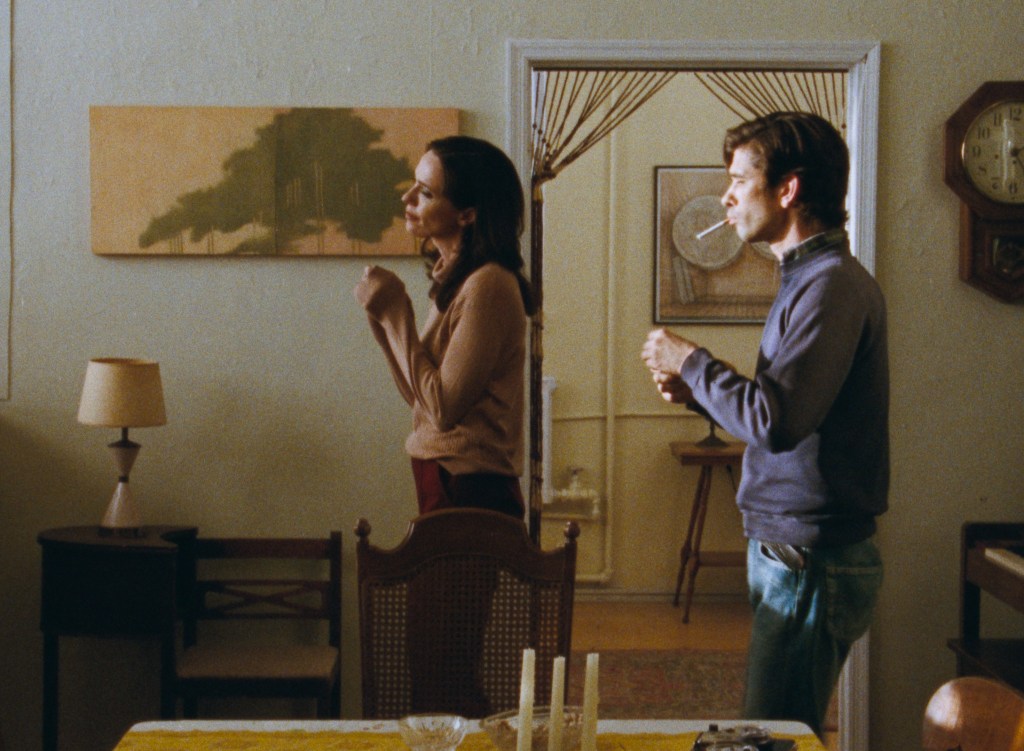
Whishaw and Hall’s simulation of years-worn camaraderie is persuasive enough to make you feel slightly intrusive nearly as soon as Peter Hujar’s Day begins: right as the interview is starting in Rosenkrantz’s living room, the sleepy-eyed Hujar smoking a cigarette and a smirking Rosenkrantz attentively listening across from him in a soft beige turtleneck. But the movie, as plaintively as it captures people alternately thrilled and addled by their respective creative drives, settles into a pleasurable patter. It invokes the feeling of eavesdropping, where certain grievances have a “you had to be there”-esque muddiness that are nonetheless made interesting because of the emotion and conviction with which they’re talked about. Peter Hujar’s Day encourages you to lean in closely.
Photo: Rebecca Hall and Ben Whishaw in Peter Hujar’s Day. Courtesy of Janus Films.
 Peterson Reviews