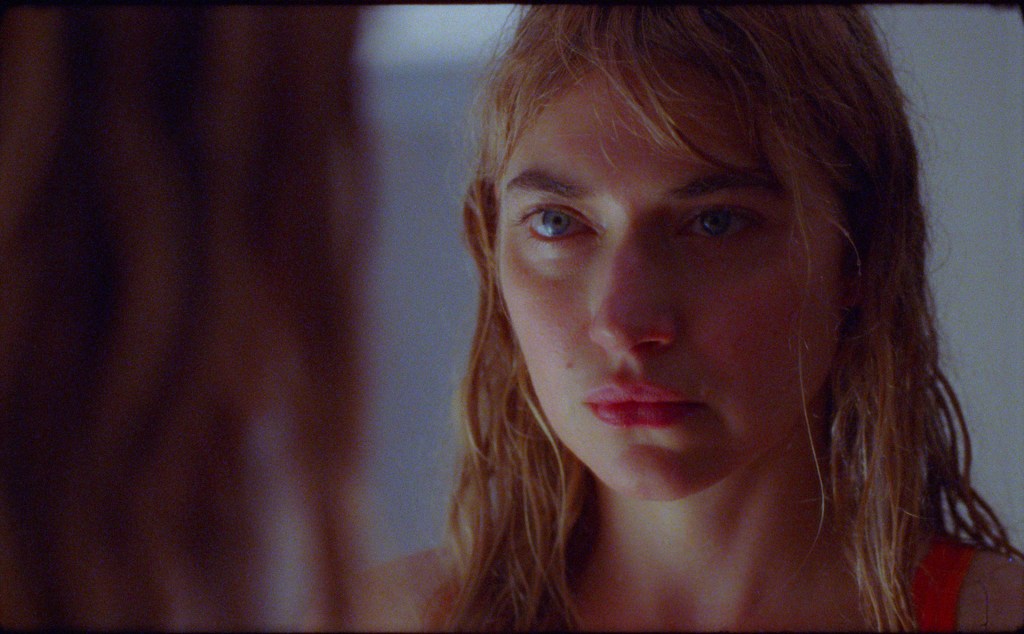
In 2017, Kristen Stewart was described by the critic Melissa Anderson as one of her generation’s most quicksilver performers. The Chronology of Water, the actress’s adaptation of Lidia Yuknavitch’s homonymous 2001 memoir, sees that unboxable quality pulsing through her filmmaking, too. Stewart’s feature-directing debut, which follows the 2017 release of her also aquatically attuned short Come Swim, tracks Lidia’s (Imogen Poots) long and strenuous process of coming into herself after an upbringing blackened by her father’s (Michael Epp) sexual, emotional, and physical abuse of her and her older sister, Claudia (Thora Birch). (Their alcoholic mother, played by Susannah Flood, never intervenes.) Stewart, in line with the obvious choice-renouncing spirit of her acting career, doesn’t refashion Yuknavitch’s story into something more palatably uplifting. The movie doesn’t suffer from the problem burdening the majority of biographically informed movies, either: an ultra-attentiveness toward time’s passage, and the milestones contained with it, that can make it feel like a character’s life is happening to them, their subjectivity of less importance than the forward motion of their story.
The elliptical The Chronology of Water favors emotional and sensorial precision over narrative coherence. It’s a trait shared with last year’s thematically kindred Die My Love, whose director, Lynne Ramsay, Stewart has repeatedly cited as an influence. (Ramsay’s 2002 breakthrough, the wandering, ghostly Morvern Callar, also feels like it could be on the other side of a dyad with The Chronology of Water; it must be more than a coincidence that the daughter of that film’s star, Samantha Morton, plays a key supporting role.) Seeming to know that loitering too long in it would encourage a sense of luridness, Stewart doesn’t dwell on all the particularities of Lidia’s and Claudia’s nightmarish childhood. Fleeting sonic and visual simulacra potently represent its persisting darkness. The horrified look on Claudia’s face as she returns to the car after her and Lidia’s dad pulls over on a road trip to assault her in the woods. The sounds of belts thwacking bare skin. A crucial exchange in the family home’s garage, at a moment when Lidia will in the next few months start college, where she hurls long-brewing insults at her father before telling him to get out of her way.
Yuknavitch found lifelong solace in swimming — “How many miles does it take to swim to the self?,” her cinematic counterpart wonders in some voiceover. She also found it in writing, which she privately turns to so ferociously in her childhood bedroom that, as shown in the movie, her pencil lead is prone to breaking as she scribbles her rattling-around thoughts down. Swimming gets her a scholarship, though a growing dependency on after-class and in-the-locker-room slugs from her flask to calm her untalked-about trauma end her pro prospects. Writing is a healthier and more reliable means of expression. Her self-esteem exponentially increases when through a friend she gets involved in the collaborative Ken Kesey book project Caverns, and he, played with chaotic paternal warmth by Jim Belushi, reassuringly tells her that she “can write, girl!,” and that “no one is big enough to hold what happens to us.” Helpful, too, is her exploration of her once-clamped-down bisexuality and especially her trying out BDSM, through which she can therapeutically levy control over violence.
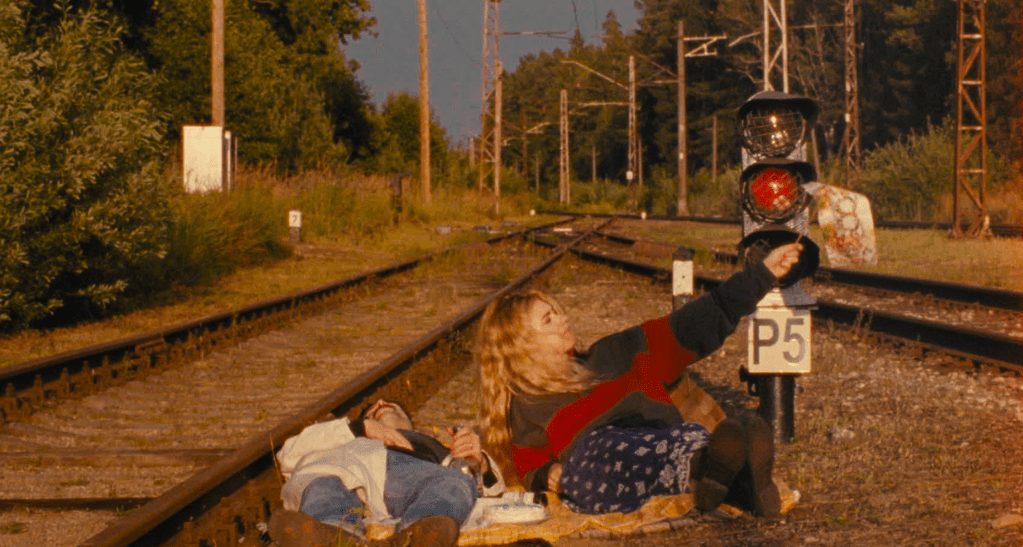
Tom Sturridge and Imogen Poots in The Chronology of Water. All The Chronology of Water imagery by Corey C. Waters/The Forge.
Everything is presented in what feels like a swirl. It evinces Stewart’s filmmaking confidence and stated hatred of pedantic direction. Her image-first formal approach could very easily, but doesn’t, veer into too-indulgent overstylization. Dates are only sometimes alluded to, usually seen on screens and snatches of paper. Many easy-to-Google biographical details must be inferred. Its creation aided by close-up-generous cinematographer Corey C. Waters, whose colors look both blanched and overheated, and editor Olivia Neergaard-Holm, The Chronology of Water’s haziness evokes the effects of alcohol; the out-of-nowhere intrusiveness of bad memories; and, naturally, submergence. Like life’s adversities, water in most cases has to be fought against with varying degrees of effort to not be swallowed. How the element figures in Lidia’s life in the film — at the start more something to successfully conquer and at the end something to soothe and to enjoy — is an obvious metaphor for her decades-long processing of her formative agonies. But the film’s pun-unintended slipperiness makes it not feel that calculated.
Stewart doesn’t sand down the transparency-welcoming Yuknavitch into a more agreeable perfect-victim type — someone who will one day decisively and unrealistically be healed. She correctly trusts that our sympathy will persist even as she’s verbally and, in one seen case, physically abusive to her sweet-natured first husband (Earl Cave) or in a drunken stupor drives and thankfully nonfatally hits a pedestrian.
Fallible humanity foundationally intrigues Stewart more than binaried judgments. Her compassion is given additional dimension by the superb work of the great, consistently underappreciated Poots. I like this flinty recent remark about it from the 1970s B-movie-associated director Allan Arkush: Given to us is “not a performance, but a complete person.” When Stewart was still struggling a few years ago to find financing for The Chronology of Water, she declared, maybe or maybe not jokingly, that she’d quit acting altogether if she couldn’t see her dream project through to fruition. It’s a relief the acting will continue, and that the threat was in service of an eight-years-in-the-making movie that powerfully does justice to a book she appreciated for its focus on “how people see things and not what they see.”

Luka Sabbat and Indya Moore in Father Mother Sister Brother. Photo by Carole Pethuel, courtesy of Vague Notion/MUBI.
Marking writer-director Jim Jarmusch’s return to anthology filmmaking, Father Mother Sister Brother subverts one’s expectations for the family movie, a genre frequently affiliated with talkiness and emotional, long-gestating catharses. Advancing the sardonic, deadpan style that’s become a cornerstone of his five-decade career, Jarmusch’s movie is more drawn in by what isn’t said — the histories responsible for stilted silences and wooden attempts at small talk.
Those histories are indirectly hinted at. The film encompasses three compact short stories, each homing in on a family for whom communication is not a strong suit. Jarmusch’s realist presentation prevents much of what resembles exposition. Dialogue that comes close to it is clipped and stiff. You can feel the weight of what wants to be said, but probably isn’t for the sake of minimizing discomfort, in each carefully chosen word.
In the first tale, two 40-something siblings (Adam Driver and Mayim Bialik) visit their reclusive, rural father (Tom Waits), whom they haven’t seen in two years. They worry about the financial security and loneliness of a man they mention as having always been “crazy” in a charming way and also pretty emotionally disconnected. (A fond memory he offers of their late mother is that she “loved water.”) He doesn’t seem particularly worried about them, though. He feigns interest in the details they offer about their lives and entirely forgets that his son, who’s been sending him money on the sly for things about which he’s maybe not being honest, has been divorced for a few years.

Vicky Krieps, Cate Blanchett, and Charlotte Rampling in Father Mother Sister Brother. Photo by Yorick Le Saux, courtesy of Vague Notion/MUBI.
In the second story, two sisters (Cate Blanchett and Vicky Krieps) meet their novelist mother (Charlotte Rampling) at her expensively filigreed home for an annual, extravagant tea. It’s the only time during the year that they see each other, and on this occasion they proceed, as is probably always the case, to be almost comically unforthcoming. (When they do share anything, it’s lightly and potentially truth-stretchingly boastful.) Is it out of fear that parts of their lives will appear in one of their literarily prolific mother’s books, or is she really that frighteningly judgmental?
And in the third tale, tight-knit twins (Indya Moore and Luka Sabbat) reunite in Paris to take a final look at the vacated apartment of their parents, who died in a strange private plane crash and have, we’ll learn, kept their adoring children in the dark about much of their lives. It isn’t until digging through some left-behind documents, for instance, that the siblings find out where they and their parents were actually born. The discovery of a sham marriage certificate brings to light that this family was chronically on the move, for reasons not gotten into.
Each of Father Mother Sister Brother’s segments is named after one of the familial roles listed in the title. Save for the concluding story, which testifies to how geographical distance can only do so much to hinder a genuine bond, the literalism nods to how much, in dysfunctional families, relationships can be whittled down into nothing more than a blood connection and a label. One could understandably get frustrated, as my boyfriend did, with Father Mother Sister Brother’s guesswork-reliant reserve. I think I also would have if the predisposition of family movies in general was not to be melodramatic and emotionally showy. The novelty of Father Mother Sister Brother, with its true-to-life insistence on pleasantries and soul-damaging internalization, is refreshing, albeit not deeply excavated enough to make it great rather than minor. But its understated, accumulating melancholy still leaves a lasting impression. What would these relationships be like if these characters dropped appearances and used their reunions to say what they really felt?
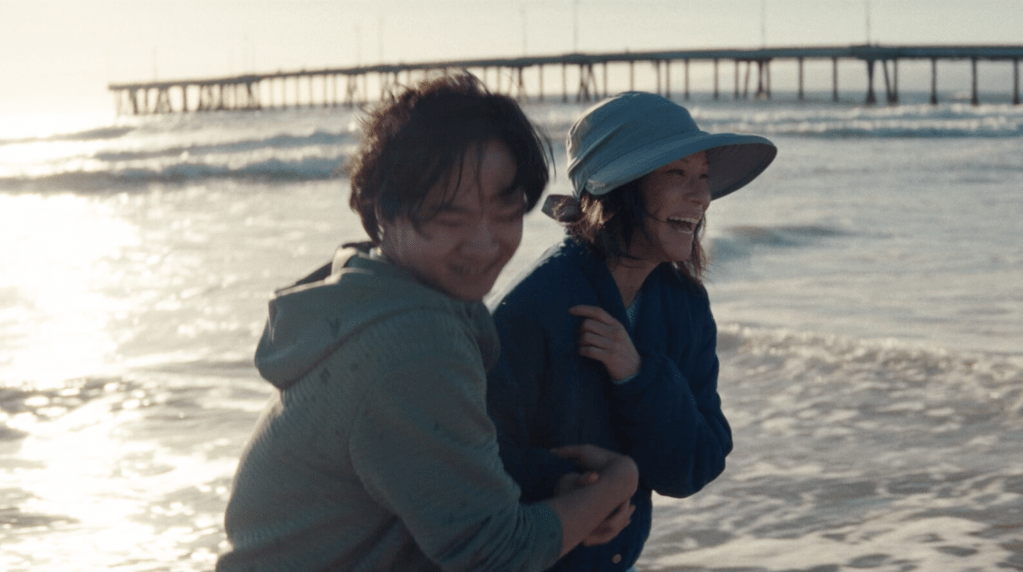
Lawrence Shou and Lucy Liu in Rosemead. Courtesy of Vertical.
I keep seeing reviews that describe Rosemead as “sensitive.” I don’t doubt its empathy for its subjects, especially in the heartbreaking desperation depicted in its devastating final moments. But the descriptor feels a little generous for a well-meaning film that nonetheless often misguidedly applies a race-against-time-thriller framework to its narrative and employs horror-movie aesthetics and music to depict schizophrenia. The movie is most effective in its quieter moments: nostalgic flips through a scrapbook; a funereal birthday party. But its periodic sensationalism gives it Lifetime movie-evoking soapiness that’s hard to shake off.
Rosemead, written by Marilyn Fu and Eric Lin, is based on a tragic true story. In the summer of 2015, a terminally ill widow with good reason to believe that her schizophrenic, 17-going-on-18-year-old son was going to carry out a mass shooting fatally gunned him down while he slept. The mother, Irene, is played by a very good Lucy Liu, a stupefyingly underrated actress who seldom gets roles of this one’s seriousness. The son, Joe, is portrayed by Lawrence Shou, whose performance mostly stays at an unsettling simmer.
More guided by its narrative and thematic imperatives than meaningful engagement with its characters’ subjectivity, Rosemead has a certain PSA-like frankness, bent on clearly telegraphing how social stigma and limitations in resources could lead the main character to enact such a shocking act of violence. Seeming close to casting her out, the closely bonded immigrant community of which Irene is a part doesn’t offer much real emotional support for what she’s going through. She’s side-eyed for hesitantly enrolling her son in therapy — a tool characterized as something strictly for “foreigners” — and even her most supportive friend earnestly posits that Joe has been taken over by a malevolent force.
And though psychiatric help is a boon, the already-skeptical Irene doesn’t have much faith that it can stop Joe’s worrying obsession with mass shootings and its attendant gun-store visits, ominous social-media posts, and disturbing-drawing-cluttered notebooks. Certain that being honest about her sickness — which follows her husband’s recent illness-related death — will speed up Joe’s unraveling, she believes her ultimate life-ending decision will be the best way to protect both her child and the people he might harm.
Fu smartly avoids a trope regularly seen in true crime-based drama: clarifying, at the start, where everything will lead. If you don’t know the story Rosemead is dramatizing beforehand, you wouldn’t assume where it’ll end up, even if its foreshadowing is not, in retrospect, that subtle. Liu is worrisomely coughing almost immediately. Unhelpful interactions with friends and acquaintances are almost one-after-the-other defeating. Despite some of its aforementioned sensationalism, keeping the climax unexpected and focusing on Irene’s torment encapsulates the film’s considerate commitment not to villainize. For all its presentational flubs, Rosemead persuasively elicits the feeling of being at the end of one’s rope.
 Peterson Reviews