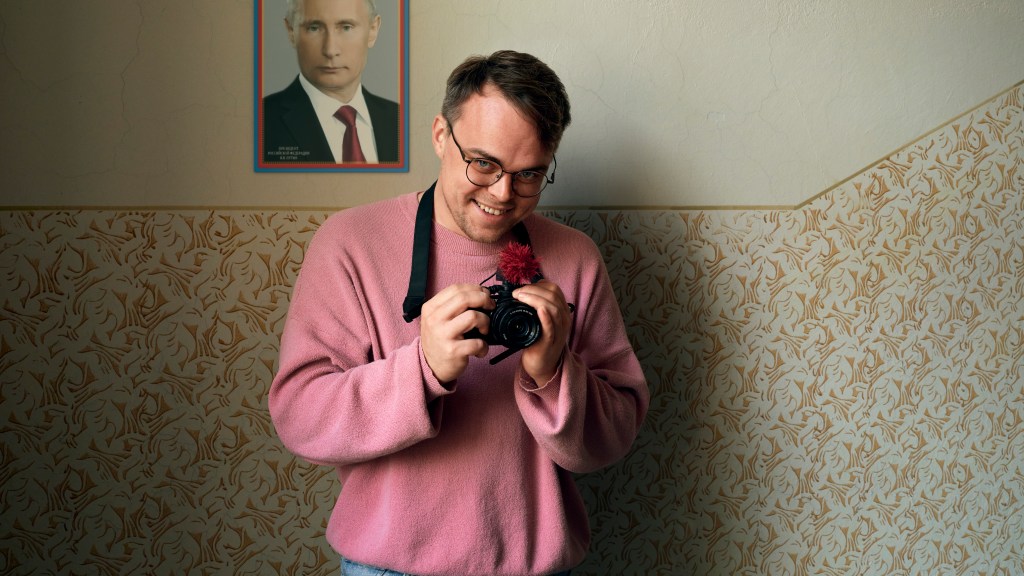
“Love for your country means saying ‘we have a problem,’” Pavel “Pasha” Talankin concludes partway through Mr. Nobody Against Putin, a film-length manifestation of the sentiment. Concentrating on the extreme free-speech crackdowns in Russia after its government’s February 2022 invasion of Ukraine, the documentary is a first-person account from someone whose perspective hasn’t been highlighted much by the frontlines-preferring Western media. Talankin — a progressive born and raised in the tiny, infamously factory-polluted, and near-permanently snowed-in Karabash — held videographer and event-coordinator jobs at the school where he also got his early education. His once-enjoyable gig became nightmarish when, immediately following the Russo-Ukrainian War’s start, the school’s teachers were forced by President Vladimir Putin’s administration to teach war-supporting, state-scripted lessons. Talakin was ordered to film them for compliance-checking purposes and obediently upload them to a shadowy server.
Functioning like a log of what he saw after the shift, Mr. Nobody Against Putin doesn’t imply Russia was a bastion of free speech before the 2022 invasion — more that small towns like Karabash had had more freedom to set their own educational agendas without the same overwhelming fear of reprisal. (Talankin laments in the film that the sort of propaganda-heavy lessons he nauseously observes are jarringly out of step with anything he experienced in the classroom when he was growing up; in passing we see several fellow educators, including the school’s principal, vent in his office about how the onslaught of governmentally mandated “curricula” has made it nearly impossible to have time in the day to do anything resembling teaching.) Not wanting to continue being little more than a puppet for a corrupt regime, Talankin decided a few months into his newly overhauled job to resign. He was persuaded to stay after virtually connecting with the Copenhagen-based American filmmaker David Borenstein, who encouraged him to obtain footage for the purpose of what eventually became Mr. Nobody Against Putin, for which each man gets a co-director credit.
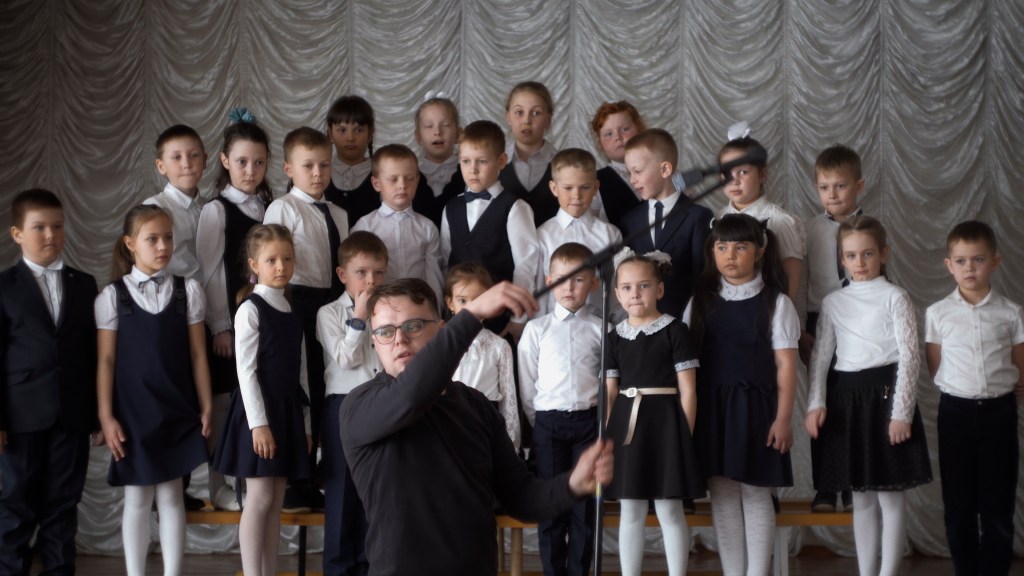
Pavel “Pasha” Talankin in Mr. Nobody Against Putin. Courtesy of Talankin. Header image by František Svatoš.
Borenstein and the film’s producers helped Talankin flee Russia in the summer of 2024, the night after that year’s graduation. Love for his students as much keeps him in Karabash as the project’s obligations. He’s heartbroken, at an accelerating rate, to see sensitive kids either gradually become uncritically more pro-war or reticent to open up to him about their dismay about what’s going on. School days are increasingly interrupted by jingoistic pageantry: assemblies headed by weapons-toting soldiers; grenade-throwing practice sessions (and attendant skills-commending awards); morning-starting marches singing Putin’s praises. Most enthusiastic among the staff is a history teacher and state apologist who, in one of the movie’s most casually horrifying moments, exclusively names well-documentedly bloodlusting Stalin cronies when asked by Talankin which dead historical icons he’d like to meet most. He earnestly says afterward that he hopes his students will one day recall him being “a fun person.”
Once a go-to among many members of the student body to freely discuss their frustrations with the world, Talankin’s office, amply decorated with pro-democracy iconography, becomes less and less visited as the war drags on. How couldn’t it, especially after Putin’s April 2023 signing of legislation greenlighting life-imprisonment for treason, a move patently designed to subdue even the faintest whispers of criticism? There’s close to no one around town to meaningfully talk with about his anxieties — not even his dour mother, who works as the school’s librarian and tells him that he should turn his brain on. To temporarily calm his pent-up frustrations, Talankin starts giving sounding board-style confessionals to a camera in his book-packed two-bedroom apartment, where his only company is his indifferent pets. Talankin isn’t, besides the similarly bewildered teachers seen onscreen, entirely without allies in Karabash, though — several moments in the film see him trailed from behind by someone brandishing a separate camera, for instance — but as an ostensible act of protection, those on his side who presumably haven’t left their shared homeland are kept anonymous.
For a movie so thoroughly unfurling from a first-person vantage, its central figure reveals few details about himself. We don’t learn much about what foundationally transformed Talankin into a reluctant voice of opposition. (I most wanted to know if he could remember the moment when he started to doubt his town’s political ideologies du jour and the moment he realized his newfound inklings had become irreversible convictions.) And though vague references to his lifelong outsiderdom insinuate queerness, that part of his identity isn’t deeply probed, either. More of a testament to how immediately war can more broadly upend a life, Mr. Nobody Against Putin can feel paradoxical. It’s a work of personal filmmaking with a diaristic slant that tells you far more about the societal and cultural conditions in which it’s been made than the person proffered as a main character.
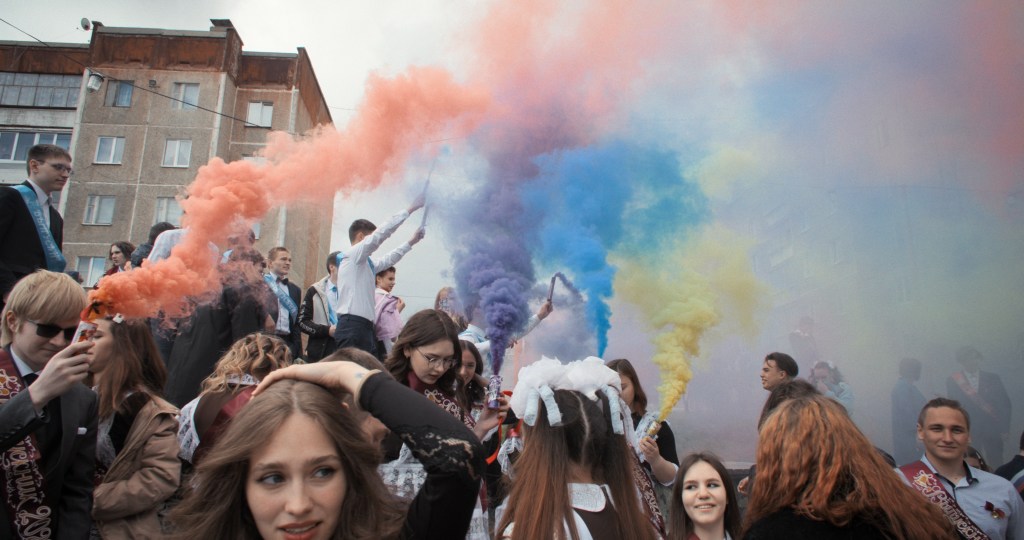
From Mr. Nobody Against Putin. Courtesy of Pavel “Pasha” Talankin.
Talankin eventually develops a reputation around Karabash for his dissent. He’ll variously make it clear by insubordinately blasting the American national anthem, as sung by Lady Gaga, on the school’s speakers; climbing atop the institution’s roof to take down its flag; and replacing the big Zs taped to street-facing windows with Xs. (The Zs signify war support; the Xs, in contrast, broadcast sympathy for Ukrainians.) It’s when he starts noticing police cars outside of his apartment building that Talankin begins seriously thinking that he might need to leave.
Early on in Mr. Nobody Against Putin, Talankin says he regrets not being as brave as the particularly confrontational protestors participating in bigger cities’ anti-war demonstrations. It’s a declaration that comes across, as the movie progresses, as almost preposterously modest from someone who had to carefully decamp from their country, pessimistic about his chances of returning, to transmit the truth. During a moment of fleeting peace the evening before he leaves, Talankin swears he can almost smell the clean mountain air through the town’s poisonous fumes.
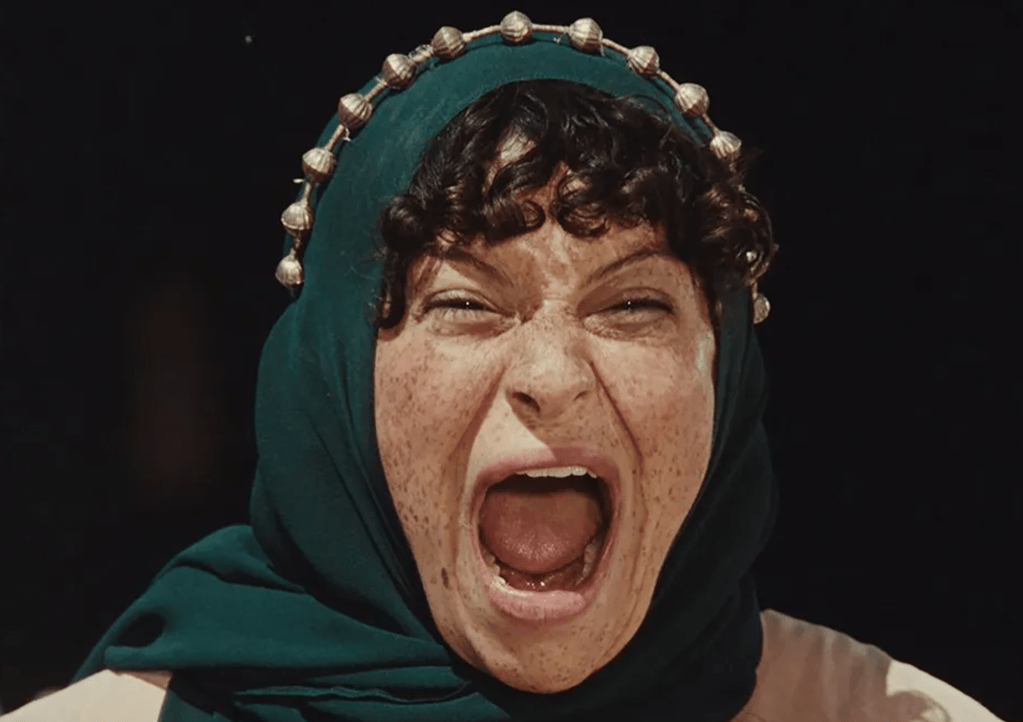
Alia Shawkat in Atropia. Courtesy of Vertical.
In an ideal world, Hailey Gates’ feature-directing debut, the 2006-set Atropia, would have been a documentary. After learning that the U.S. military had constructed a made-up country in the Mojave desert comprising “villages” bedecked in remote-controlled explosives and populated with costumed actors to serve as preparation sites for to-be-deployed soldiers, the onetime Vice journalist wanted to investigate and present what she found. She spent a little time trying to get in the good graces of what was then called the Department of Defense for a closer look. Since the access she sought didn’t ultimately seem feasible, making a satirical comedy inspired by Robert Altman’s M*A*S*H (1970) struck her as a worthwhile compromise.
I say that Atropia would have been a documentary in an ideal world because the final product is far less interesting than what real-life footage might have hypothetically caught. Gates, who also wrote the movie, well enough captures the malevolent absurdity of simulated war, where disoriented and clumsy soldiers practice the dos and don’ts of country-conquering and learn to see people and their cultures mostly as props before arriving at the destructive real thing. But she comes up short in doing more than monotonously pointing that absurdity out.
As the laboring-to-be-farcical action moves around the faux hamlet Atropia is set in, Gates proves better at lampooning the self-deceiving seriousness with which actors can take themselves. Her main character is a pregnant performer, Fayruz (Alia Shawkat), of Iraqi heritage who’s being dishonest about her family history to needlessly convince others of her artistic credibility and who pressures her fellow simulation-enforcing actors to treat their risible, imperialistically complicit work as important. Better than the film itself, Shawkat is clearly having fun playing a woman high on her own delusional self-importance. You also never get that firm of a hold on the character, even if one could argue that that’s part of the point.
Atropia’s initial, already not-that-convincing friskiness is further deadened when more of the narrative orients itself around a romance that blossoms between Fayruz and a fellow actor (an appealingly scruffy Callum Turner). He was once enlisted; he’s hoping to redeploy. The movie’s glib, pleased-with-itself tone, relished on a premise expanded on by mostly stating the obvious and dishing out limp jokes and sight gags, makes it close to impossible to care about where things will lead between them. To watch Atropia, a flimsy movie you can tell was shot in fewer than three weeks, is to endure it.
 Peterson Reviews