
At a bar one evening, 20-something Colin (Harry Melling) makes the obvious choice. Should he pursue a second date with the bland guy in an “Alexa, Free Britney” T-shirt his mom has blindly set him up with, or should he see what the hottie who discreetly slips him a hookup-inviting note (Alexander Skarsgård) at the counter is all about?
The strapping, almost freakishly handsome second (and selected) option is named Ray, lives in a Patrick Bateman-spare townhouse, and is part of a gay motorcycle club whose members are all in BDSM relationships. Ray, it turns out, saw sub potential in the meek Colin, who’s a regularly spat-at meter maid by day and a barbershop-quartet member by night. The instinct proves correct. During their first rendezvous, the latter unhesitantly licks off the dirt caking Ray’s leather boots and powers through some gag reflex-testing oral in a grimy alleyway. “What am I gonna do with you?” Ray wonders, to which Colin softly replies with puppy eyes, “Whatever you want.”
Pillion, adapted from Adam Mars-Jones’ Box Hill (2020) by debuting writer-director Harry Lighton, sees a new arrangement crystallize soon thereafter. Colin will spend most of his time at Ray’s house, where he’s tasked with cooking and cleaning and never gets to hang his coat up, sit on the living-room couch (the empty space is reserved for Ray’s muscular Rottweiler), or sleep in the bed. His obedience will be sexually rewarded but always on Ray’s terms, which never involve kissing or the strain of missionary-style intimacy Colin is tight-lipped about wanting. Colin’s doting parents (Douglas Hodge and a movingly tender Lesley Sharp), whom he continues to live with into adulthood, worry about the relationship, about which they know little but can anxiously tell requires a level of self-minimizing devotion missing from a conventionally healthy relationship. Colin, though, is invigorated, and finds community in the biker-gang crew of which Ray is a part.

Alexander Skarsgård and Harry Melling in Pillion. All Pillion imagery courtesy of A24.
It’s a shame, then, that Lighton strangely confines almost all of Colin’s interactions with his new milieu to convenient montage — the only member we know by name is fellow sub Kevin, probably only because he’s played by Scissor Sisters co-frontman Jake Shears — and that there’s so much tacit pity for the exaggeratedly feeble Colin in the writing that he feels first like a sympathetically frowned-at “poor thing,” then a person. Colin and Ray’s respective emotional caginess rings true, though. You can feel all their years of self-understanding — Colin seeing himself as powerless and Ray long accustomed to the authority inherent in his preferred role-playing dynamic — in Melling and Skarsgård’s committed work more than you can the writing. (It’s probably for the best, however, that there arrives no moment where each man ham-fistedly explains themselves and their desires.)
Though it alters some features of the original text — namely transposing the late-1970s setting to contemporary times — Pillion is blessedly free of overtly normie-pandering narrative developments by way of its revisions. Real feelings don’t usurp the relationship’s agreed-upon degradations for something more comfortably ordinary. There’s no underlying feeling that Lighton is goggling at rather than seriously looking at a dynamic that’s common in life but exotic in mainstream cinema, inching toward a conclusion that it’s impossible to find happiness or gratification in a relationship like it. The movie’s closest example of ethos-affirming exposition is couched in some dismay from Colin’s mother. Ray correctly reminds her, amid her fretting, that her concern does not innately make something that’s been assented to wrong.
Pillion is sexually frank, pierced-dick flashes and all, albeit in a way I’d argue could stand to go further — antagonize more discomfort and, by the same token, erotic charge. But perhaps wanting to see even more extremeness is symptomatic of the fundamental distance Pillion maintains that makes it easier to respect than feel much affection for. With its characters’ personal and inner lives so cursorily rendered, you might look for that deficit of dramatic and visceral pulling elsewhere. At least it nails the ending — a shockingly (and, it transpires, deceptively) sweet bait-and-switch that would be a lot more devastating if it didn’t act as a conduit for slightly mawkish but nevertheless earned self-discovery.
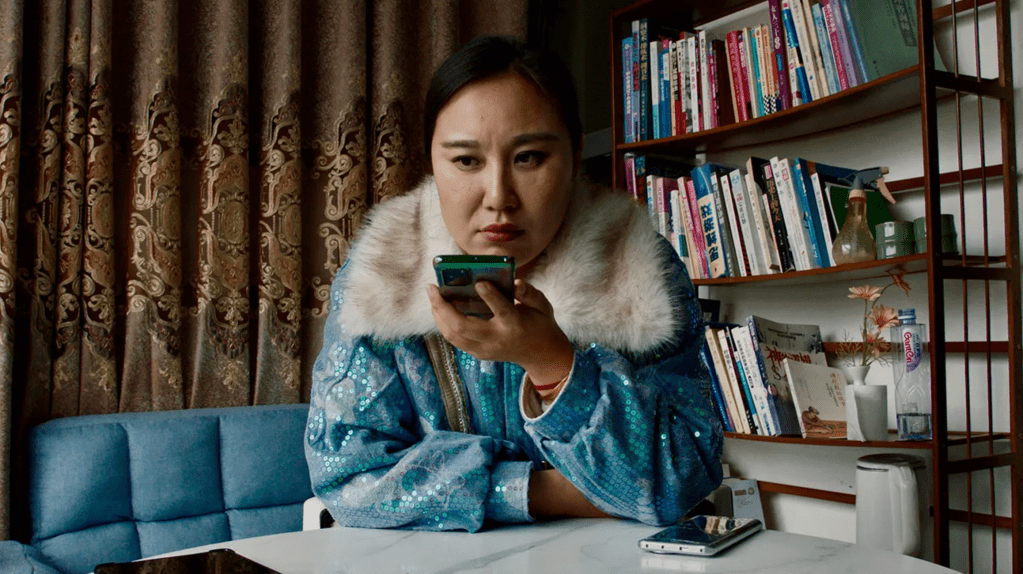
Wang Zhenxi in Mistress Dispeller. Courtesy of Oscilloscope Laboratories.
Mistress Dispeller is the sort of documentary with a level of access that persistently leaves you a little dumbfounded. Its subjects are not public figures with images to maintain but private citizens with a lot more to lose than gain from participating: A middle-aged married couple and the husband’s younger mistress, whom he’s been seeing for about a year. The film, directed by Elizabeth Lo, documents the work on one particular case pursued by a “mistress dispeller.” Often turned to in China, the occupation entails its called-in expert ingratiate themselves into an infidelity-stained relationship and then find a way to gently but effectively oust the other woman or man. Mistress’ dispeller is named Wang Zhenxi, a cool-headed professional while she plans but invitingly open-hearted when she is, so to speak, in the field. Planting little manipulations to help her subjects, in a sense, figure out their problems on their own, she’s been hired by the wife to put an end to her husband’s cheating. It’s being exercised on a woman who openly admits to preferring unavailable men because they’re less intimidating, kind of like an easy-to-forgive brother on whom you know you can’t rely.
Lo’s shooting and Charlotte Munch Bengsten’s editing were supremely cautious, assiduous not to betray the trust of the film’s participants. Lo repeatedly set down cameras Chantal Akerman-style and left the room so that her subjects could converse in artificial solitude. Moments were scissored from the final cut that were thought to be unnecessarily intrusive. But her careful compassion doesn’t come at the cost of revelatory candor — insights on how difficult it can become to directly communicate in a decades-long marriage and how affairs are so frequently a byproduct of bone-deep loneliness. Even when initially under the guise of a long-lost cousin to better cultivate trust, it’s no wonder the movie’s eponymous professional can get everyone involved to reveal so much about themselves and their frustrations without that much goading. They want to be understood — for the situation’s untenability to change, hopefully in their favor.
 Peterson Reviews