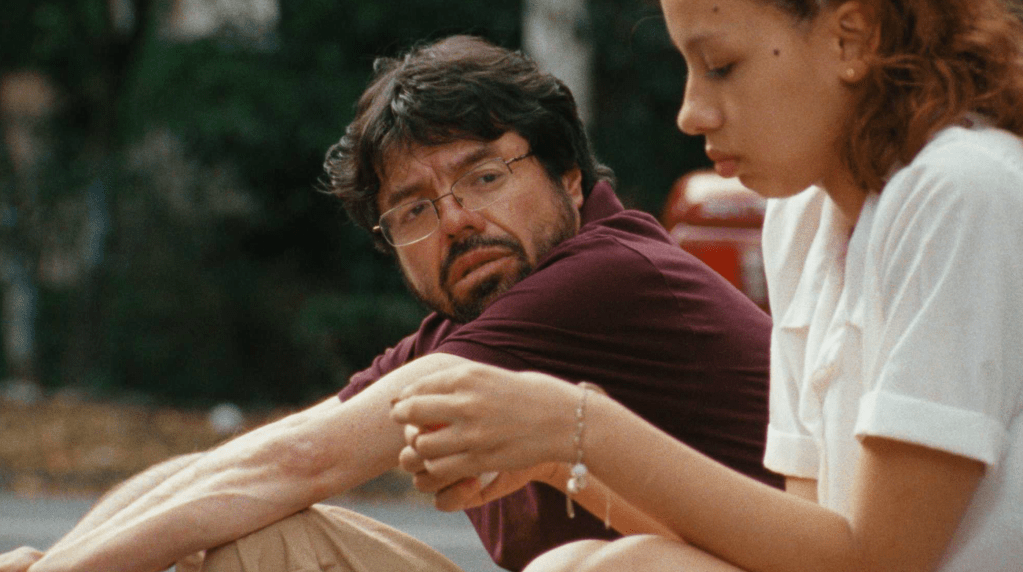
Oscar (Ubeimar Rios), the failed-bard protagonist of writer-director Simón Mesa Soto’s A Poet, is introduced to us as such a comically pathetic fuck-up that it takes you by surprise when he turns out to be fundamentally decent and good-hearted when he’s not wallowing in alcohol-addled self-pity. This 50-something artist manqué still lives with his elderly mother (Margita Soto), whose small pension he leeches off of. He’s basically estranged from his ex and their teenage daughter (Alisson Correa), who’re both sick of despicable behavior that includes asking the latter for money nearly every time he sees her. And because he thinks it would muddy his creative purity, Oscar hasn’t pursued a job in years despite having only a pair of decades-old, barely bought collections to his name. (When he does finally get a lecturing gig at a high school, he spends his first day sloshed and stumbling, his laughed-at instruction as incomprehensibly purple as his prose.)
A Poet feels like a Colombian relative of a Safdie movie. There’s its narrative, shaped by stressfully poor decision-making that seems impossible to wriggle out of. There’s also Juan Sarmiento G.’s shaky, guerilla documentary crew-like cinematography, which echoes the work of Safdie collaborators Sean Price Williams and Darius Khondji down to its flair for hilariously packaging absurd, antic mises en scène. And though squat, square-headed first-time actor Rios is less conventionally easy on the eyes than Safdie leading men like Timothée Chalamet, Robert Pattinson, and Adam Sandler (all of whom were at least done up to look unappealingly sleazy), he carries over the filmmakers’ yen for weathered, everyday faces that also happen to have a lot of character. Rios’ defining feature is a boyish, crooked smile whose every flash endears you to him a little more.
Moaning-prone Oscar’s ostentatious suffering is darkly funny. He’s dead serious when he laments that he should have killed himself at 30 so that he’d be among the crop of artists whose premature death inflated interest in their work. It also always feels genuine: Soto makes fun of his anti-hero while rooting for him, too. It’s clear that Oscar’s creativity and kindness have been drowned out by his drinking, which has long encouraged his self-hatred, shamelessness, and inability to take any real accountability.
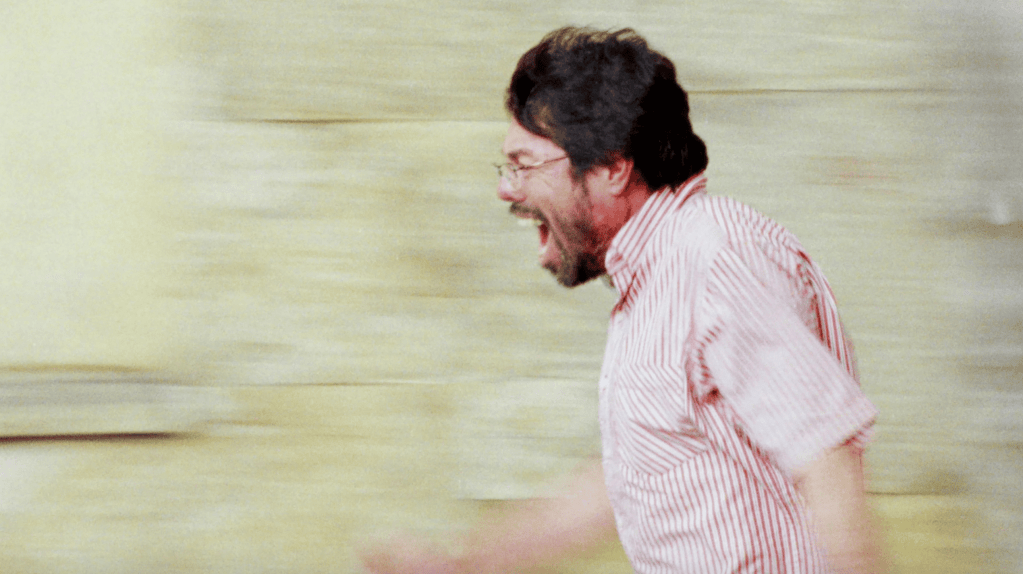
Ubeimar Rios in A Poet. All imagery courtesy of 1-2 Special.
That aforementioned lecturing job brings out his redeeming qualities. Through it he meets Yurlady (Rebeca Andrade), a lower-class introvert whose notebook brims with stunning drawings and softly profound poems. Yurlady doesn’t have literary aspirations. She sees herself in adulthood as a hair stylist or manicurist — something indicated by her meticulously long and sparkly talons — and is perfectly content using her private art solely as a cathartic means of self-expression. But Oscar, who believes in her enough to stop pouring liquor into his morning coffee, sees Yurlady as a next-big-thing figure in the poetry world. He sets himself up as an unsolicited mentor, his efforts ideally culminating in an appearance at a local poetry festival whose organizing nonprofit treats him similarly to a family’s patiently-put-up-with black sheep. He plies her with meals out and fancy dresses and bottles of nail polish she’d been saving up for to distract her from complete indifference.
Oscar’s film-opening pitifulness initially makes you expect the worst of him. (The moment he discovered Yurlady’s gel-penned body of work, I felt certain he’d try to swipe it and pass it off as his own, weaponizing her blue-collar upbringing as a reason not to believe her if she publicly tried to stand up for herself.) So it becomes touching that he finds purpose again in his miserable life simply by seeing promise in someone else and wanting to boost what she can’t see in herself. This self-appointed avuncular role is still prickly, though. He doesn’t ask the bemused Yurlady nearly often enough how much she truly wants to be doing any of this. His zeal has strong whiffs of classist condescension — notions that he’s trying to rescue her from a hypothetical fate he thinks is beneath her.
A Poet makes you half-anticipate a traditional salvation story while instinctively knowing that it won’t go there. Its humor is too itchy, dizzy with dread. You’re pestered, after a while, by the feeling that Oscar is starting to realize that this all hasn’t been a good idea — that pursuing poetry in a professional capacity, rather than happily doing it just for oneself, is indirectly responsible for his debilitating arrested development and that he’s pushing Yurlady into an apparatus he knows can be destructive. Everything going downhill feels inevitable once the descent arrives — it’s kicked off by a drunken set piece that relies too much on Andrade’s fatness as itself a joke — though the movie’s tone doesn’t necessarily become darker. It solidifies; it feels more fully realized. The movie’s tragicomic aims might be more appreciated in hindsight, when everything, including its emotional and unexpectedly hopeful last few minutes, has clicked into place. Until then, A Poet’s chaotic turns are exquisitely uncomfortable.
 Peterson Reviews