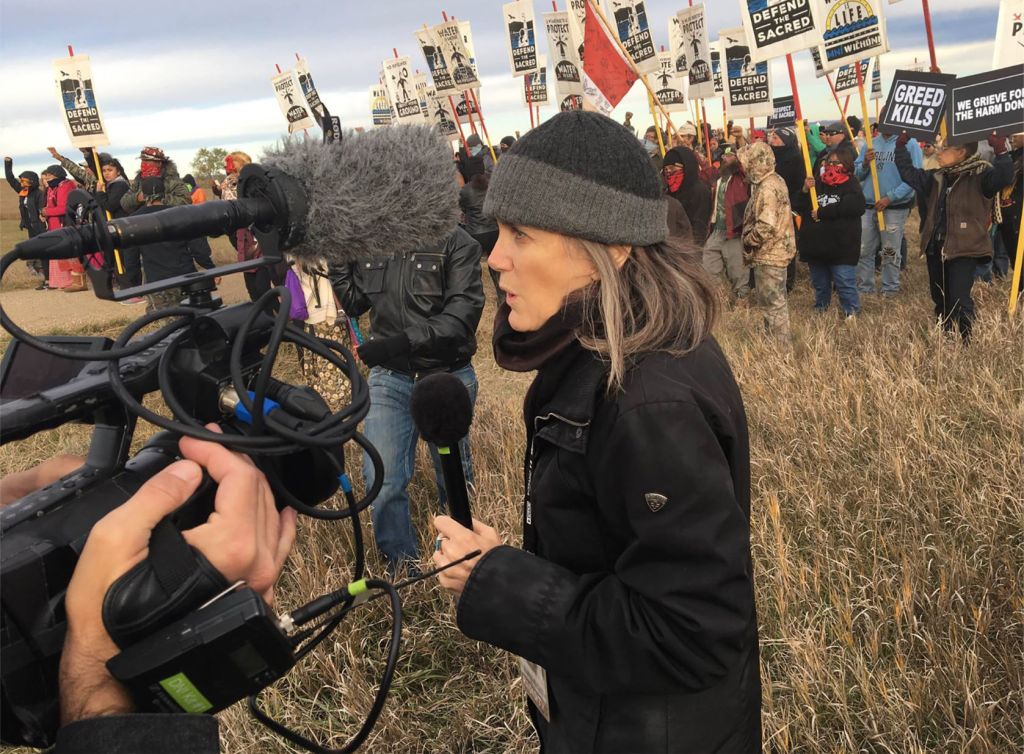
The name of the new documentary Steal This Story, Please! comes from its reporter-activist subject Amy Goodman’s embrace of what she wryly calls “trickle-up journalism.” The host of the independent, progressive news show Democracy Now! isn’t precious about her hard-hitting, often life-riskingly reported scoops. She wants them to seize enough attention so that the mainstream media, whose built-in acquiescence to corporate and governmental pressure she detests, has almost no other choice but to aggregate and potentially build on what she first put a spotlight on, whether it’s Indonesia-inflicted atrocities on East Timor’s populace or the wrongful imprisonment of a Black Louisianan who’d self-defensively killed two KKK-affiliated police officers.
The refrain that will inevitably and not incorrectly be applied a lot to Steal This Story, Please! is that it couldn’t have come at a better time. Its release arriving a little over a month after Democracy Now!’s nine-station debut 30 years ago (it’s now broadcast on around 1,500 radio and TV channels), Steal This Story, Please! on the one hand rousingly functions as an anniversary-celebration-style retrospective. It runs through the litany of major stories and incidents that have defined Democracy Now!’s uncompromising three decades, which have always placed more value on the experience of the everyman than the man at the top. It regularly exemplifies Goodman’s sometimes stupefying fearlessness, regularly contained in just a few words through the unflappable bluntness of her interviewing style. (The movie begins with her doggedly following question-ignoring Trump crony Wells Griffith up and down the 2018 Climate Conference, though for her that seems like light work compared to sneaking into Chevron’s Nigerian headquarters in the ’90s so that she could confront, her recording device on, an executive complicit in the murders of local dissidents, or challenging law enforcement at her own expense at anti-Iraq war and North Dakota access pipeline demonstrations.)
With Trump’s continuing undermining of the press and the corporate appeasement that has followed suit, Steal This Story, Please! also doesn’t just renew the case for press freedom writ large but also underlines the ongoing vitality of the work Democracy Now! does. You never have to worry about it acceding to outside interests or trying to make its work more pleasant to a wider audience. Its very founding in 1996, around the time of the Telecommunications Act’s signing into law, aimed to be a corrective to all that. If one does worry about the show, it’s likely to have more to do with an increasingly difficult time accessing prominent public figures or the general well-being of the people who put together its mixture of domestic and global stories in the face of the incessant belligerence of Trump, his administration, and the legions of people following their lead.
Directed by Tia Lessin and Carl Guest, who have sometimes guested on Democracy Now! for their documentary work, Steal This Story, Please! provides some requisite background on Goodman that deepens one’s natural appreciation of her. She was raised in a Jewish, Eastern Europe-descended household in Long Island whose familiarity with persecution and governmental corrosiveness instilled in her from a young age profound moral certitude. Her own penchant for journalism was kicked up early on when her baby brother started a passionately-worked-on family newspaper, then nurtured further by leadership roles at her high school’s student-run outlet. (She was determined post-college to produce The Phil Donahue Show — she loved its keenness to engage with hot-button issues despite its weakness for sensationalism — though the silver lining of that not working out was that it helped set her on a path toward radio.) But Steal This Story, Please! is less a profile of Goodman as she is outside of her job than an appreciative, thoughtful appraisal of her life’s work — a cumulation of showing things honestly and looking at people as they are.
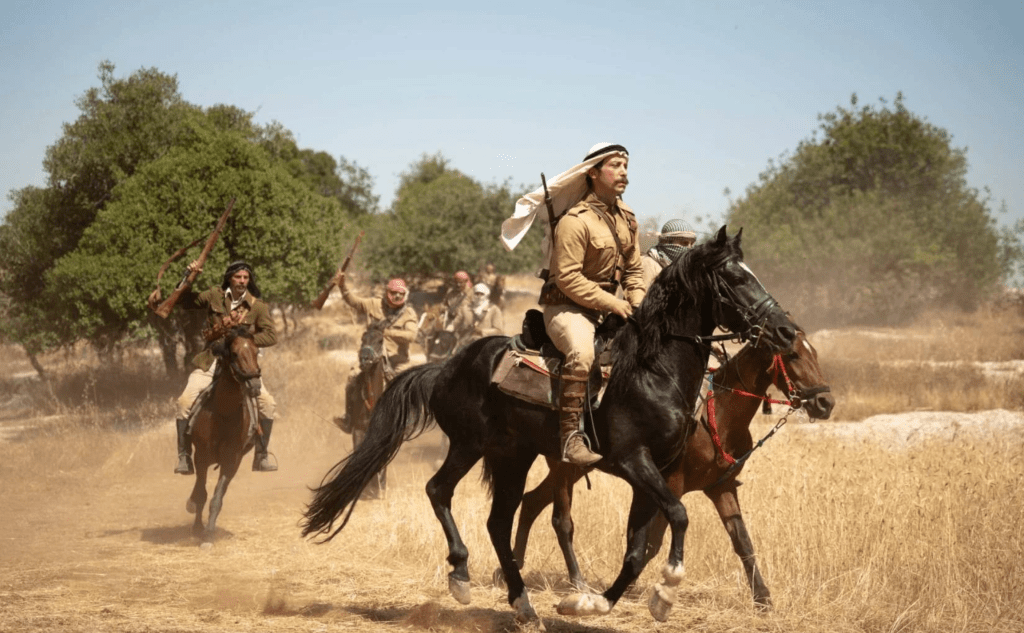
From Palestine 36. Courtesy of Curzon Film. Header image is of Amy Goodman covering the Standing Rock oil pipeline protest, October 2016. Courtesy of Reed Brody.
Palestinian filmmaker Annemarie Jacir’s father was born in 1936, though that’s not the only reason she sees the year as something of an origin point. That April, Palestinian Arabs rose up, en masse, against their country’s British occupiers and the displacement-causing Zionist settling it propped up — a violent, unequally manpowered conflict whose consequences still reverberate today. Jacir’s new movie, the matter-of-factly named Palestine 36, dramatizes with careful aesthetic detail and to great emotional effect the first few months of the revolt almost entirely from the vantage of Palestinian civilians. Outside of a handful of malicious-to-conflicted British officials to drill in the day-to-day perniciousness of colonialism, she keeps governmental figures largely to the periphery.
Interludes featuring restored, colorized news footage from the period remind you how little distance there really is between the past and present, not just temporally but as it relates to the crux of the struggle itself. Palestine 36 has a large, excellent ensemble, encompassing characters who decide to join the rebellion; everyday citizens just trying to survive; members of the bourgeoisie soon-to-be-regretfully open to colluding with the British for potential financial gain; and more. Jacir doesn’t utilize everybody as substantially as one might like: The great Saleh Bakri and Hiam Abbass, for instance, appear to have originally had bigger parts that were trimmed in the editing room. But the movie never remaining for too long on a single perspective is also one of its strengths. Part of the movie’s impetus was to do justice to and elevate Palestinian voices. The film’s variety of experiences underscores the humanity of people seen as expendable by more powerful forces and often reduced to a projected-upon monolith by the wider world.
Jacir fought to shoot as much of Palestine 36 as possible on location — production started not long after the Oct. 7, 2023, attacks, making scheduling and safety logistically difficult — and her passionate tenacity can be felt in a movie that mournfully eulogizes Palestinian endurance in the face of constant dehumanization. “It was something to keep hope,” Racin said in a recent interview with Reverse Shot of her movie’s making, “and a way to insist that we will try to do what we set out to do, no matter what.”
 Peterson Reviews