The other day I was listening to the Pop Pantheon podcast’s insightful recent series on Whitney Houston. On the subject of her early career, its host made an interesting point: that much of the joy of her music, especially on her prom queen of soul-era first couple of albums, came from a sense that she took more pleasure, and found more of an emotional pull, in her own musical abilities than her songs’ topics. It didn’t really matter if she actually wanted to dance with somebody who loved her — to know for sure what it felt like to be head over heels for someone. It mattered that she was having an infectiously great time perfectly executing the style of vocal acrobatics that can only confer world-stopping importance on everyday desires.
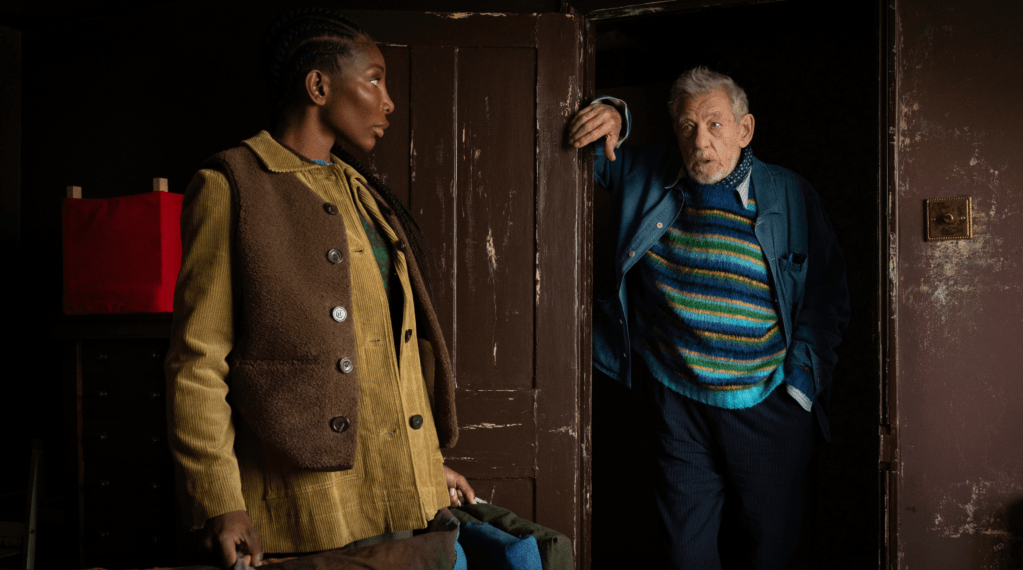
A version of this observation came to mind while watching Ian McKellen in The Christophers, the indefatigable, genre-hopscotching Steven Soderbergh’s seventh movie of the 2020s. The 86-year-old actor, who hasn’t lately agreed to many comparably meaty movie roles, gives a characteristically excellent performance as a mercurial, lightly grouchy painter. Part of the fun of watching it is the feeling that McKellen is having the time of his life deducing on the fly when to bug his eyes for emphasis, suddenly quicken his age-slowed gait with a burst of enthusiasm, give extra volume to a sudden and uncontrollable fit of laughter. I’m hard-pressed to think of another recent film performance — much less from someone doing this as long as McKellen — where the work isn’t just good, but you watch the actor and can almost tangibly feel their affection for their art. You love to watch McKellen in part because he clearly loves what he’s doing.
McKellen’s still-strong zeal for his chosen profession is at odds with the man he plays in The Christophers. Julian Sklar, the kind of artist whose works sell for millions, has become a recluse. He hasn’t finished anything in 20 years and thinks anything produced in the 10 before that is better left undiscussed. A rare disease has all but ensured his imminent death; he bides his handful of days left and lines his pockets by endlessly making Cameo videos for his fans on the third floor of his cluttered and capacious London flat.

Ian McKellen in The Christophers. This and header image courtesy of Neon.
Desperate to suck up as much of his money as possible before it’s too late, Julian’s talentless, greedy children (James Corden and Jessica Gunning) — who don’t expect they’ll get anything very substantial, if anything at all, in their father’s will — hire a painter and art-restoration specialist, Lori (a magnetic Michaela Coel), to do what amounts to forgery. They’ll get her an assistant job with their father. Then she will, with her newfound close proximity, finish the final few, and for-now unfinished, works of a fabled series of portraits of an old lover the movie is named after.
Lori would be more ethically hesitant in another similar scenario. But a formative run-in with Julian that made her subsequently too fearful to publicly exhibit her paintings makes this all sound like an appealing act of vengeance. She’d make good money off someone who derailed her promising career. Pulling it off would also likely imbue her with some much-needed life-changing confidence. She has, since that years-ago experience with Julian, taken to sporadic arts-criticism gigs — one of which entailed a scathing essay on the latter — and completely private creation, making ends meet in her off hours by manning a Chinese food truck.
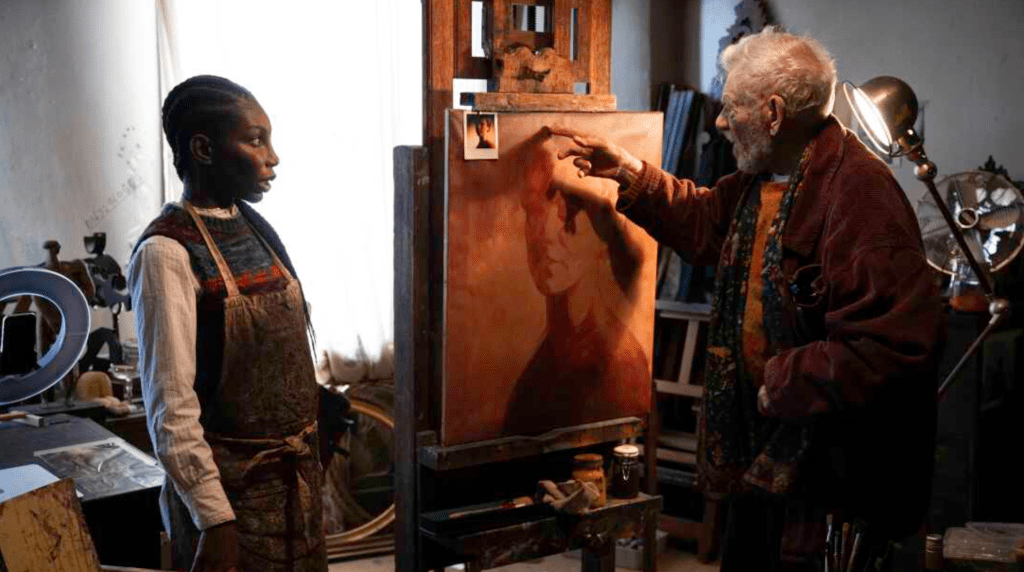
Michaela Coel and Ian McKellen in The Christophers. Courtesy of Claudette Barius/Neon.
The Christophers’ screenwriter, Ed Solomon, and Soderbergh’s own gravitation to the genre set you up to expect something like a heist movie: a lot of suspenseful sneaking around, maybe a climactic sequence at an auction where we tense up over whether Lori and co.’s deceptions will be revealed. But Julian is too quick-witted for typical con-movie games to last. (You know they’re over the moment he coolly reminds Lori “never to underestimate the internet powers of a man who’s spent decades Googling himself.”)
The Christophers thereafter becomes a low-key, touching-but-not-mawkish character study where Lori leverages this tetchy relationship to tend to her old wounds and where Julian gets closer to figuring out why he hasn’t been able to finish his Christophers series or, at minimum, put a paintbrush to a canvas. (The film knows how artistically inhibiting grief, even when not borne of death, can be; sometimes pain is too immense to be straightforwardly worked through and released.) I like how Coel and McKellen’s rapport always remains slippery, fracturing when you expect it to take a conventionally tender turn. The ending feels less like closure than something only proximate to it.
The Christophers’ fascination with and care toward the fickle artistic process — as well as the moments that openly show its artist main characters struggling financially — makes Soderbergh’s recent defenses of generative AI (and his copping to using it in an upcoming project) particularly disheartening. Even if he’s made a point in recent years to embrace technology that would otherwise seem cinematically off limits — recurrently shooting projects with fleets of iPhones being the most famous example — he seems smart enough to know when something ought to be totally off limits. But maybe, to paraphrase Coleman Spilde in a recent Salon essay, The Christophers’ take on a creator losing his touch is apt in a way it didn’t intend.
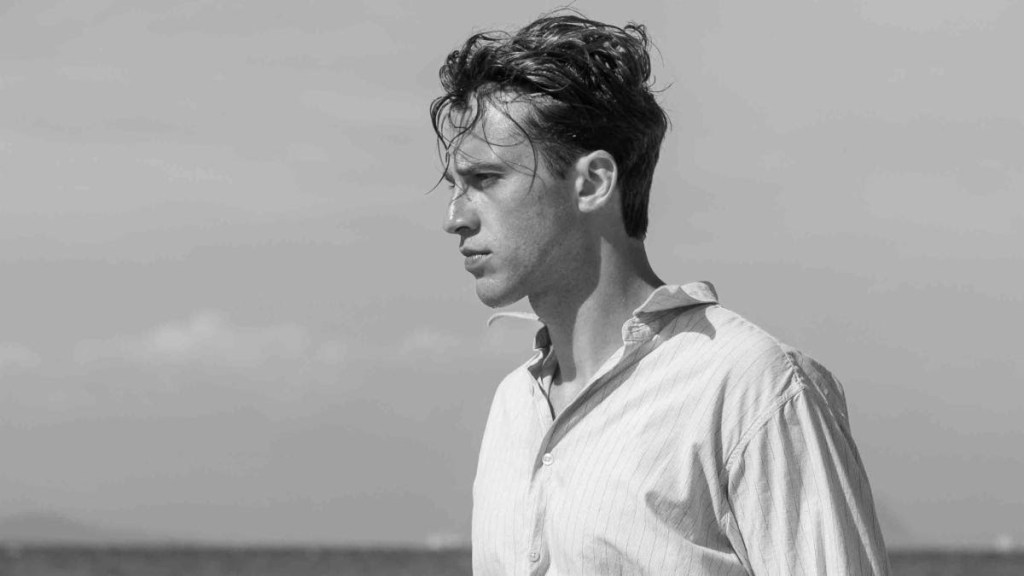
Benjamin Voisin in The Stranger. Courtesy of Music Box Films.
You can count on a François Ozon movie to not look bad. His new adaptation of Albert Camus’ The Stranger is among his most ravishing-looking — shot by cinematographer Manu Dacosse in a pearlescent black and white that recalls fashion magazine-friendly Steven Meisel and Bruce Weber spreads that make clothes look made to be taken off. Cast as the novella’s iconically emotionless and nihilistic protagonist, Meursault, Benjamin Voisin gives a just-right ice-gentleman performance as a well-coiffed avatar of chronic indifference. Like Alain Delon playing the sociopathic social climber Tom Ripley in Purple Noon (1960), Voisin’s prettiness makes his repellent character a little easier to watch; his effortless-seeming musculature and hair, appearing perfectly tousled even when unctuous and unkempt, are gazed at admiringly by Ozon.
It takes a while for this not to seem like beauty for its own sake. The black and white comes to visualize what’s obvious — the colorlessness with which Meursault, unfazed even by his mother’s recent death, sees the world made literal — and how colonialism drains reality of its vibrancy, undermining the freedoms of its victims and bracing the blinkered worldviews of its perpetrators and those complicit in it. (The Stranger, both novella and adaptation, takes place in the 1930s, in France-occupied Algeria.) The glossy-pictorial handsomeness of Ozon’s Meursault comes across as a fleshy manifestation of his appallingly taken-for-granted privileges. You both resent him for it and enjoy taking it in.
Much has been made of Ozon’s narrative fealty to the original text. But his deceptively lovely presentation and other all-his-own flourishes — brief rejoinders to the pointed dehumanization of Arab people in the source material, renewed interest in the story’s gay subtext and how it might influence Meursault’s climactic murderousness, both attributes not as awkwardly expanded on here as they could have been — also prevent it from seeming limitingly dutiful to the analyzed-to-death Camus text it translates.
Ozon’s version still doesn’t do enough to convincingly justify its own making. Maybe controversially I’m of the mind that a generations-later revival of a classic text should be fairly radical to make the dredging up worthwhile. Ozon’s movie-a-year restlessness makes his Stranger ultimately seem like a scratch being itched more than something he urgently needed to exorcise, lest he feel artistically incomplete. But there have been less thoughtful pet projects that have looked a lot worse.
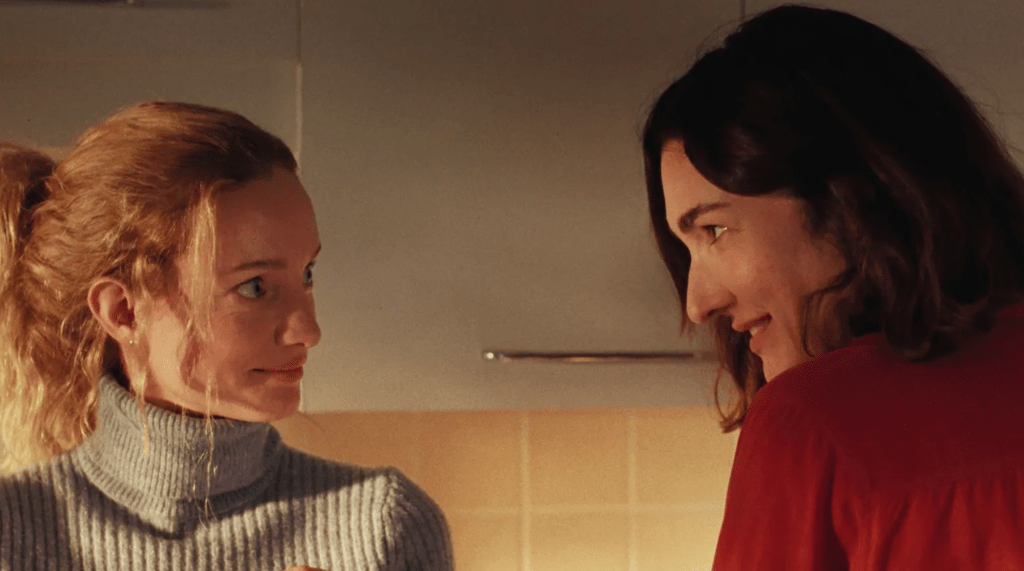
Laurence Laboeuf and Karine Gonthier-Hyndman in Two Women. Photo by Sara Mishara/Joint Venture.
Two Women’s sex scenes are the best thing about it. They’re not that explicit: clothes remain on for the most memorable one. They’re so good because the film’s director, Chloé Robichaud, effectively renders the painfully pent-up horniness of its titular leads and how good it feels unleashing what’s been stifled for so long. The first few’s tentative awkwardness improves them: It wouldn’t be believable if intense desire were traditionally photogenic — choreographed with too much concern over how the viewer might see them.
A contemporary remake of a same-named farce from 1970, Two Women finds a pair of maritally bored, sexually frustrated neighbors, Florence and Violette (Karine Gonthier-Hyndman and Laurence Leboeuf), egg each other on to step out on their respective spouses. (It’s persuasively framed as not that big a deal because one guy is fully cheating, the other committed to unspoken celibacy and all-around emotional disengagement.) Florence and Violette’s method for securing one-after-the-other lays is by phoning over handymen of various specialties — exterminators, plumbers — and seducing them while their husbands aren’t around. Two Women takes the form of a goofy sex comedy, albeit with inconsistent laughs and some tonal wobbliness. But the seriousness with which it takes the carnal needs of its brazenly behaving leads, plus the cogent way it depicts their loneliness and stir-craziness, wins you over.

