Charli XCX has mentioned loving Jacques Rivette’s trippy friendship odyssey Céline and Julie Go Boating (1974) enough times to make it particularly heartening to see a spirited riff on it among her seemingly unending post-Brat (2024) forays into film. In the transient, likable Erupcja, she plays a woman named Bethany, a normie christening that seems like a conscious effort to cleave her from her cool-girl public persona. Bethany is in Warsaw with her blandly nice boyfriend, Rob (Will Madden). He’s planning to propose with his dad’s resized ring at some point during the trip because Bethany seems to hold the city dearer than her native London. She’s been about five times, in close enough touch with its metropolitan makeup that the movie’s deadpan, Rohmerian narrator (the never-seen Jacek Zubiel) informs us that she misses the way the city’s transit screeched before some recent renovations.
Bethany undersells how much her sentimental attachment to Warsaw depends on someone who lives there. She first met Nel (Lena Góra), now running a flower shop inherited from her mother, while on a class trip about 15 years ago. The two immediately had such strong us-against-the-world friend chemistry that an Icelandic volcano erupted around the time they were introduced. I wouldn’t imply causation if volcanoes didn’t continue blowing their tops every time the pair thereafter met up. Bethany’s arrival in Warsaw is heralded by Italy’s Mount Etna wheezing aggressively enough for her and Rob’s return flights to be indefinitely postponed.
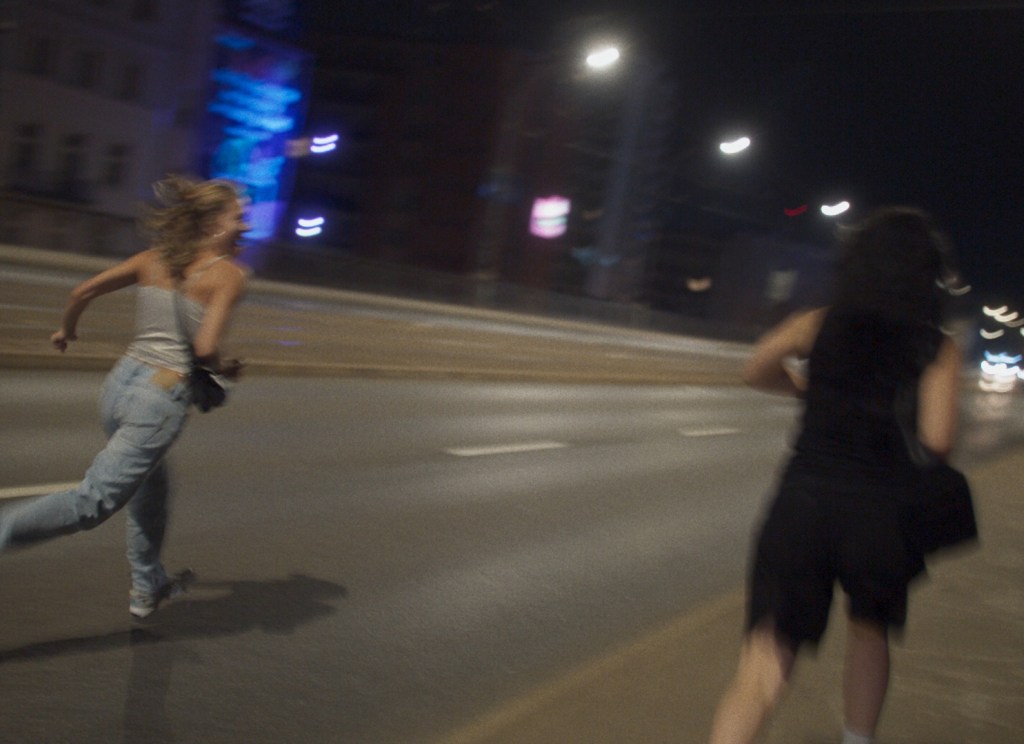
Suggested to be their norm, Bethany reconnects with Nel not after any real planning but by loitering around an old meet-up spot. Bethany doesn’t try to catch up and say hello when she inevitably first spots her friend from afar. Erupcja would rather pay homage to one of Céline and Julie Go Boating’s best-remembered sequences: a stalking session around the streets of its appealingly shot main setting that might make you think of Alice’s Adventures in Wonderland (1865).
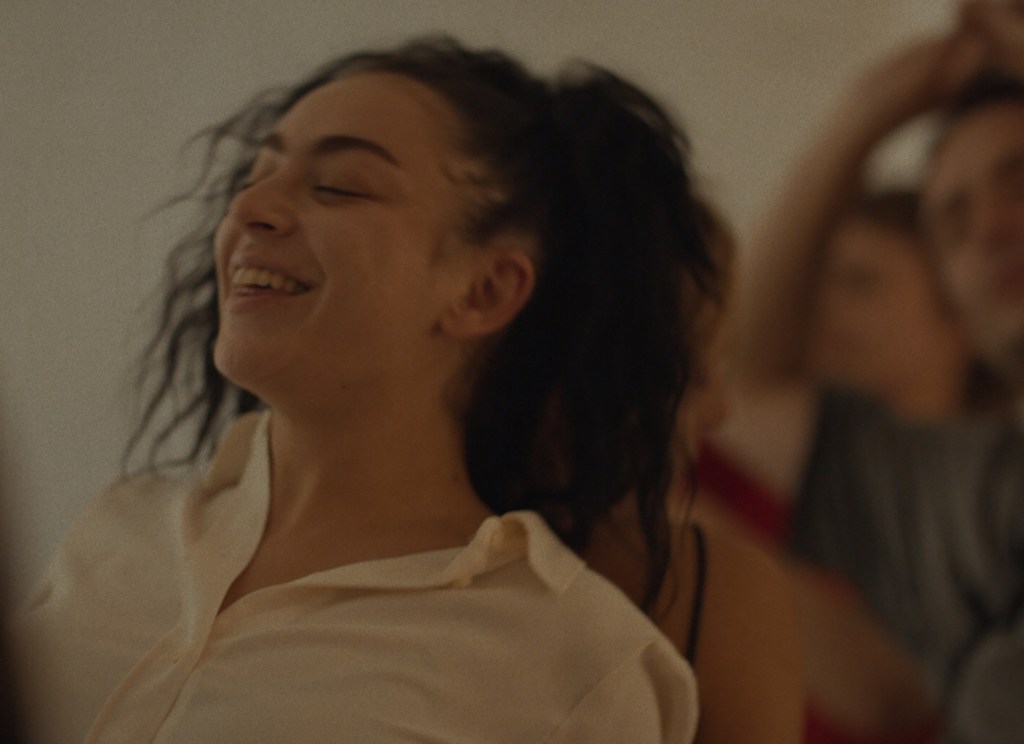
Charli XCX in Erupcja. All Erupcja imagery courtesy of 1-2 Special.
A byproduct of affection informed a great deal by general fascination, the chase is played cooler in Erupcja. It doesn’t take up as much time, either. Most things move comparatively quickly in the movie, attuned to the fleeting quality that has always been inextricable from its international friendship’s power and the spartan nature of the production itself. Much of Bethany and Nel’s fun around town is compressed into dreamy montage, and speckles of backstory are often economically offered via narration rather than face-to-face disclosure.
One’s instinct might be to want Erupcja to be longer. It feels lived-in, not just literally. (Shot right before Charli’s Brat tour, it was by turns spontaneously and guidedly improvised by its cast members and their director, Peter Ohs, an approach only exacerbating the abundant comparisons to Céline and Julie, whose screenplay was similarly devised.) But Erupcja’s brevity — it taps out at around 72 minutes — reinforces our hold on these characters more than it leaves something to be desired.
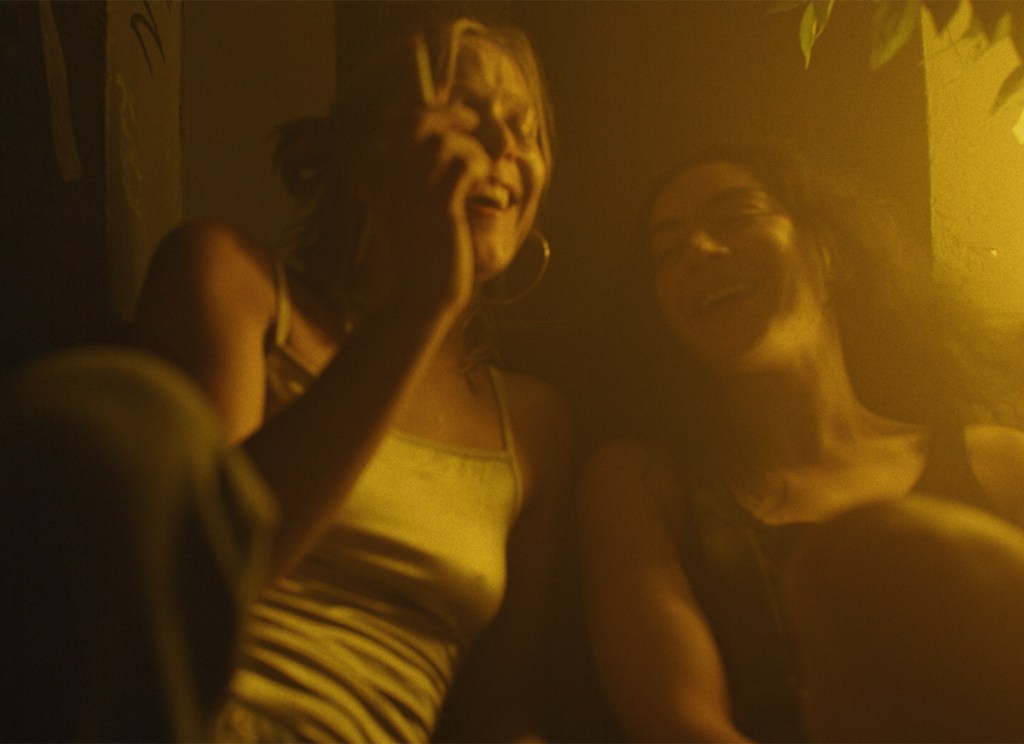
Lena Góra and Charli XCX in Erupcja.
That’s especially true of the flighty Bethany, who all but ditches the in-denial Rob when she takes up with Nel again. She can’t help but follow her whims, and she’d prefer not to commit to anything or stay around too long in something comfortable. The immediacy of her friendship with Nel underscores her domestic unhappiness to the point of her realizing that she needs to rid herself of it. She also seems to have just as much of an underlying awareness that the intensity of her and Nel’s kinship is meant to be enjoyed in short bursts. Being around it all the time could either be unhealthy or simply drain its coveted power. She’d rather not find out. Charli’s deceptively aloof performance emanates dread when it isn’t, in her scenes with Chloë Sevigny lookalike Góra, radiating ease.
When Bethany finally departs from Nel, she says her farewells, spoiler alert, with a hastily scribbled note taped to her Polish pal’s patio door, not a hug and tender parting words. And she decides, off-camera, to continue exploring Warsaw, sans Rob, with no proper explanation, hoping silence communicates what she wants it to. Her destructive — or, to flatter the movie’s main metaphor, volcanic — free-spiritedness isn’t romanticized because it’s made into a semi-punchline. Once she heads home, Bethany moves back in with her parents, waiting it out until she again has a hold on things.
Erupcja is more sympathetic to the probably long-suffering Rob than it needs to be. You can feel in your bones the unbearable temperance of this relationship just in the image of him peeing while sitting down, something Ohs presents with a documentarian’s faux indifference. Indelicate as she is, you get where Bethany is coming from. Mostly, though, I wanted more passages between her and Nel than I got, even though I know that Erupcja’s striking evocation of a familiarly melancholic feeling — reuniting with and then saying goodbye to a faraway and deeply missed friend — is a sign of it working. It wouldn’t be right to feel content.
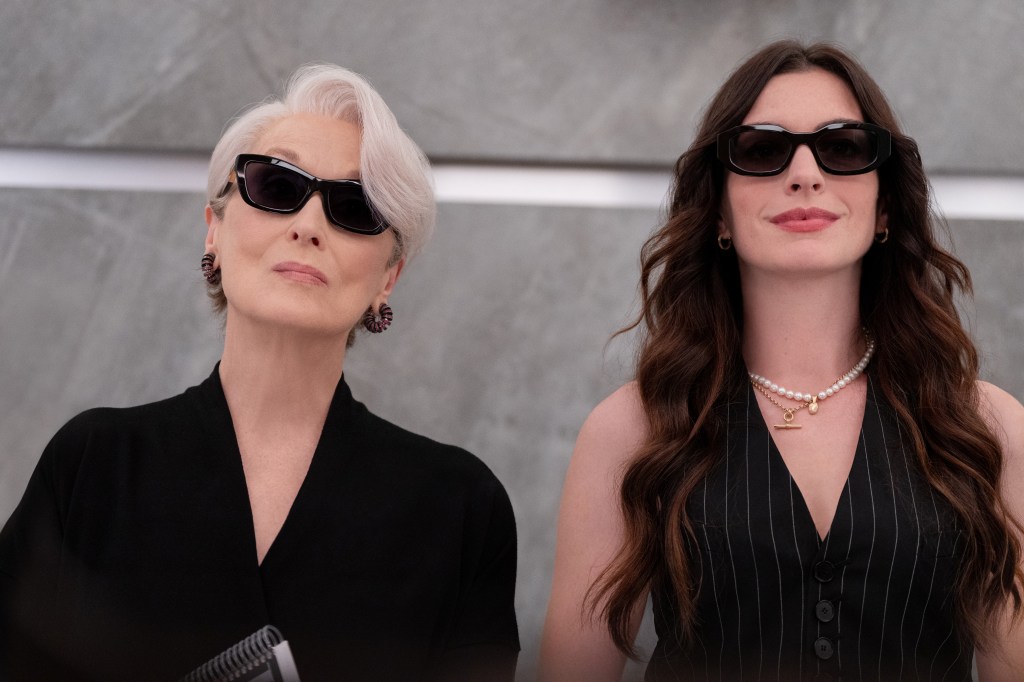
Meryl Streep and Anne Hathaway in The Devil Wears Prada 2. All 2 photography by Macall Polay, © 2025 20th Century Studios.
Until a memory-jogging rewatch a few days ago, I’d forgotten that The Devil Wears Prada (2006) wasn’t very enamored with fashion — at least not ultimately. To jog your memory, too, the movie is about a high-minded aspiring journalist, Andy (Anne Hathaway), who takes a job at a thinly veiled Vogue stand-in, Runway, as one of the interchangeable assistants of its editor in chief, thinly veiled Anna Wintour stand-in Miranda (Meryl Streep). Andy thinks the servile position could be a stepping stone for the hard-hitting career she envisions. But needy ice-queen Miranda’s round-the-clock demands gobble up her personal life and any chances of upward professional mobility.
Andy, on the bright side, gets some joy out of the designer fashions newly at her disposal. But that’s implicitly characterized in The Devil Wears Prada as symptomatic of a sort of Stockholm Syndrome. It’s arguably concluded that to remain in the cutthroat and ostensibly superficial fashion milieu is soul-killing, as evidenced by the flashes of misery seen in Miranda mid-movie; in Miranda’s forever grinning-and-bearing-it right-hand man, Nigel (Stanley Tucci); and in Miranda’s other assistant, Emily (Emily Blunt), who’s so obsessed with keeping a svelte shape that she cracks that her latest crash diet involves eating a single cheese cube every time she feels ready to pass out. The Devil Wears Prada was a horror movie about a toxic work-life balance, Andy its barely intact final girl.
When we meet Andy again, 20 years later, in The Devil Wears Prada 2, we’re happy for her before we aren’t. She’s mounted a career as a respected investigative journalist, living itinerantly for most of the last couple of decades to pursue stories, and in her first scene she’s seated among colleagues at an awards banquet at which she’s being recognized. But just before taking the stage to accept her honor, she and others at her scrappy publication learn they’ve all been laid off as part of a downsizing effort, the news broken in an impersonal mass text. Her subsequent speech — extolling journalism’s taken-for-granted importance and lamenting the corporate greed only willing to see the practice’s value in dollar signs — goes viral.
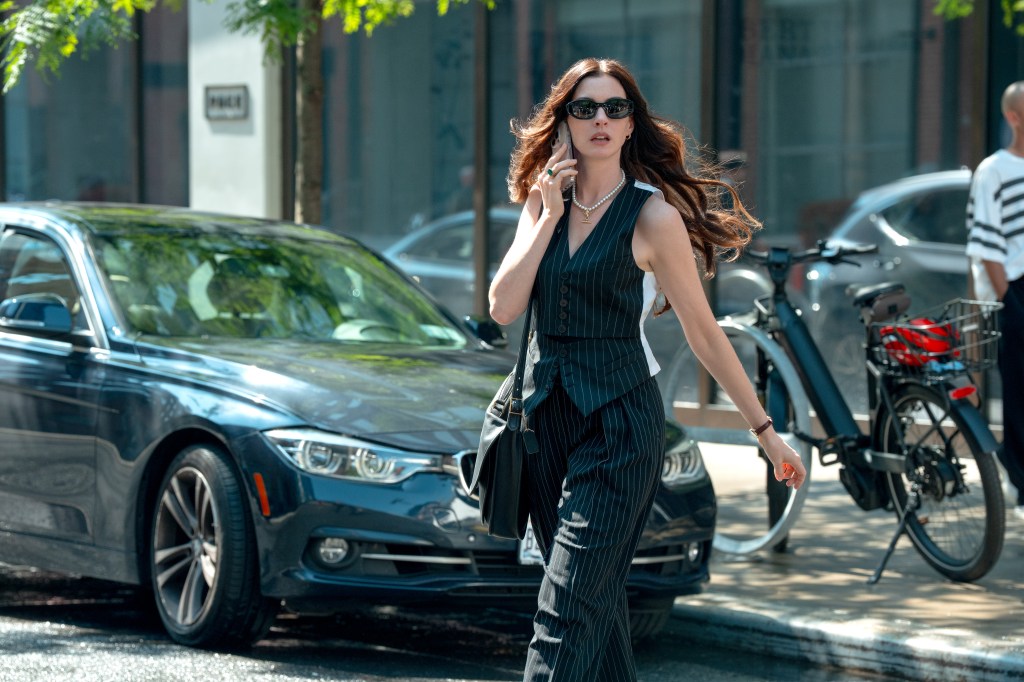
Anne Hathaway in The Devil Wears Prada 2.
The media landscape’s slow death by corporate avarice turns out to be the primary preoccupation of 2, which like its predecessor was directed by David Frankel and written by Aline Brosh McKenna. Andy and her far-lower-paid reporters are in danger, and so, too, are Miranda and her prized Runway. The notoriously moneyed magazine’s budgets and schedules have been dramatically undermined. (Upper-level staffers now have to fly coach: the horror!) Miranda, on top of the pub’s own waning dominance, is beginning to seem out of touch. Her character starts the movie by weathering an outcry: She signed off on a flattering puff piece on a fast-fashion brand widely known by the public to be exploitatively sweatshop-dependent, prompting endless outraged memes and face-to-camera monologues.
Miranda and Andy’s requisite reunion in 2 is, much like the latter’s hiring in the first movie, pretty ludicrous. After seeing her impassioned awards speech, the Larry Ellison-like figure who owns Runway’s parent company (Tibor Feldman) hires Andy, no interview required, to take over the magazine’s feature department. He’s convinced she’ll give it back some credibility to dismayed readers. She’s excited about the opportunity, whose salary doubles her previous gig’s and will give her the means to move out of the janky apartment whose water runs brown for a few beats before clearing up. Yet she still sees it, like her assistant job of her early 20s, as a launching pad into something more prestigious.
Andy’s rehiring brings back much of the same old dynamic between her and Miranda, who pretends at first not to remember her one-time underling. Much of the latter’s bad behavior has been toned down in the last 20 years. She now actually knows her assistants by name, racks her own coats instead of chucking them at others to pick up, and when she slides into not-particularly-PC language during staff meetings, she mostly stops talking when others cluck. But she’s still determined to stamp on Andy as much as possible, only giving her feedback when it’s negative and saying outright that she’s confident her newest hire will fail at the task that’s been handed to her. And for a while she does, though only in the numerical sense. Andy’s rigorous direction is appreciated by some attentive readers, but it’s not algorithmically friendly — an untenable trait in a media world where even The New Yorker and the New York Times are working to figure out how to drive engagement via quick-hit TikToks and Instagram Reels.
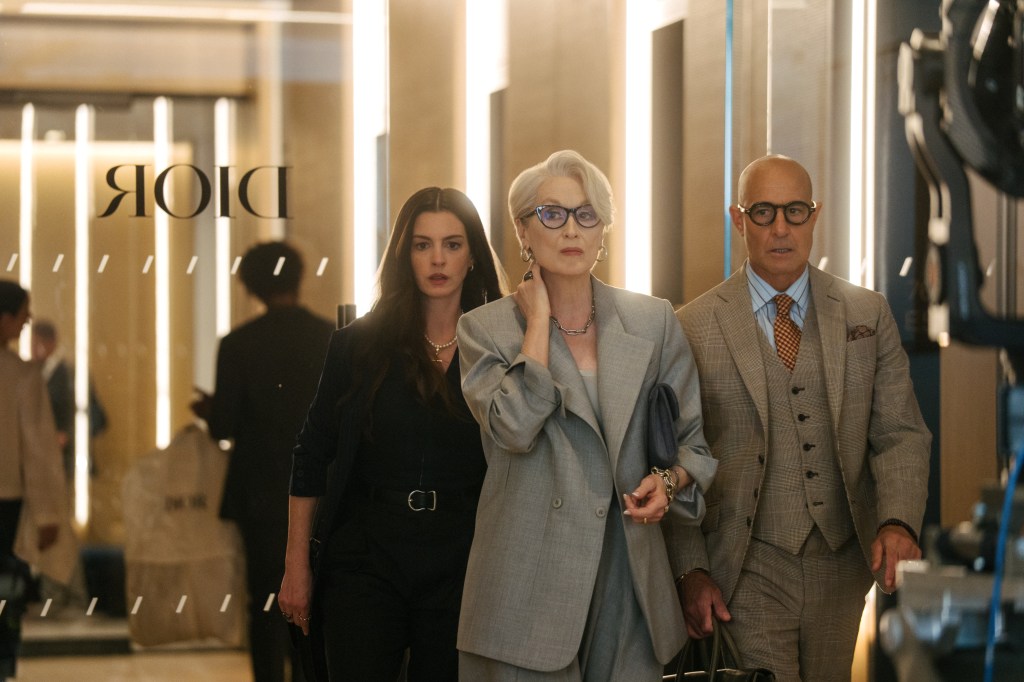
Anne Hathaway, Meryl Streep, and Stanley Tucci in The Devil Wears Prada 2.
Those concerns, as well as the film’s deservedly rude satirizations of idiot-billionaire types — B.J. Novak’s David Ellison figure, Justin Theroux’s grotesque take on Jeff Bezos — are nice to see in a mainstream movie, a venue which mostly hasn’t engaged with the present state of journalism. (The bulk of 2 is, surprisingly, about finding the right buyer when Runway’s fate is suddenly jeopardized.) But there’s wrongheadedness on the other side of every decent point made. It’s true that even the most storied of publications can’t be protected by reputation alone: just look at how Bezos, the Washington Post’s current owner, has decimated what had once been one of the U.S.’s most reliable watchdogs. But Vogue is, relatively speaking, among the nation’s least vulnerable, making the precarity in which Runway sits for much of 2 hit like fantasy. It’s true that Bezos’ first wife, McKenzie Scott (whose analog is played by Lucy Liu), has used staggering amounts of her post-divorce lucre to help organizations in need, but journalism hasn’t thus far been much of a priority for her, rendering Liu’s decision to, spoiler warning, come to Runway’s rescue seem naïvely hopeful.
Runway and Miranda are generally hard to root for when pitted against the less well-resourced peers I couldn’t help but think about while watching 2. Vital as it is, the existence of Vogue and its fictional doppelgänger is nonetheless far less crucial to a community than the countless local newspapers that have been shuttered for craven entrepreneurial reasons in recent years, ensuring cities and towns across America have no attested way to know what’s happening where they live or hold those locally abusing power to account. And though one might shiver seeing someone with decades’ worth of experience and culturally influential taste be treated as dispensable by vulgar man-children, it’s difficult to feel that bad for someone of retirement age whose firing, at the very worst, would result in a multimillion-dollar payout. (Miranda’s real-life equal, Wintour, is fine in the meantime, moving on from Vogue for even bigger roles: parent company Condé Nast’s global chief content officer and artistic director. And tonight’s Met Gala, of which Wintour is the lead chairwoman, is open to having Bezos buy his and his wife Lauren Sánchez’s way into co-hosting duties.) The Devil Wears Prada 2 plays like cinematic wishful thinking.
I liked 2 better than the first. Andy, so beaten down in the first movie that being harried and exhausted are basically her defining traits, gets to be more of a person now; I appreciated how much more Hathaway’s well-known mirth becomes part of Andy’s own relentless can-do energy. Laugh lines are more plentiful, too, though as in its forebear most of them come from Blunt, whose crassly opportunistic character now holds an executive-level position at Dior and greater capacity for villainy. It’s good to see her and her castmates again in a flawed sequel that’s better and more thoughtful than it perhaps needed to be.

