Blue Heron’s brief opening narration clarifies what probably doesn’t need to be: that this semi-autobiographical drama is the product of fragmented, not particularly trustworthy memories. A similar semi-disclaimer could be applied to most of the works encompassing writer-director Sophy Romvari’s career thus far. The Canadian filmmaker built acclaim and a following starting a decade ago with a series of personally imbued short films that had in some way been “a form of memory retrieval.” The pinnacle is generally agreed to be 2020’s Still Processing, in which Romvari digitizes a stack of long-undeveloped family photos and through them obliquely comes to terms with the tragic, premature deaths of her two older brothers, the details of which are obscured to the viewer. Blue Heron is an apotheosis of Romvari’s last decade of achievements as well as what can’t help but feel like the start of a sort of second act, her intimate work’s affecting potency demonstrably not limited to short-film concision.
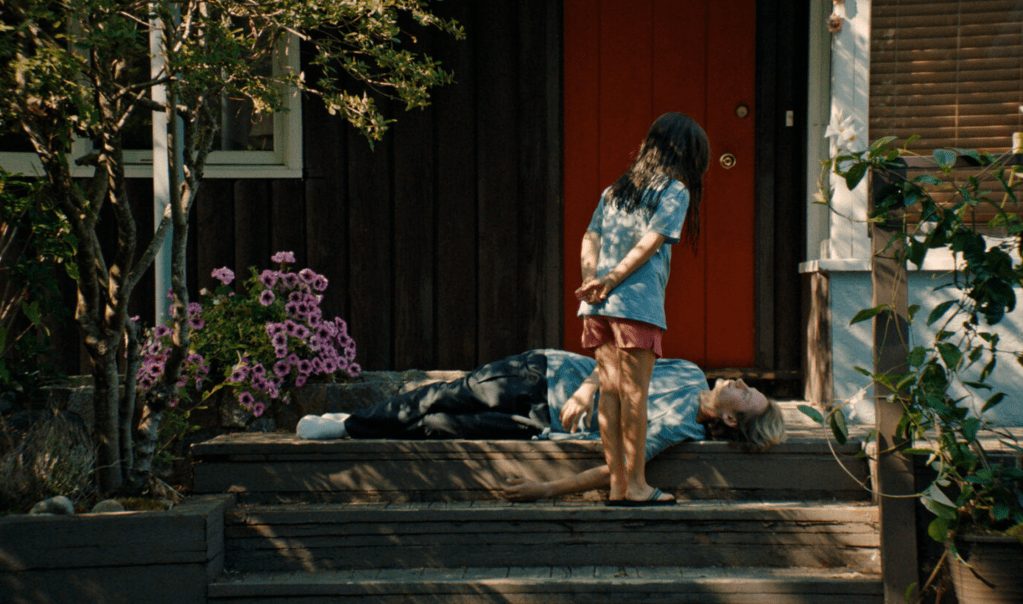
Blue Heron is set in the late 1990s on Vancouver Island, where a Hungarian-immigrant family moves at the beginning of the movie. Present-day urgencies eclipse the details of their background. All four kids — Romvari stand-in Sasha (Eylul Guven), Henry (Liam Serg), Felix (Preston Drabble), and stepbrother Jeremy (Edik Beddoes) — are home for the summer. The three youngest spend their aimless days lazing and playing, Sasha especially with some mischief-making girls her age in the neighborhood. Restless Jeremy is worryingly reckless, a trait alluded to have already been causing much familial anxiety before the move. Early trouble-making is innocuously adolescent: sprinkling and blowing powdered sugar all over the kitchen for the minor thrill, swiping a tiny aquatic-themed keychain from a gift shop. But things frighteningly escalate, with Jeremy ambling on the house’s roof, ignoring calls to come down, and making threats to burn down the house, small reserves of gasoline hidden in his room ready for ignition. It’s not unheard of for him to be driven home by the police, walked to the door in handcuffs. Later, he’ll make himself bleed.
Blue Heron’s atmosphere can be paradoxically lovely, consonant with the nostalgia many of us might remember the idling summers of our youth. (The action is sometimes interrupted with scrapbook-ready black-and-white snapshots taken by the film’s cinematographer patriarch, echoing Still Processing and nodding to how the medium can recast life’s worst moments as better than they really were.) But it’s a pointed loveliness, Sasha’s innocence channeled through a beautiful but still watchful aesthetic filter. Resembling River Phoenix in Running on Empty (1988) with his blonde-streaked shaggy hair and bookish glasses, Beddoes’ Jeremy remains a beloved-but-misunderstood figure. The potentially clarifying power of making a movie partially inspired by your life may only serve to make another person’s realities less apparent than to underscore the restrictions of one’s own gaze.
Such is underpinned by Blue Heron’s meta switch in the second act. The drama, as we’ve gotten used to it, ceases, fast-forwarding to an adult Sasha (Amy Zimmer). She’s now a filmmaker deep into the process of making the movie we’ve so far been watching. She meets with psychiatric experts to get a better hold on what might have been going on with Jeremy — and how the era’s mental-health resources might have failed him and her family — and, in a reality-distorting climax, talks with the actors, still in character, who play her at-a-loss parents (Iringó Réti and Ádám Tompa). There’s so much about her childhood that Romvari couldn’t fully see and continues to struggle with; the perhaps without-end state of being giving her fame-making 2020 short its name — still processing — is apt for the haunting Blue Heron, too.
Image: Eylul Guven and Edik Beddoes in Blue Heron. Courtesy of Janus Films.

