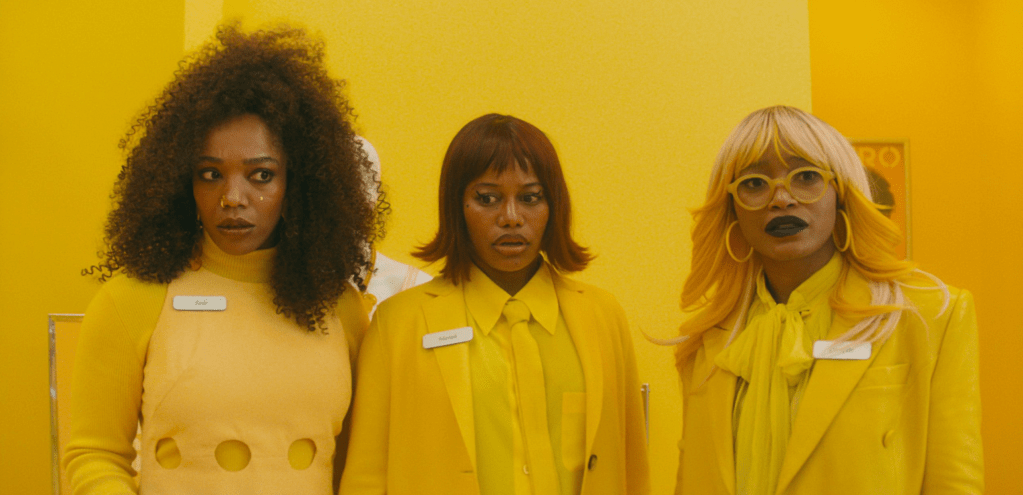
I didn’t really see I Love Boosters the first time I saw it. It was the opening-night movie at this year’s Seattle International Film Festival, and the venue — the nearly century-old, 2,807-seat Paramount Theatre — proved so echoey that I concluded, a few minutes in, that I couldn’t write about it in good conscience, the dialogue too incoherent to make out more than half the time. The movie’s overarching, visually reinforced themes could largely be extracted, but the storyline was, by and large, too murky to confidently follow. Unaddressed either by him or the moderator, the bad sound unintentionally gave more urgency to one of writer-director Boots Riley’s entreaties during the post-screening Q&A: get tickets for the movie an additional time — opening weekend, if possible.
After having seen I Love Boosters in a packed theater with comparatively pristine audio a few weeks later, those two immediate impressions — vivid themes, disjointed story — remain mostly unchanged. Rapper-turned-filmmaker Riley’s long-awaited feature-length follow-up to the bananas corporate satire Sorry to Bother You (2018) doubles down on the latter’s visual flamboyance and carries on with its leftist messaging all while servicing a cluttered, unfocused narrative populated with characters that barely transcend notions of their being placeholders, the details to be filled in later. But it’s a captivating, very fun jumble, its aesthetic zest and deep-seated political frustrations hitting forcefully in a contemporary filmmaking landscape increasingly numbed by visual homogeneity and a disinclination to critically engage with the wider world’s injustices.
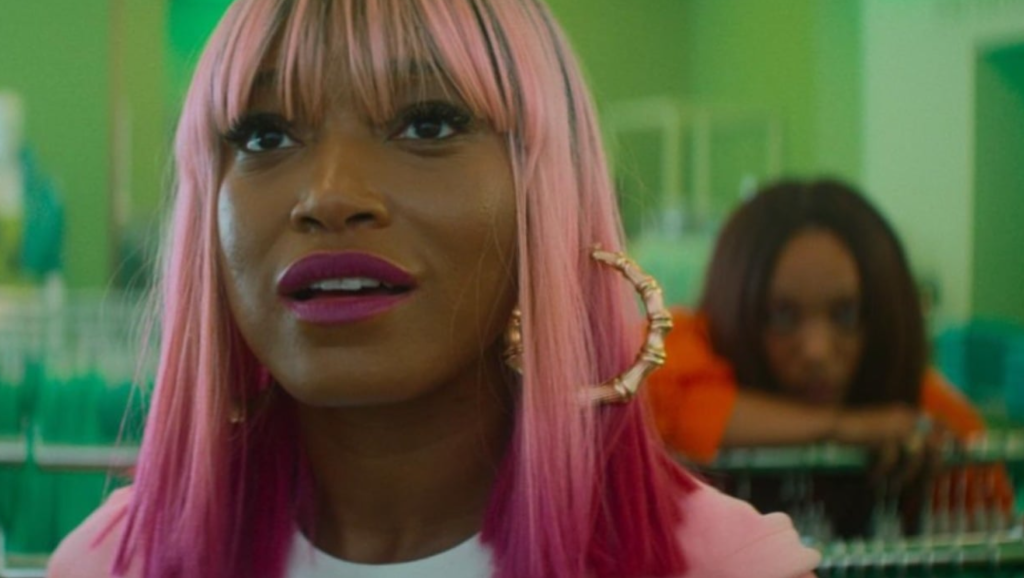
Keke Palmer and Naomi Ackie in I Love Boosters. All imagery courtesy of Neon.
Set in a version of the Bay Area where people dress like living crayon boxes and often move like Looney Tunes cartoons, I Love Boosters gets its name from the line of work from which its trio of cash-strapped best-friend main characters makes its money. Frequently waddling out of targeted stores with their clothes so stuffed with stolen goods that they resemble the Pillsbury Dough Boy in pastels, Corvette, Mariah, and Sade (Keke Palmer, Taylour Paige, and Naomi Ackie) have been selling swiped luxury items at a discounted rate long enough that they’ve earned a catchy nickname in the media: the Velvet Gang, a reference to them fashionably switching wigs and candy-colored outfits between every job. They near-exclusively prey on the storefronts of Christie Smith (Demi Moore), an influential designer with a girlboss approach to leadership who flippantly decries the three as “low-class, urban bitches” in one breath while blatantly ripping off their sartorial flourishes in another. (I Love Boosters’ astonishing costumes were designed by Shirley Kurata.) Mariah brands what she and her associates do as the start of a movement called FFF: fashion-forward philanthropy, the first two letters of that last word switched out to better serve the acronym.
Corvette’s fixation on Smith is couched, contradictorily, in admiration. She’s an aspiring designer herself who’s reread Smith’s memoir enough times that she can recite certain sections from memory. An allusion to a previous jail sentence explains why she’s resorted to boosting and why she’s squatting in an abandoned fast-food restaurant. We know nothing, meanwhile, about Mariah and Sade beyond their loyalty and Sade passingly mentioning having kids, who are kept off camera.
Its mischievous spirit well-encapsulated by Tune-Yards’ sneaky score, I Love Boosters is crammed with waggish sight gags that do less to push the story forward than give Riley an outlet for his absurd, sometimes antic sense of humor: Smith living in a skyscraper that tilts so aggressively that anyone who walks into her apartment struggles to stand up straight; a Corvette-enamored side character, played with doe-eyed Casanova flair by LaKeith Stanfield, who’s rumored to suck the souls out of women via cunnilingus once he gets them in bed; a posse of skinless performers acting in right-wing interests that made me think of the money-grubbing aliens from John Carpenter’s They Live (1988); a car chase almost completely done with miniatures and what looks like remote-controlled vehicles.
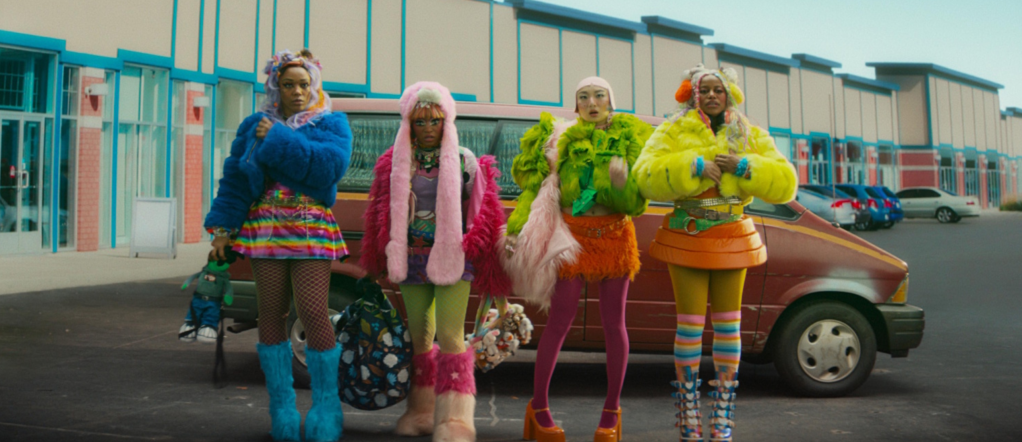
Naomi Ackie, Keke Palmer, Poppy Liu, and Taylour Paige in I Love Boosters.
They do wonders for Riley’s world-building, where nothing is what it seems to an ostentatious degree. But I Love Boosters’ wall-to-wall outlandishness, enhanced by Christopher Glass’ production design, can also make it feel overstuffed after a while, the Stanfield B plot in particular taking up a decent chunk of the runtime despite not adding much to the movie aside from Riley simply thinking it would be funny. “Riley’s films are maximalist not only because they are loud, zany, and brightly colored, but also because he seems to ask, at every moment, ‘what else can we add in?,’” Blair McClendon recently wrote in Film Comment. The less said about a magical device introduced later in the movie to help the Velvet Gang with their robberies, the better: I can’t think of the last time a technology was so extensively and mechanically explained in a film with such little payoff.
If to parse everything down, I Love Boosters becomes a revenge movie with a pro-union slant. Its vengeance-via-mass-theft is aimed at Smith and her predilection for creative theft and unapologetic exploitation of overseas factory workers who make her garments for grievously small paydays and workplace health hazards. But something feels missing in the Velvet Gang’s transition from well-dressed thieves into figures that pave the way for a global workers’ strike; I couldn’t tell, at the film’s conclusion, where Corvette’s new relationship with labor organization and her old one with fashion design now related to each other. The movie is so action-oriented that motivation and interiority are consistently more assumed than felt, its ultimate messaging slightly dampened by its distractibility and weakness for tangents. Its presentation thrills — and distances.

