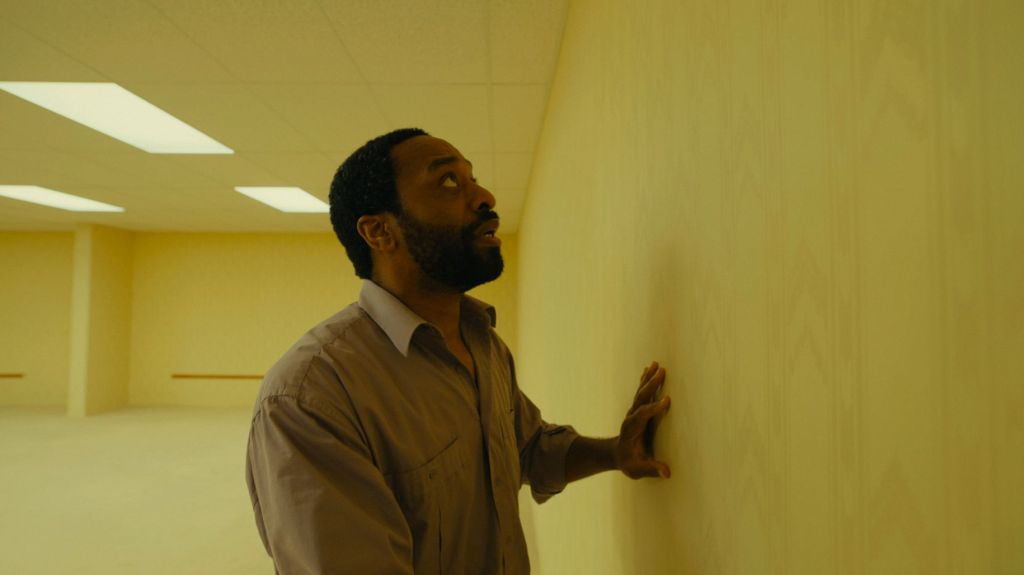
Backrooms and the 22 web shorts that precede it have an undeniably good horror-movie hook. What if you accidentally stumbled into, and got trapped inside of, a never-ending subterranean labyrinth that doesn’t quite exist? Every turn takes you to increasingly warped versions of the same place: abandoned office-like spaces with humming fluorescent lights and walls yellowed with decay. Strewn-about furniture, most of it slowly and puzzlingly sinking into their environment, serves as uncanny décor; tunnels, slit-wide corridors, and yay-high Alice in Wonderland-like doors abound, less-than-friendly humanoid creatures loitering around certain corners. As one character puts it, it’s the architectural equivalent of someone who’s never seen a dog drawing one based on another person’s description.
It’s a purgatorial milieu you’d never want to encounter and also might be compelled to explore against your better judgment — at least until you arrive at the sort of danger that makes you desperate to get back to reality. Backrooms has an eerie, enigmatic vibe, for lack of a better word, that effectively evokes the various metaphors I’ve seen imposed on it since its release. It harnesses the feeling of tumbling down an internet rabbit hole, some innocent curiosity leading to dark places you didn’t intend on visiting but keep compulsively moving toward anyway. It germanely turns into a horror movie being stuck inside an AI image that could pass as real until you notice that the people in it have seven fingers and extra arms and are standing somewhere hallucinated by a thieving robot. It — and this is particularly true of one of the movie’s principal characters — symbolizes spiraling-down depression: the more you give it the time of day, the worse things get.
Backrooms works the most when it isn’t overexplaining itself, its audience given the space to choose its own adventure and freak itself out over what might happen next. It stays on that wavelength for a while, using, for its first couple of acts, only a shard of story so that its intriguing mysteriousness can dominate. Clark (Chiwetel Ejiofor), an alcoholic furniture-store owner in the Santa Clara Valley resentful over his recent divorce, unintentionally discovers the thankfully never-outrightly-named “backrooms” in the basement of his perpetually empty business. He becomes obsessed with this weird place you have to walk through a specific section of wall to get into; he inveigles a pair of college-student employees, Kat and Bobby (Finn Bennett and Lukita Maxwell), into assisting him during one “research trip” that goes about as well as expected in a horror movie involving an infinitely winding maze with monsters lurking inside. Clark’s psychologist, Mary (a miscast Renate Reinsve, who also provides some on-the-nose therapy-speak voiceover), unwisely comes looking for her patient when he stops responding to attempts at contact.
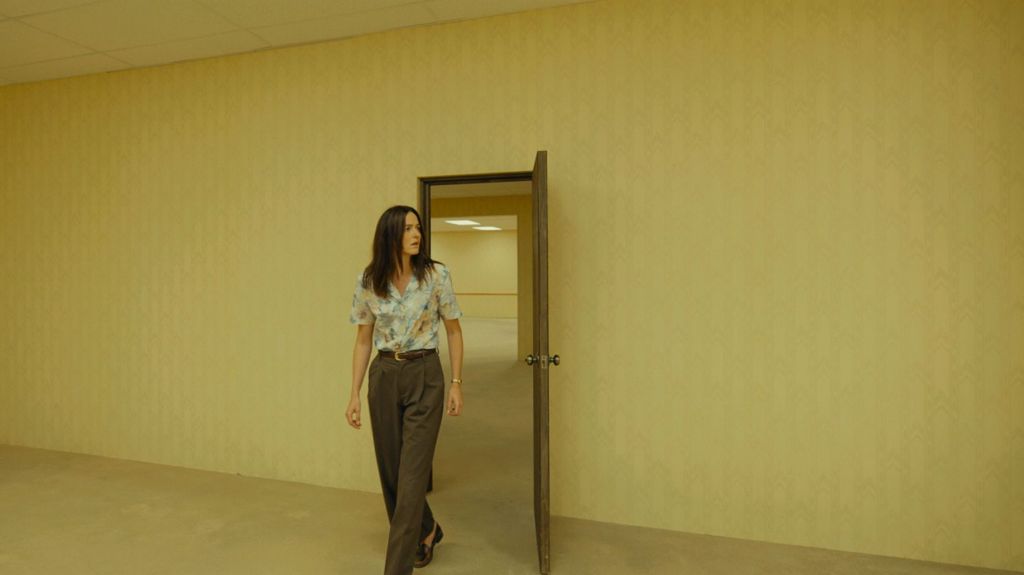
Renate Reinsve in Backrooms. All imagery courtesy of A24.
Backrooms wasn’t written by its director, Kane Parsons. The first-time feature-length filmmaker made the YouTube shorts Backrooms came from as a teen; impressively and tellingly, Parsons is just 20 years old, born four months after the launch of the website that made him famous. Its eponymous setting and subsequent lore inspired by an image posted on 4chan in 2019, the movie is set in 1990, and Parsons’ minimalist recreation of the year, helped by production designer Danny Vermette, accords with the unsettling otherwordliness of the backrooms themselves. It’s conspicuously based on what’s been consumed rather than personally experienced, plasticky in a way that’s redolent of the Evil Norman Rockwell approximations of suburbia associated with David Lynch. Parsons’ strongest instincts are in his aesthetics.
Lynch can also be felt in a climactic scene involving a kidnapped Mary, forcibly seated at a dinner table and flanked by creepily calm humanoids, though only visually. Where the late auteur and Backrooms most diverge is the latter’s third-act insistence on being more legible than it has to be. There fortunately comes no long-winded exposition about the backrooms’ materialization. But the film’s screenwriter, Will Soodik, takes pains to give the movie more emotional legitimacy with trauma-plot-101 backstories for Clark and Mary, and he tacks on another narrative stratum when it’s confirmed that much of what’s been going on is being surveilled by a shadowy company. The pain-steeped character development never seems like more than a feeble attempt to make us care more about its limply written characters, and the film’s conspiracy-thriller hallmarks, though technically a carry-over from the web series, feel here only to lay the foundation for sequels or spin-offs.
There seems to be an unsaid concern that viewers won’t take Backrooms as seriously unless the characters are emotionally and psychologically mapped out, and that a horror film with blockbuster potential needs to have connective tissue for more content to be created with in our IP-dominated moviemaking landscape. It isn’t hard to see the better, more frightening movie within the much-hyped-about (and already staggeringly bankable) Backrooms: the one more thoroughly committing to the sensibilities perfected by The Blair Witch Project (1999) and The Descent (2006), not wandering back into the quote-unquote real world out after Clark, Kat, and the home-video camera-wielding Bobby plunge deep into its central setting’s ever-shifting bowels. The sequence, which happens around the halfway mark, is the only time the movie is unbearably heavy with dread and fear. Backrooms doesn’t need to do as much as it thinks it does; in a horror film, it’s wiser, almost every time, to carefully conceal — to do, and say, as little as possible and let the viewer’s paranoia do the heavy lifting.

