
An unexpected song intrudes on Forastera’s most devastating moment. Upon arriving home after a night out, teenage main character Cata (Zoe Stein) discovers that her beloved grandmother, Catalina (Marta Angelat), has seemingly tripped and fatally fallen while taking out the garbage. The moment’s gravity is undermined by the track blaring fuzzily from Catalina’s phone speaker: “Heat,” a galloping club banger by the Swedish pop star Tove Lo.
Grief brushing up against the not-quite-right is an enduring friction and fascination of Forastera, adapted by writer-director Lucía Aleñar Iglesias from her same-named short film. Cata is unable to cry after the sudden, gut-punching loss of her family’s matriarch. So in lieu of tears she tends to her mess of feelings by doing what begs to be frowned upon: Imitating her grandma on the phone while speaking to those unaware of her death; coaxing her inconsolable grandfather, Tomeu (Lluís Homar), into recreating vintage romantic portraits of himself and Catalina; outrightly declaring, late movie, that she is Catalina. It’s not uncommon to wear the clothes of a late loved one as if their old garments were a comfort blanket; the way Cata ambles around in one of Catalina’s prized red polka-dotted dresses has a way, by contrast, of making you anxious.
Forastera has some paranormal wrinkles. A flickering bulb is suggested to be the work of an attention-seeking ghost even before Catalina’s passing. Near the end of the film, an uncanny sliver of light zips through her and Tomeu’s beachfront home, which Cata and her younger sister (Martina García) have been staying at all summer in an apparent bid to avoid their flighty mother (Núria Prims). But Forastera is not so much a traditional ghost story as a prickly meditation on something more universal: the way mourning a loved one can dovetail with thoughts and actions that one in their sound mind couldn’t come up with.
Cata, for what it’s worth, enacts more extreme examples. Forastera compellingly stays rather button-lipped about whether what she’s doing is part of a larger pattern that could one day have more traditionally dire consequences or if it’s a more sudden ramification of her sadness. Some inexplicable, unplanned parallels between Cata and Catalina’s respective histories — a traumatic beach visit involving an octopus, “Heat” as a surprising leitmotif — further complicate our handle on Cata’s reality and motives. Mallorca, where the film is set, is rendered eerily — sunblanched.
I can relate to Cata’s need to feel closer to someone who’s not there anymore even if I can’t as much her disconcerting expression of it. When my grandma died last fall, my sorrow over simply not having her around intensified whenever I thought about how much I probably didn’t know about her despite our closeness — how much was filtered through a grandparent-grandchild dynamic that’s always going to have some built-in idolatry that unintentionally gets in the way of seeing someone’s full complexity. I think about all the questions I could’ve asked and the stories that didn’t come up during visits. The swiped dress Cata won’t stop wearing made me think of a cream-colored sweatshirt with dancing figures on it that my grandma wore a lot. I loved it but couldn’t find it after she died; I cling, for now, to the other things that make me think of her.
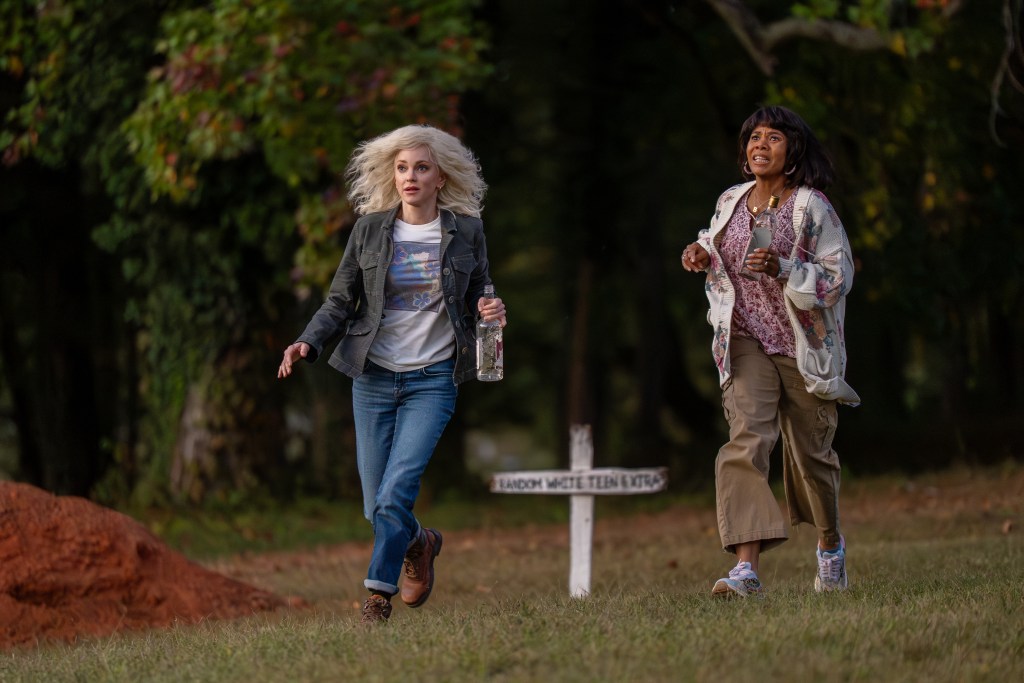
Anna Faris and Regina Hall in Scary Movie. Courtesy of Paramount Pictures. Header image is of Zoe Stein in Forastera. Courtesy of Grasshopper Film.
The new Scary Movie reboot is mostly the same as its predecessors. It can be very funny; it can be very offensive. (I still can’t believe they brought back one character built off stereotypes about people with intellectual disabilities and another whose entire deal is that he’s not-so-secretly gay, but also, I can.) The long-fallow parody franchise’s approach to comedy — immediately crystallized by the Wayans family-guided original — has always been like this video of a knife-wielding robotic tentacle. Targets are everywhere and aren’t restricted to the horror genre, but an unruly aim results in about as many hits as misses. Poked-fun-at movies in the new Scary Movie include Get Out (2016), KPop Demon Hunters (2025), the Final Destination franchise, The Substance (2024), and, once again, the Scream saga; often seen are not quite satirizations but reappropriations of these movies’ iconography to crack verbal and physical jokes about larger cultural topics and general tropes. Sound internal logic is foregone for constant silliness at all costs, which is charming unless it is, as it’s wont to do a lot, punch down.
Scary Movie’s greatest caveat-free pleasure — besides the Teyana Taylor-starring cold open, which memorably celebrates her abs’ Olympian tautness and cheekily laments her recent Oscar loss — is seeing Anna Faris and Regina Hall gamely goof off again as franchise mainstays Cindy and Brenda. (None of the new cast members comes close to what the pair first achieved more than 25 years ago.) Faris is, as ever, a master of the bewildered, breathy line read. Forced into a bowl-like Ma (2019) wig, Hall remains a maven of vulgar squawking. The first Scary Movie introduced the then-up-and-coming actresses as formidable comedy performers; their series comeback reminds you what they excel at, and how much better the movie landscape would be if it greenlit more comedies in which they could show off how preternaturally good they are at landing a joke.

