
For its opening scene, Jackass: Best and Last mines from the past. It’s 1998, when footage was still being stockpiled for the first season of the prank franchise’s MTV series, and ringleader Johnny Knoxville and his posse are in the middle of nowhere. They’re plotting a stunt that would not, ultimately, air. Wearing a bulletproof vest cushioned by a stack of Hustler magazines, Knoxville is going to shoot himself in the chest. It nerve-wrackingly takes a few futile clicks — there’s only a single bullet loaded into his pistol’s chamber — but it ends up being fine. As Knoxville and his associates speed away in their car after the deed is done, hoping no one comes over to investigate what had just gone on, he’s amazed to have barely felt it. The wind wasn’t knocked out of him; it doesn’t seem like a bruise will bloom over the next few days. The only evidence of the risky dare is the soot-haloed hole in his white shirt.
Best and Last’s introductory scene sets the tone for the rest of the movie: reliant on archival scraps; beset with anticlimax. It’s been promoted as a last hurrah — a final chance for its middle-aged but young-at-heart pranksters to chance their well-being for the sake of a good laugh before their bodies truly can’t handle it anymore. Yet it all mostly underscores how exceptionally 2022’s Jackass Forever had already accomplished that, its lineup of ingeniously gnarly and entirely new set pieces accommodating the newfound age-abetted frailty of its main crew without excessively toning things down. Introducing a handful of new ensemble mates was wise, too, both for guinea-pig purposes and for broadening the hazardous but infectious sense of communal fun that’s always been at the core of the series’ merrily sadistic appeal. (Most of them, however, are puzzlingly sidelined in Best and Last, the most aggravating example being how the troupe’s only woman member, Rachel Wolfson, isn’t invited to do anything but snark in the background — though maybe that’ll prove untrue when leftovers from the cutting-room floor are, as the tradition goes, released later.)
I don’t doubt the good time Knoxville and his loyal team are having as they gleefully embark on Best and Last’s small collection of freshly conceived stunts: a scatological revamp of the game of Twister; a human marionette show whose big-eyed actors are tormented with tasers and chucked pineapples; a prostate exam conducted by an indelicate robot; an “escape room from hell” where holes in the wall lead to different kinds of nooks, if you know what I mean, and where one the only way to liberate oneself from one trap is to sit in a less-deadly-but-still-excruciating version of an electric chair.
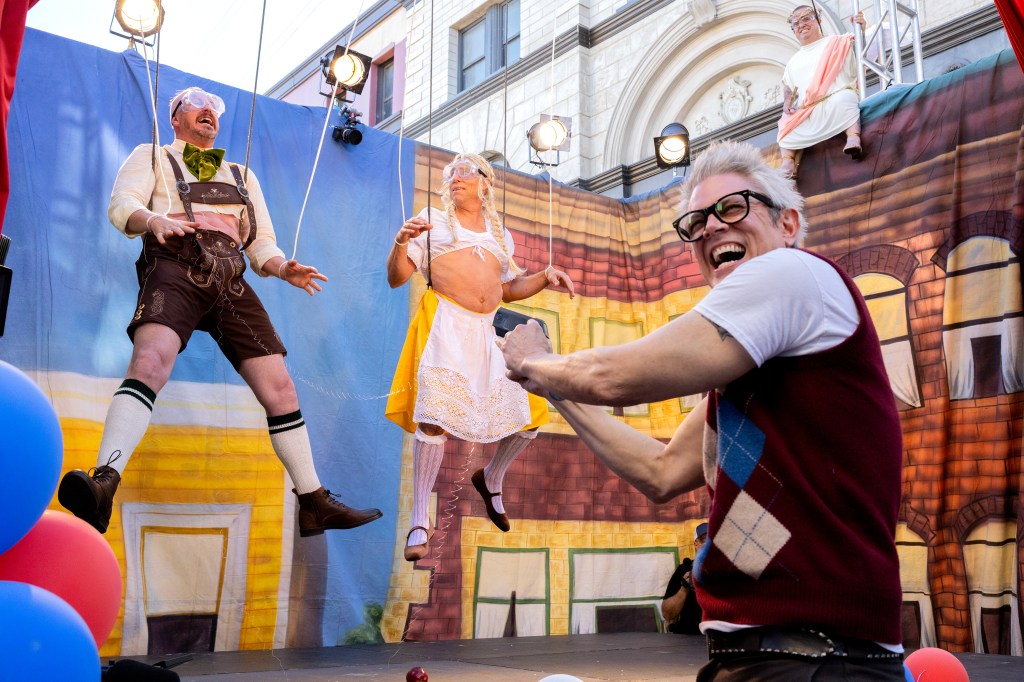
From left to right: Ehren McGhehey, Dave England, Johnny Knoxville, and Jason Acuña in Jackass: Best and Last. All imagery courtesy of Paramount Pictures.
But there seems to be an unspoken awareness from the cast and director Jeff Tremaine that the offerings this go-around may underwhelm compared to its predecessors. The glut of archival segments, both never-before-seen and seen-before, is presented like diamonds being retrieved from a vault, though I struggled, even when I was laughing, to see them as anything but a means to pad out the runtime, which is 92 minutes but feels more like 45, and to contribute to the film’s forced-feeling pathos. The latter is most of all imparted by the several moments where Knoxville gets choked up when he’s asked about or is reminded of Best and Last being the putatively final time he and his buddies will make a Jackass movie.
Forever had a bittersweet tenor without having to remind us why enough times to make it seem like there was a quota to meet. Best and Last seems convinced we’ll miss the point, or maybe it knows that it might be thought of, with its dependence on old-if-unseen highs, as a last-ditch cash-grab, and that it’s imperative to do a little emotional guilt-tripping to make us not see it so hostilely. (That could probably have been combatted if it were released the way the other movies’ direct-to-video “sequels” — given names like Jackass 2.5 and Jackass 3.5 and so on — have been, since their dependence on the archive is inextricable from their very existence.) Best and Last’s failure is arguably best signaled by cameraman Lance Bangs, whose weak stomach has been hilariously spotlit in every other Jackass film, never throwing up, not even during one brown-heavy stunt where I almost did myself.
I don’t want to have bad feelings for a Jackass movie; I never have before. I’m susceptible, like a kid, to the series’ crude brand of physical humor — like Tom & Jerry or The Three Stooges if there were a very real possibility that someone, with their improbable openness to being plowed down by a distressed bull or flung hundreds of feet in the air while precariously strapped inside a porta potty, could die. And I’m endeared to how it, without even seeming to try, challenges strong-and-stoic male gender norms. It celebrates and rewards vulnerability, beckons rather than carefully avoids humiliation; there’s no homophobia-induced fear of a nude male body, and it doesn’t seem like it would mind if one were to perpetuate the oft-repeated speculation that all these rituals were being conducted so that these men could see what was going on beneath their clothes. The friendships the Jackass franchise depends on are so strong because of everyone’s willingness to put everything out there. The series has an ethos worth aspiring to: You can’t expect to have strong relationships if you self-consciously hide too much of yourself. You don’t, though, have to be a courageous daredevil to accomplish that. Best and Last retains all of Jackass’ defining qualities while also achieving a first: playing it safe.

