
Several beautiful young people live alienated lives in Hong Kong. Such could describe the lion’s share of the movies made by Wong Kar-wai, the now-67-year-old director whose main thematic hang-up is indigenous to something most people subconsciously or otherwise work through for the rest of their lives: the traumas and pains of their formative years. “When I was a child,” Wong once said in a 2001 interview promoting the recent release of In the Mood for Love, “I was the only one who came to Hong Kong; my brother and sister stayed in Shanghai. I didn’t have a lot of friends, so I know about loneliness.”
In the same interview, Wong considered the characters his originating dolor had thus far yielded to be “in orbit.” In other words, stuck in a cyclical routine before a world-upending interruption of some sort — say, love or heartbreak — pushed them in a new direction. Wong’s fifth film, Fallen Angels, arrived at the midpoint of the 1990s and continued to carve away at his favored theme while debatably becoming his at-that-point aesthetic peak. His go-to cinematographer Christopher Doyle’s use of dizzying wide-angle lenses and oppressive neon remain among the decade’s most exhilarating visual gambles; using the night’s pitilessness exclusively as its backdrop, Doyle’s agitated camerawork feels simultaneously nauseating, sobering, and a touch invasive.
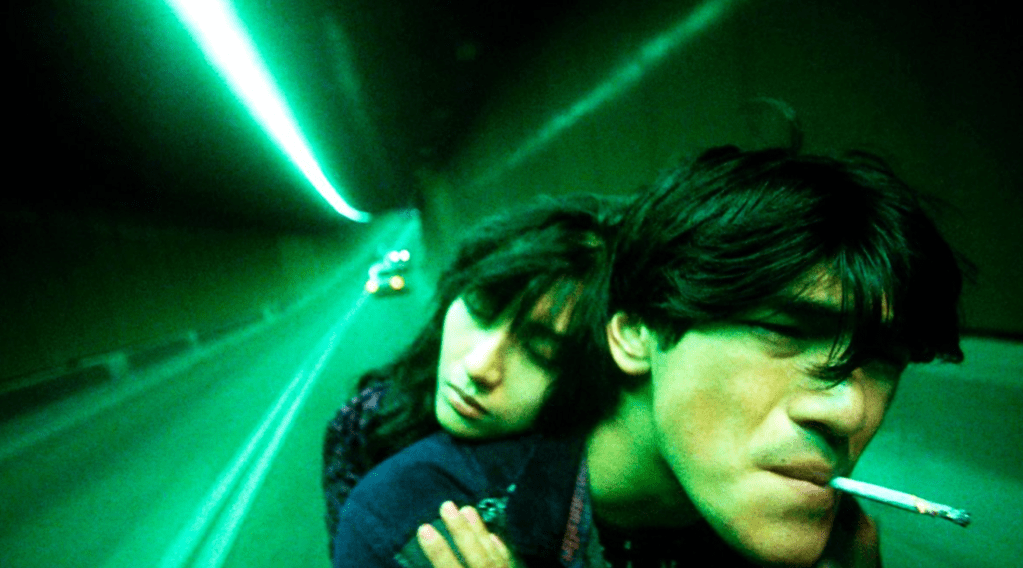
Michelle Reis and Takeshi Kaneshiro in Fallen Angels.
Like Wong’s previous movie, the generally more appreciated Chungking Express (1994), to which it’s often negatively compared, Fallen Angels’ bisected narrative only fuses on the irregular occasions it feels like it. Each’s center of gravity is a foredoomed relationship. Fallen Angels’ A plot is the better one, mostly because of its more alluring presentation. An unnamed handler (Michelle Reis) is erotically fixated on her primary hitman employee, Chi-ming (Leon Lai), who claims his start in his bloody trade was triggered by laziness. The intensity of her obsession is fanned by absence — the two have worked together for 155 weeks, Chi-ming says in voiceover, without ever having had an in-person meeting — and happily-tended-to devotional rituals that in their taboo industry are analogous to wifely duties: stockpiling jobs; freshening up his apartment when he’s away. The handler is well-aware that her romantic idealization would fade if she got to know Chi-ming better. That logic, however, cannot quell the severity of her heartsickness. It manifests with bar visits where she idles in Chi-ming’s favorite stool and late-night masturbation sessions whose fantasized-about intimacy is prematurely defeated by heaving sobs.
I didn’t mind that I didn’t care about these characters, both of whom are more beguiling figures than flesh-and-blood people. Wong and his actors effectively tap into a shallow, lizard-brain conclusion that made me feel like a teenager discovering movies again: These characters look really cool, and that feels like enough. That’s less true of Chi-ming, who aloofly walks into bystander-heavy jobs and completes them with almost balletic assuredness. But that’s only because Reis, contorting conventional femme-fatale tropes, outclasses him in the presence department. Disaffectedly slinking around in stylish mini dresses, her jet-black bangs like curtains, she’s scarcely ever without a lit cigarette or a cherry-red lip. Fallen Angels’ most iconic image is the one of Takeshi Kaneshiro, whom I’ll get to later, and Reis speeding on a motorbike sans helmets in a green-lit tunnel. I wish that level of visual fame also were conferred onto the scene where Reis tenderly caresses a jukebox while a pining ballad wafts from its speakers, her lavender manicure popping against the machine’s orange-yellow glow. Sometimes, though, you have to watch a movie in full to get the proper effect.
The latter moment is an evocative abbreviation of Fallen Angels, a movie that’s finer at aesthetically communicating alienation than at communicating it emotionally. You’re likelier to hold on to how these characters look, and how the movie sounds — the main variation of Roel A. Garcia and Frankie Chan’s score knocks off Massive Attack’s “Karmacoma,” a staple in a genre, trip-hop, that too rescripts hellish personal darkness as kind of sexy — than what they’re like as people.
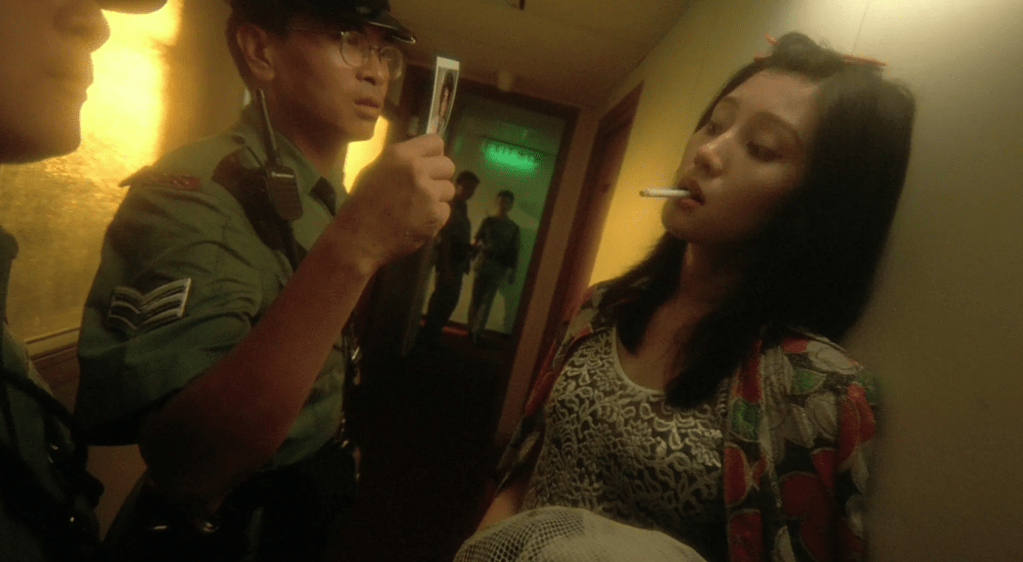
Michelle Reis in Fallen Angels.
I hadn’t seen Fallen Angels for more than a decade until a few days ago. One of the testaments to how the film’s look and feel make more of an imprint than anything else is exemplified by my not remembering that the chief register of the film’s other story — about a mute troublemaker (Kaneshiro) about town and a flighty woman (Charlie Yeung) with whom he establishes a rather one-sided bond — is grating.
If the Reis and Lai storyline is mostly defined for its noirish swagger, the stuff with Kaneshiro and Yeung is demarcated by its would-be comedy. Brought about by devouring a can of expired pineapple as an impressionable 5-year-old, the Kaneshiro character’s silence, in addition to Yeung’s jealousy-fueled histrionics, is packaged with the sort of whimsy that even Kaneshiro’s chiseled handsomeness cannot make much more tolerable. (Fallen Angels is, while I’m on the subject of physical traits, a wonderful hair movie: Reis’ partition-like tresses; Kaneshiro’s heartthrob mop, always messy in the right ways; Yeung’s lethargic curls; the faded-to-orange, Marilyn Monroe-like pile atop the head of Karen Mok, who plays a screechy woman Chi-ming takes up with who underwent a dye job so that no one who ever saw her would forget her.) It’s a good thing, then, that Fallen Angels is a perennial thrill to look at, recasting life’s miseries as inviting, even when it’s floundering. “The night’s full of weirdos,” one character will declare; in Fallen Angels, society’s ignored outcasts are temporarily bestowed an importance that makes everybody else seem insignificant.

