A delayed bus made me a couple minutes late to my Saturday-morning screening of Nicolas Winding Refn’s Her Private Hell. I don’t know if that missed sliver of time could have changed anything, but for a movie that turns out to be monotonous enough for it not to matter if I’d, say, slipped out for an extended bathroom break partway through, I doubt it.
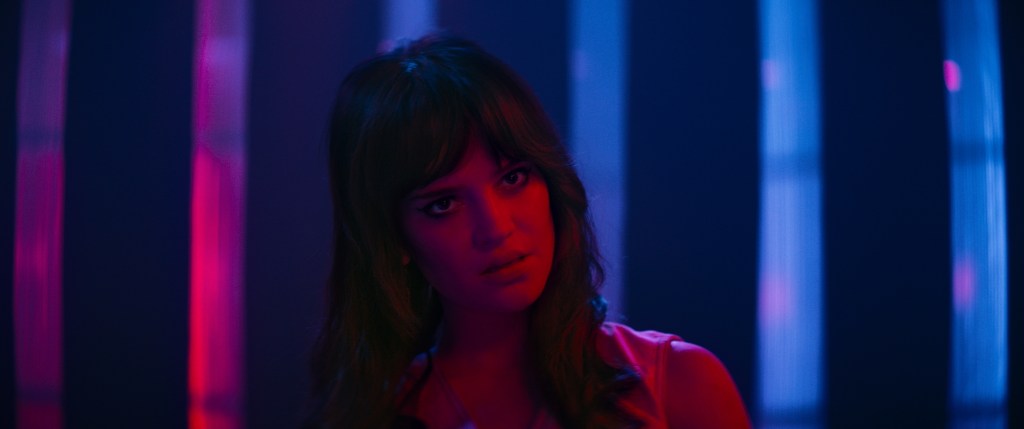
Refn’s proportionately stylish and insufferable latest — his first feature-length project, after a period working in TV, since 2016’s gruesome showbiz nightmare The Neon Demon — carries on with the latter film’s proclivity for bisexual lighting, imperiled willowy beauties, and grisly violence, all of which feed a narcotically spare, two-for-the-price-of-one narrative. The primary one circles a harem of gorgeous 20-something actresses who’ve assembled high up in a tony hotel for the shoot of a low-budget space movie in the key of Mario Bava’s Planet of the Vampires (1965). All are worshipful of the director, Johnny Thunders (Dougray Scott), an unctuous auteur who’s the type to store cigarettes behind his ear and cast both his daughter, Elle (Sophie Thatcher, better than the movie), and her new about-the-same-age stepmother, Dominique (Havana Rose Liu), as the leads. The production — from which we only see a single sequence — is being menaced by jealousy- and apparently lust-fueled infighting but more so a black-clad serial killer who looks straight out of a giallo movie. Dubbed The Leather Man, he has dangerously sharp diamond-trimmed gloves, Boogeyman-esque facelessness, and a calling-card ability to rip open pretty young things in two with his bare hands.
In Her Private Hell’s secondary, mostly wordless story, an American GI, Private K (Charles Melton), vengefully stalks the city below’s mist-choked, mostly abandoned streets. He’s searching for his young daughter — ostensibly snatched not long ago by The Leather Man — when not brutally and unsolicitedly rescuing women who appear to be in deep trouble. For a movie so awash with female objectification, I liked that the only extensively flashed skin belonged to the marble-taut, sweat-shiny Melton, which looks beautiful even when being vigorously pummeled and whipped by fuming opponents.
The Copenhagen-shot Her Private Hell’s world doesn’t much resemble ours. Streaked with eerie post-apocalyptic barrenness, its wandered-around neon purgatory unifies the visual fundamentals of the aforementioned Bava; the New York City-set films noirs of the 1940s and ’50s; and Ridley Scott’s Blade Runner (1982), down to its exoticized invocations of Japan. Fog malevolently snakes around buildings like poison ivy; a nightclub’s odd emptiness suggests an unseen ghostly clientele. Everyone speaks, zombie-like, in semi-koans that are once absurdly given a break when a pair of characters decides to converse by yipping like dogs. If they were pleasurable at all, Her Private Hell’s pleasures could be said to be purely aesthetic. Resembling moving mood boards of a designer-brand commercial or a big-budgeted photo spread from a magazine like V or Interview, Refn’s sophisticatedly curated dupes of decades-old styles is slickly manicured and clearly exhaustively studied but dispassionately clinical, its lone bright spot the swooning, strings-heavy score from the legendary Pino Donaggio.
Part of me wants to complain at length about Her Private Hell’s retrograde depiction of women — every female character is a glassy, handsomely shot object of desire (sexual, homicidal, patronizingly salvation-minded, you name it), and when women are alone they’re usually talking about a man — if that strain of umbrage didn’t feel so obvious, or if the enduringly provocation-chasing Refn weren’t probably gunning a little for some indignation. The ending semi-complicates the film’s stylized recapitulation of the damsel-in-distress trope. But the sexist shallowness coming before it made me see it cynically — that the movie’s decided-on “final girl” (whose survival is, for what it’s worth, not conditional on her reifying the stock type’s sexy-virgin constraints) has only gotten to survive because her male creator has permitted it. The last decade, Her Private Hell proposes, has only nourished Refn’s adolescent-fantasy regression.
Image credit: Neon

