
Jayne Mansfield once offered an eerily prophetic hypothetical. “If I’m in an auto accident and my face is scarred and I lost my legs — [if] any terrible mishap happens,” the actress once told a reporter, “my children will always be cared for.” Mansfield would, tragically, be killed in a car crash in 1967, two months after her 34th birthday. Most of her kids sat in the backseat; all survived. Her children would, as she’d promised during that aforementioned interview, continue to be looked after after her death. But she couldn’t account for the emotional wilderness they’d keep having to cut through in the decades that followed. It’s one thing to prematurely lose a parent, quite another when they were at one point monoculturally famous, yoked to an image having little to do with who they were behind the scenes.
In My Mom Jayne, a documentary released on HBO Max last summer, Mansfield’s second-youngest child, Law & Order: Special Victims Unit star Mariska Hargitay, leverages the documentary form as a tool to grow closer to the mother she never knew. (Three at the time of Mansfield’s death — which she was at the scene of — Hargitay has only one admittedly untrustworthy memory of her mom: of Mansfield affectionately stroking her hair as she munched on her morning cereal.) Early on in the film, Hargitay professes to spending much of her life attempting to distance herself from her sex-symbol mother, ashamed of her breathy-voiced bombshell public image and lastingly hurt by the familial fissures she left behind. But COVID-era reflectiveness, further urged by a steady stream of fans sending her Mansfield-related memorabilia, softened her. She felt newly determined to get a fuller picture of a woman her family didn’t often talk about, not wanting to kick up painful memories, and whom she was protectively warned never to read the countless tall-tale-filled biographies of.
Directed by Hargitay herself, My Mom Jayne does not, as it could be inferred, neatly fit in with the several other documentaries and dramatizations of the last decade about blonde women public figures put through the wringer: 2017’s I, Tonya, 2021’s Spencer and Framing Britney Spears, 2022’s Pam & Tommy, to name a few. Those works arrive at the same facile-but-not-unearned conclusion: that these women were treated horrifically at the peak of their fame, and that the media landscape and consumers who propped that atmosphere up collectively owe them an apology. My Mom Jayne doesn’t necessarily disagree with these films’ thesis. A short clip in which Mansfield is mocked on a talk show, both by the host and audience, for vying to reintroduce herself as deeper than a bubble-headed sex symbol is agonizing to watch, for instance.

From left to right: Mickey Hargitay, Jr., Mariska Hargitay, Jayne Marie Mansfield, and Zoltan Hargitay in a scene from My Mom Jayne. All imagery courtesy of HBO Max.
Assisted by testimony from Hargitay’s semi-reluctant siblings, My Mom Jayne evinces Mansfield’s life story as more nuanced than palatable victimhood framing can contain. Yes, Mansfield’s public image as a male gaze-lassoing bombshell became an albatross whose artistic limitations ended up severely depressing her. But she also was obsessive and, for a time, enthusiastically gung-ho about attracting as much publicity as possible at all costs, newspaper clippings assiduously collected in a swollen scrapbook by the actress herself to quantify her endurance in the public conversation. She was as known for blessing the openings of new stores as she was for her work in movies, Mansfield’s nearly-100-year-old press secretary Raymond Strait recalls while seated across from Hargitay.
My Mom Jayne is a tender but fairly gimlet-eyed act of biography made more heartrending by Mansfield’s physical inability to explain herself in the present tense. It commemorates the multidimensional woman Mansfield seldom got to be in public — she could, for example, fluently speak five languages, and she was a skillful violinist and pianist — while unhesitantly airing out her faults: her infidelities; her tendency, especially in her troubled later years, to prioritize her buckling career and fraught romantic relationships over her maternal obligations. (Adding to the distance Hargitay felt between herself and her late mother was the fact that, in most of their pictures together, Hargitay is not being held by her mom but standing off to the side, and how her older siblings’ baby books are packed with details while Hargitay’s own has only a handful of general remembrances.)
But My Mom Jayne doesn’t revel in negative judgment or full-throated resentment. “For me,” Hargitay says, “A lot of this is about reclaiming what was lost.” Now in her 60s, mother-of-three Hargitay paints a portrait of her mother nearly as a peer — another woman who lost a parent as a 3-year-old. She also can’t help but now see her mom through a protective maternal lens, too. Once dubbed “Broadway’s smartest dumb blonde,” Mansfield was thrust into the spotlight at just 21, advised by self-interested handlers quicker to capitalize on her physical assets than her voiced desire to pursue the more substantive acting work prepped for with pre-fame classes. Of course her personal failings were only aggravated with age, fomented by the crippling dissatisfaction with the direction of her career. Though she briefly tried to reshape it, studio executives and the public couldn’t accept her attempted liberation from the Marilyn-shadowing image she once calculatedly characterized as a means to an end.
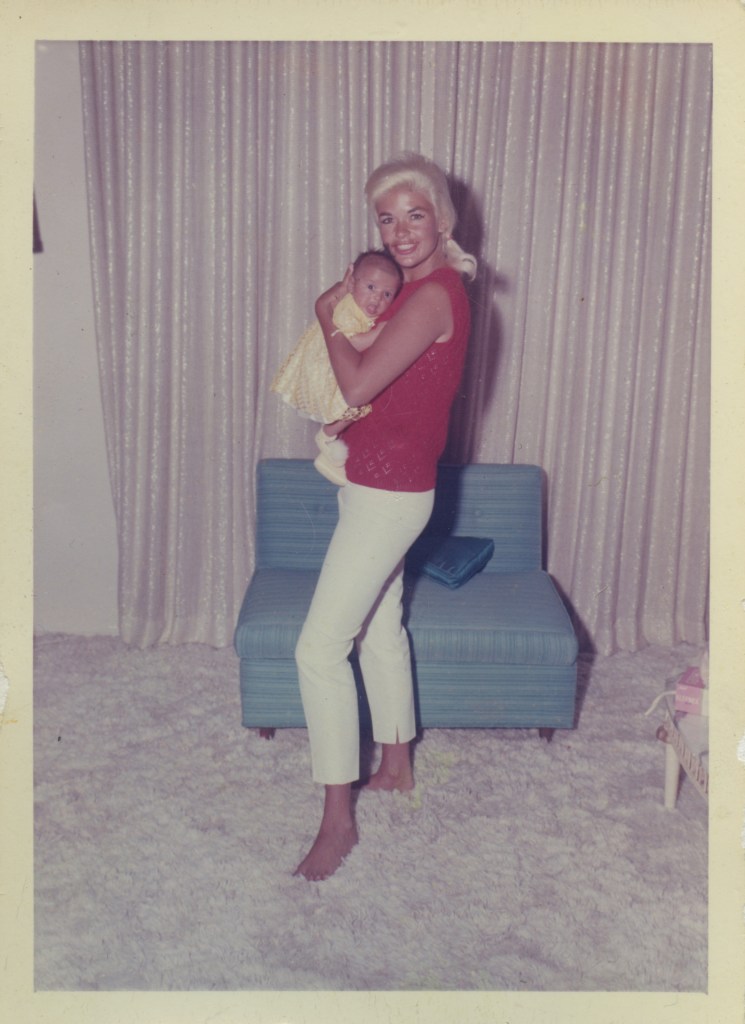
An archival snap of Mariska Hargitay and Jayne Mansfield featured in My Mom Jayne.
Mansfield had moments in her professional life where she got to feed the quote-unquote serious artist. They’re on full, impressive display in movies like the John Steinbeck adaptation The Wayward Bus and the grimy film noir The Burglar, both from 1957, and even in one of the movies for which she’s best known: the acid-dipped showbiz satire The Girl Can’t Help It (1956), in which Mansfield’s character is similarly aware of the image expected of her. But Mansfield’s eldest daughter, Jayne Marie, notes to the inquiring Hargitay that opportunities for meaty roles dried up about as soon as they were offered. Having to go back to doing something like 1963’s Promises! Promises!, now best known for being the first post-talkie-era film to feature a mainstream actress doing nudity, was, for Mansfield, a sort of nightmare, a pride-swallowing surrendering to an archetype out of desperation.
My Mom Jayne is more puzzlework than definitive biography — of a different sensibility than one would expect from a child making a compassionate movie about their parent. It’s not a hagiography. It’s nearly as much about Mansfield as it is about Hargitay, who spends the movie’s last half hour or so detailing her discovery, in her mid-20s, that Mickey Hargitay, whom she’d grown up understanding was her dad, actually wasn’t. (This section of the movie, sensitive to both of Hargitay’s father figures and how they viewed their respective relationships with her and Mansfield, marked the first time Hargitay publicly disclosed this truth, kept secret for decades to protect the man who raised her.) My Mom Jayne is a reminder that absence-through-death is its own kind of constant presence, fundamentally shaping us in ways we can directly point at and in ways that are unconscious until they’ve been fed more details, more context. For years, Hargitay couldn’t understand why there seemed to be a vaguely maintained distance between her and the family unit with whom she grew up. She’s now regretful of how the eventual truth impacted not just her biological father but also the half siblings he gave her: the largesse of her celebrity led her to request they keep the truth under wraps, too, which also took a toll on them.
In My Mom Jayne’s first few moments, Hargitay ambles around the dusty, rusty ruins of Mansfield’s famously gaudy Pink Palace. She’s wearing a pink T-shirt that’s maybe or maybe not meant to be an oblique tribute. An apposite metaphor for Hargitay’s starting place in her inquiry — surrounded, everywhere she looks, by damaged, hard-to-make-sense-of personal history — Hargitay’s film-opening wandering is made more meaningful by the film’s end, when she’s found enough clarity to make what had once been difficult to parse painfully but gratifyingly vivid. She can now mourn a complex person. The projected-onto figure that had haunted her is now, too, a relic of the past.

