
In the films of writer-director Jane Schoenbrun, the media that resonates with us can be as nourishing as it can be vampiric. It can, on the one hand, put into sharper focus how we see ourselves — provide, even if we can’t always discern the exact crux of their impact, visual and emotional representation of what we want and who we want to be. But on the other, unhealthily relying on it as a vessel to primarily and vicariously live through can spin a cocoon that swaddles us from perhaps soulfully necessary risk.
It is, it goes without saying, easier said than done to live out all of one’s defining innermost truths, particularly when, as it is in some way or another with Schoenbrun’s three-movie-long oeuvre, they have to do with gender expression. (Schoenbrun today identifies as transfeminine and nonbinary, their transition coinciding with the making of their second movie, 2024’s I Saw the TV Glow.) The contexts we were reared in, the places we currently live, the ingrained cultural attitudes we might not have yet wholly shaken off, the traumas that have lastingly rattled us, the financial capital available to expend, and other adversities are objectively far harder to bend to our needs than pressing play on something short and soothingly predictable that makes us feel understood in some way.
Schoenbrun has said that while the haunting coming-of-age movie I Saw the TV Glow was decisively more about the purgatory of pre-transition life, their latest, Teenage Sex and Death at Camp Miasma, is more about stumbling through the post-, especially as it relates to grappling with sex after reaching a new stratum of self-acceptance and comfort in one’s body. Relying on media as a clarifying device is again an action tormented characters practice to achieve the temporary catharses that feel out of reach in real life. In I Saw the TV Glow, it was a Buffy the Vampire Slayer-esque teen soap. In Teenage Sex and Death at Camp Miasma, it’s a slasher-movie franchise of a piece with the Friday the 13th and Sleepaway Camp series, its thorny history made realer by Schoenbrun’s clever placement of fake memorabilia and popularity-tracking newspaper headlines beneath the opening credits.
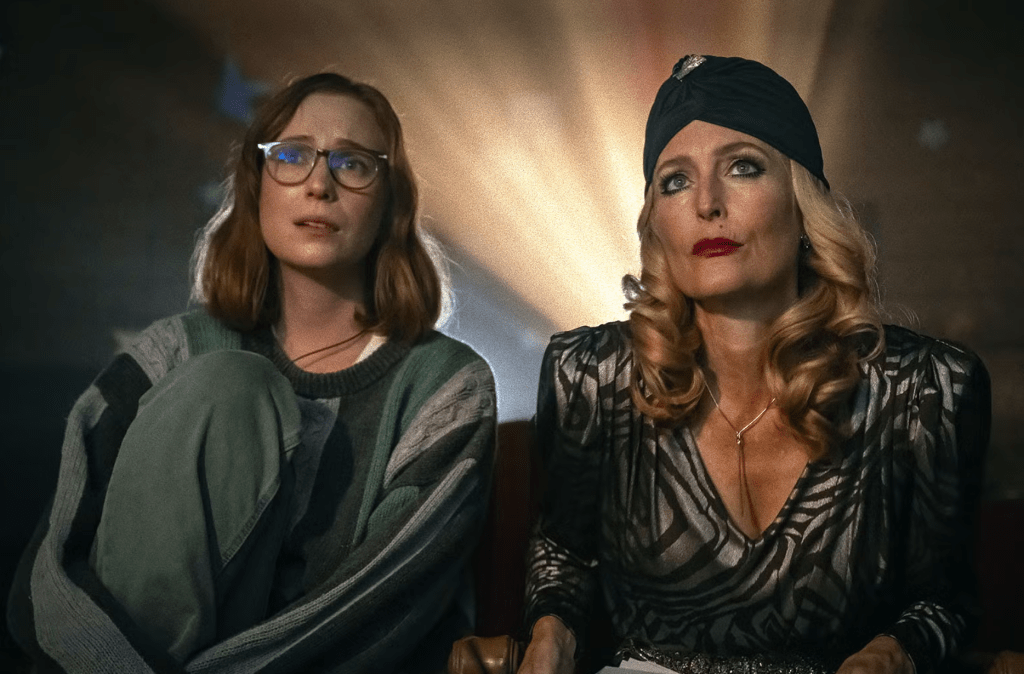
Hannah Einbinder and Gillian Anderson in Teenage Sex and Death at Camp Miasma. All Camp Miasma imagery courtesy of MUBI.
But in Teenage Sex and Death at Camp Miasma — the funniest and formally boldest of Schoenbrun’s movies so far — the nub of one’s fandom becomes something worth actively unraveling as opposed to a means of shutting out the world’s noise. Its heroine, a young, buzzy, and queer filmmaker named Kris (an excellent Hannah Einbinder), is more than hinted to be a Schoenbrun stand-in. Kris’ name is less associated with commercial success than the kind of “next big thing” critical adulation that can dose a burgeoning project with instant credibility. (Her previous project was a riff on 1960’s Psycho that unspooled a narrative from the shower’s point of view.) The preponderance of the movie’s comedy comes from Kris’ dealings with shallow industry gatekeepers and the overly analytical way she talks about her art; it’s nice to see Schoenbrun’s wit — which has mostly been spotlit in interviews and on their social media — get more screen time than it ever has.
Kris’ indie cachet is why, as the film opens, she’s been headhunted to reboot the sequeled-to-death, infamously transphobic Camp Miasma franchise. She knows she could be more insulted about the tokenized reasons she’s pretty transparently been poached. Studio executives want to lucratively revive some slumbering, badly aged IP and figure a path could be paved by a critically revered hot young thing with an “elevated” take Gen Z would be cool with. But Kris is too big a fan of the series to really care. She’s always been taken by the wide-eyed innocence and hidden layers of the pushed-around, Southern-accented final girl of the first film, Billy Presley (Amanda Fix). She has some sympathy for the killer, Little Death (I Saw the TV Glow star Jack Haven), who wears a ripped-off air vent as a mask and whose homicidal snap is blamed on gender dysphoria worsened by the sneering bullying of their peers. This particular reboot also wouldn’t be out of place in a career predicated on picking apart what Kris terms “queerness and cultural depictions of monstrosity.”
Kris doesn’t feel like she can proceed with the project until she has, at the very least, gotten in touch with Billy. Billy became a hermit almost as soon as the movie which made her a horror-genre luminary was released, never to appear in another film. But Kris believes the look in her eye captures the franchise’s soul and wants to harness its crucial power. Portrayed, in adulthood, by the perfectly cast queer icon Gillian Anderson, Billy turns out to be not just open to meeting with Kris but still quite literally living on the set of the movie that presumably ruined her life. The real-life sleep-away camp where the Miasma films had been shot still stands. Resembling the explicitly name-dropped Norma Desmond without sharing any of her delusion, Billy has moved into one of the property’s cozy log cabins, only venturing out to run errands at the likes of Costco.
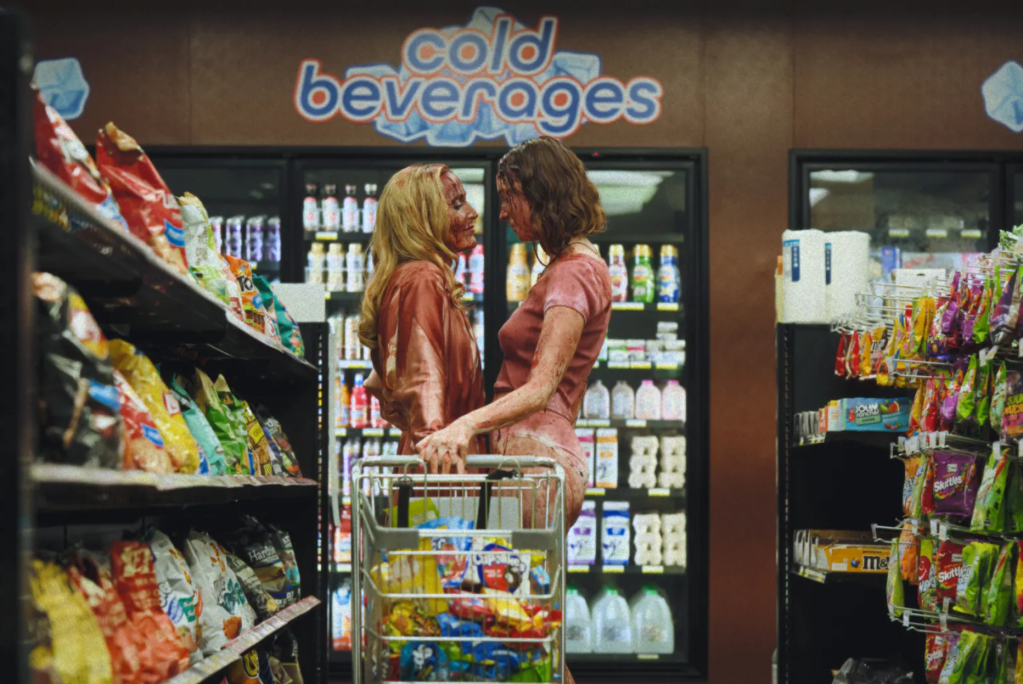
Gillian Anderson and Hannah Einbinder in Teenage Sex and Death at Camp Miasma.
Kris and Billy bond fast, willing to hear out their respective histories with the series and, later on, how it’s raveled in their vexed relationships to sex. The moment Kris sets foot onto the snow-packed camp — turned larger than life because of some ingenious, fervently artificial use of landscape-filling matte paintings — also becomes the one where reality and fantasy start unstoppably bleeding into each other. Footage from the fictional movie bringing Kris and Billy together is extensive and splashed with volcanic gore, and its narrative becomes a seemingly real part of Kris’ own the more she and Billy complicate their professional link into a personal one. The movie, in turn, intermittently becomes more aesthetically baroque, its colors going sugar-crash delirious and its lighting dreamily bloomy.
What Teenage Sex and Camp Miasma is implicitly and not-so-implicitly “about” is as legible as it was with I Saw the TV Glow — which is to say very — but I appreciate how both movies avoid a deluge of explanation. Schoenbrun trusts that you can feel what their movies mean. You sense their affection for the sorts of entertainment their characters latch onto and feel pangs of hard-to-explain recognition in, even as their tropes and the machinery fortifying them are being underlyingly critiqued. “I love television. I love American movies. And I also want to destroy them,” Schoenbrun told Vulture recently, the line of questioning in part about having to work within the commercial power structures mass entertainment requires. “I see them as prisons as much as they’re spaces of emancipation.”
You don’t feel pushed away as Camp Miasma’s abstractions snowball because Schoenbrun so uncannily and thrillingly evokes the feeling of being inside someone’s brain, a place where fantasy and reality regularly unite in indistinguishable, blob-like form. It can as easily be said that what goes on in someone’s head can only really be understood by them as it can be that it’s not as simple as that. Sometimes our reactions to things can be instantaneously comprehended; they can also take years to completely get to the bottom of. Revelations about ourselves, Schoenbrun’s movies continue to remind us, will only keep coming, and it helps to be open to hearing them.
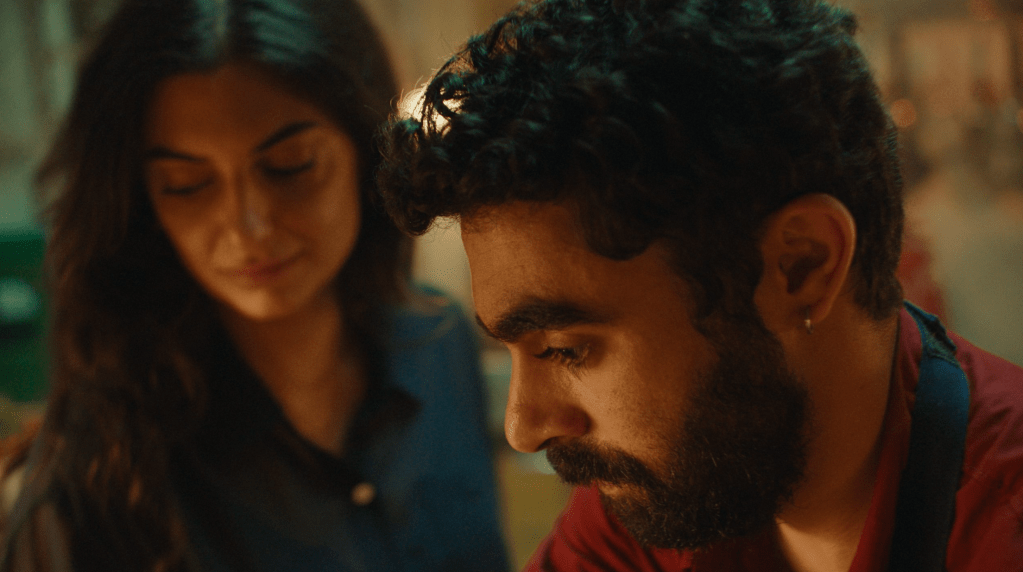
Mounia Akl and Hasan Akil in A Sad and Beautiful World. Courtesy of Watermelon Pictures.
Yasmina and Nino (Mounia Akl and Hasan Akil), the lovers A Sad and Beautiful World orbits around, were born a minute apart in the same hospital in Beirut, their mothers’ pushes interrupted by window-breaking explosions. The two’s formative connection will cyclically continue something like this for the several decades the movie covers. They’re linked nearly as quickly as they’re separated, the safety-threatening political tumult of their hometown a constant concern.
Largely a joyful, unfussily funny romantic comedy until remaining in Beirut seems truly out of the question for its characters, Lebanese writer-director Cyril Aris’ A Sad and Beautiful World has two reunions. There’s an unwitting one in childhood, where Yasmina and Nino (Alex Choueiry and Mohamad Farhat) are classmates, then a couple in puppy love, who hang out after school at an abandoned train track. Arriving years after Yasmina’s parents’ divorce forced a move, the other comes when now-restaurant owner Nino hosts a dinner Yasmina attends. They realize they know each other after Yasmina spots and then looks quizzically at a familiar portrait hanging on the wall.
Yasmina and Nino’s lost-and-found relationship — the kind one would say in real life sounds “like something out of a movie” — is reason enough to want this couple to be together. But Aris and his actors, who did much behind-the-scenes prep work and on-set improvisation incorporating their real-life personalities, make you deeply affectionate for these characters whether or not they’re together and showing off their exceptional chemistry. (Twinges of Akl and Aris’ former real-life relationship and ongoing creative kinship had some influence on the film’s topography, too.)
Yasmina, who works as a consultant, is serious-minded and emotionally guarded — the familial separation that stained her childhood is a lasting trauma — but has a choked-down appetite for mischief Nino helps push out of her. Nino is a goofy romantic whose tendency to always look on the bright side is grounded by Yasmina’s level-headedness. (Perhaps the movie’s most touching moment is when a baby-faced Nino tells Yasmina that he loves her so matter-of-factly that she initially isn’t totally sure how to take the deadpan declaration.) They’re a convincing example of why opposites can so strongly attract — a good, productive thing until, during the movie’s pained last act, they have to seriously contemplate packing up their lives and moving to Dubai. The safety of their daughter and their own financial stability have become too much of a worry in a city whose ruin seems closer by the day. They’re at odds, though, about how to approach long-put-off immigration.
A Sad and Beautiful World is a feat of storytelling, both a charming rom-com and an even-keeled account of how disruptive political upheaval can be on the people caught in the middle. Never feeling like it’s toggling between tones, it shifts into more solemn registers gracefully. It emulates life’s caprices — how one day you can be in high spirits and the next completely shattered — without too-aggressively hammering home points about the world’s unfaltering cruelty. “It felt disingenuous to show Lebanon only in darkness,” Aris said in the movie’s press notes. “The balance between warmth and devastation, between romance and rupture, was the most authentic way to tell [Yasmina and Nino’s] story, and the story of the place I call home.” The movie’s title seems, at face value, uncreatively general. Couldn’t most films be assigned the same one? But A Sad and Beautiful World’s emotional generosity earns it.
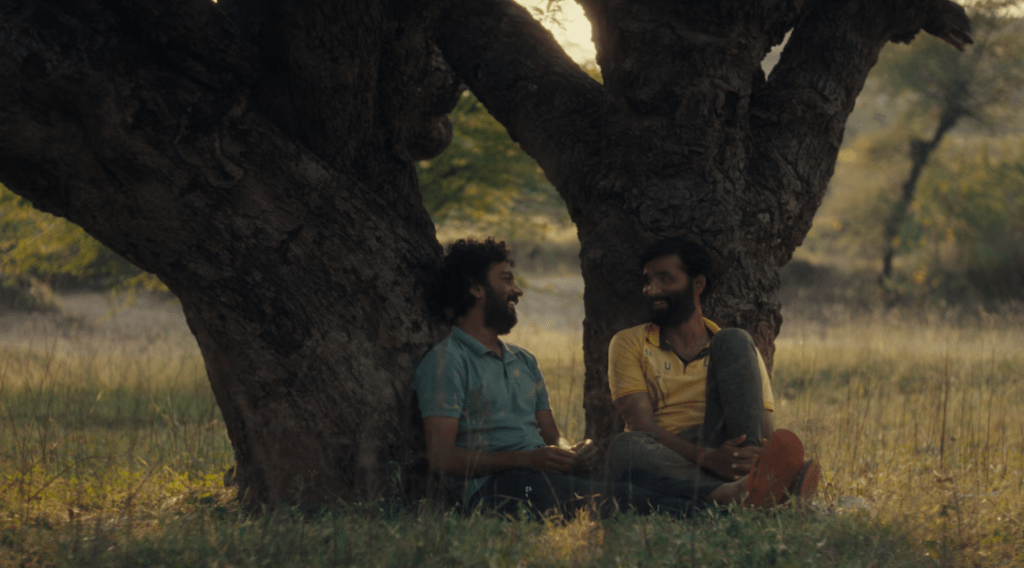
Bhusshan Manoj and Suraaj Suman in Cactus Pears. Courtesy of The Criterion Channel.
Anand (Bhusshan Manoj) has to work hard to be himself in Cactus Pears. Gay and in his 30s, he can be when he’s at home in Mumbai, where he lives with his supportive mother, Suman (Jayshri Jagtap), but that isn’t where the film is set. Instead it’s almost totally stationed in the tiny village where he was raised. The occasion is his father’s funeral. Whenever there’s a respite from the many rituals his traditionalist extended family conducts to pay their respects, the subject almost always turns to Anand’s singledom. Questions never begin with a “why” because everybody is too wrapped up in how soon they can possibly find him a wife. A year — three at the most — would be ideal.
The clammy tension you can probably imagine coming from the constant badgering belies the gentleness of Cactus Pears, which marks writer-director Rohan Parashuram Kanawade’s feature-length debut. The nagging is certainly rough, but Kanawade renders it more like pesky, resilience-testing din compared with the poignance of Anand’s relationships with his mom, an introvert trying to get everybody off her son’s back, and the romance he develops with Balya (Suraaj Suman), a childhood friend he reconnects with who immediately gazes at him with love-of-his-life softness. I confess to melting, a little, when Balya points out some of Anand’s sprouting white hairs so that he has an excuse to lovingly stroke it, or him delivering, offscreen, a bag of the freshly plucked titular fruit to where Anand is staying, its spikes already carefully tugged out.
In this beautifully shot, languidly paced movie, the familially enforced marital pressures both men have to withstand in order not to flatten who they really are are painfully dramatized. Kanawade, however, rebuffs the sort of cliché a different movie with Cactus Pears’ same storyline might capitulate to: requiring Anand achieve familial acceptance and getting the guy for a proper happy ending. He will, spoiler alert, get the guy. But the movie dismisses the idea that winning over people likely not to jibe with who you are anyway is all that important when you have a love interest, mother, and father — the latter of whose ghost will be tearfully embraced in a dream — in your corner, not wanting to change a thing.

