Of the two Steven Spielberg movies that’ve come out this year, I enjoyed The End of Oak Street more. Oak Street was not, I should say, actually directed by the soon-to-be-80-year-old blockbuster titan. That credit goes to David Robert Mitchell, best known for the generationally influential stalker-horror movie It Follows (2014). But Spielberg’s moviemaking genetics are so thoroughly embedded in the film, down to the heavenly way the sun casts down on the titular stretch of could-be-anywhere suburb in the opening scenes and how its histrionic Michael Giacchino score tells us to emote, that one could say he’s, genealogically speaking, responsible for it.
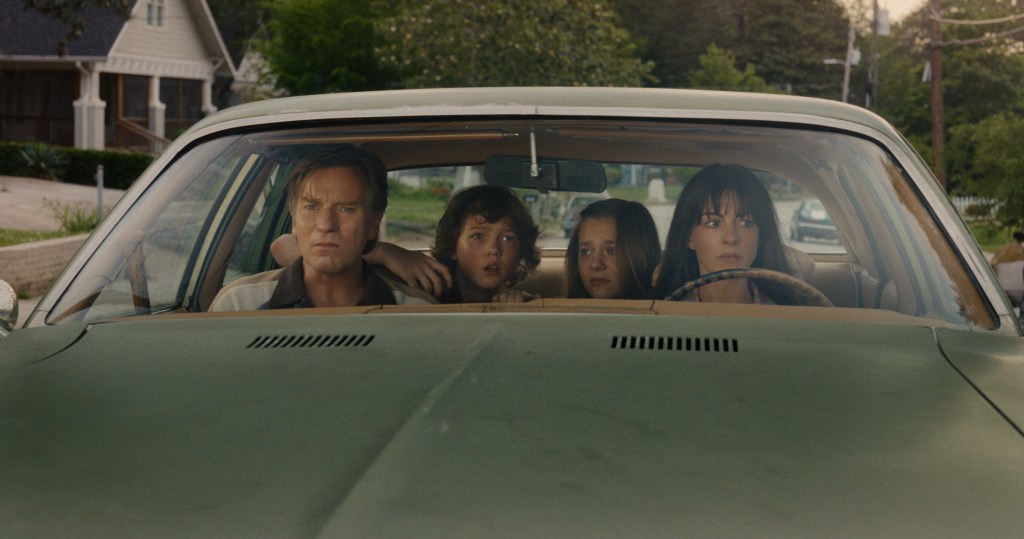
Set in the same year E.T. the Extra-Terrestrial came out, The End of Oak Street is like a Frankenstein’d-together Spielberg project. (If it weren’t as well made and fun, you’d be readier to give credence to suspicions that it were the result of prompting AI to hallucinate its own Spielberg film, and spend more time complaining about mainstream cinema’s ever-worsening preference for nostalgic familiarity over originality.) It marries two modes with which child-of-divorce Spielberg has become associated by standard-setting default: An average suburban neighborhood life-changingly forced to deal with the extraordinary; famished, big-toothed dinosaurs miraculously given the opportunity to tear into soft human flesh. Unlike Jurassic Park (1993), Oak Street doesn’t get into granular detail about how the latter is possible. The nuclear family the movie focuses on — made up of Ewan McGregor and Anne Hathaway as the parents, Christian Convery and Maisy Stella as the kids, and a pet Australian cattle dog named Starbuck I couldn’t believe makes it to the end — simply wakes up one morning, after noticing some blinding flashes of light a few nights before, and notices that a good chunk of their neighborhood has time-traveled back millions of years.
Read the full column at 425.
Header image: Warner Bros. Pictures

