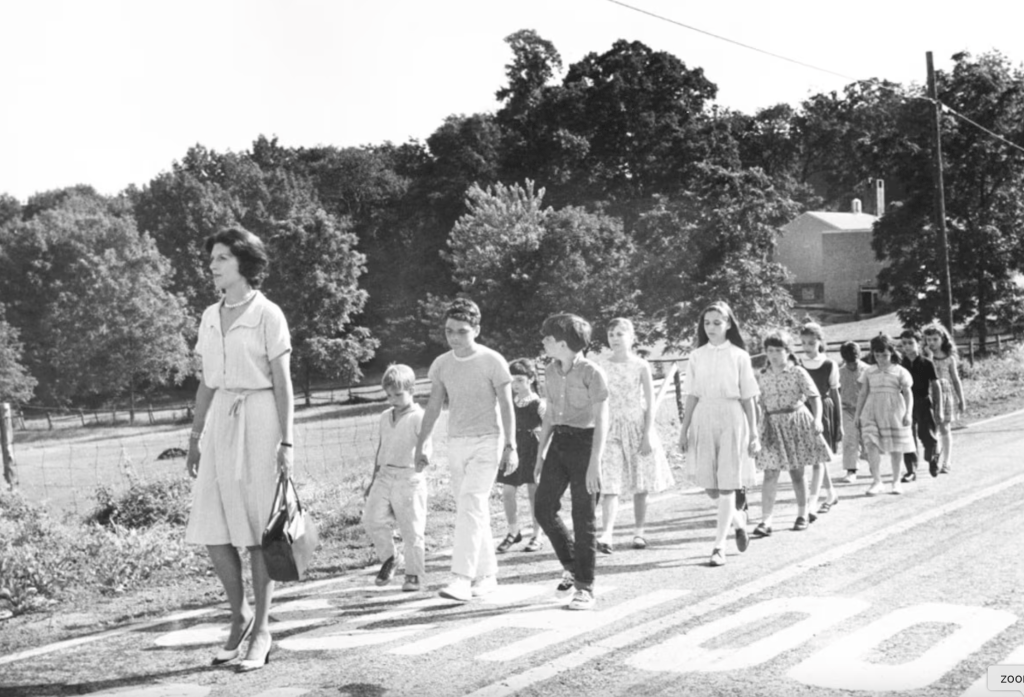
You’re made to second-guess if what’s happening in Ladybug Ladybug (1963) is real. Beyond it being a work of fiction, I don’t mean that its narrative smears the line between reality and fantasy. It’s that it largely keeps ambiguous, all the way until its frantic final few moments, the truth at the heart of its premise. It begins on a hot day at a secluded elementary school in the Midwest. It’s an average morning until an alarm starts to blare in the front office. It cannot, at least not immediately, be dismissed as a drill. The machine is meant to keep those whose ears are being split by it vigilant in the case of Nuclear War. Today’s siren emits a different light and gnat-like noise than the one teachers and students are used to — the one that goes off when it’s time for a practice drill — and a nearby handbook makes it clear: If one is to hear and see this particular signal, then a bomb will likely be dropped within the hour.
The yet-to-happen advent of smartphones and the internet, but more pressingly the lack of answers when official lines are called, leads everybody in Ladybug Ladybug to think this is the real deal. The school’s dearth of a bomb shelter necessitates teachers lead their students on walks home, though that won’t make any difference for the kids living without underground hideouts to lock themselves in. The main teacher the film focuses on, Mrs. Andrews (Nancy Marchand), humorously laments wearing high heels on today of all days.
Written by Eleanor Perry and directed by her husband, Frank, Ladybug Ladybug was based on a Lois Dickert short story that appeared in McCall’s magazine. She, in turn, was inspired by an incident said to have happened in California. I have not, regrettably, been able to track down either. Both, I’m sure, would further immerse the modern viewer in the Perrys’ dread-laden look at life during Cold War-time, which for the then-contemporary audience member incensed by constant paranoia was probably agonizingly “too real” — a nightmare realized.
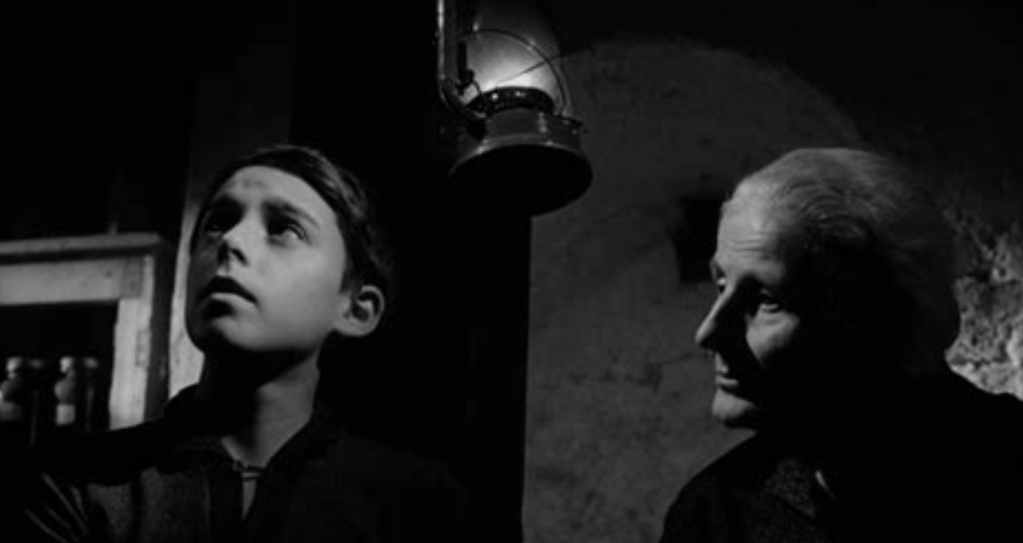
Alan Howard and Judith Lowry in Ladybug Ladybug.
But Ladybug Ladybug is abundantly disquieting as is, and the fears it depicts haven’t been pacified enough to render it a relic. American children may not live with the same terrors over potential eradication by warhead — though one can’t say that with full confidence with the current administration’s fondness for international aggravation — but still fundamentally the same is a younger generation coming of age with the unsettling understanding that their future could be snatched from them at any time, physically these days by the increasing rate of climate change-related calamities and existentially by the advancements of AI. In Ladybug Ladybug’s age of the nuclear weapon, the school isn’t a sanctuary; likewise, too, for our present-day age of the mass shooter, for instance.
Growing up jaded about the world can result, the film shows, in deepened empathy, as it is with the war-abhorring Steve (Christopher Howard). Or it can give you a warped view of the world, as seen in a moment in a bunker where a couple of kids jokes about bombs killing millions at a time and, later, when a classmate arrives late to retreat in a shelter with her peers. They won’t let her in because there will not, ostensibly, be enough oxygen. Whether prodding at their still-being-worked-out ideologies or watching them melancholically make tenuous weekend plans with each other, Eleanor Perry has an excellent ear for the way children express themselves and talk to each other. Frank, for his part, coaxes performances out of most of his young actors devoid of cutesy mugging.
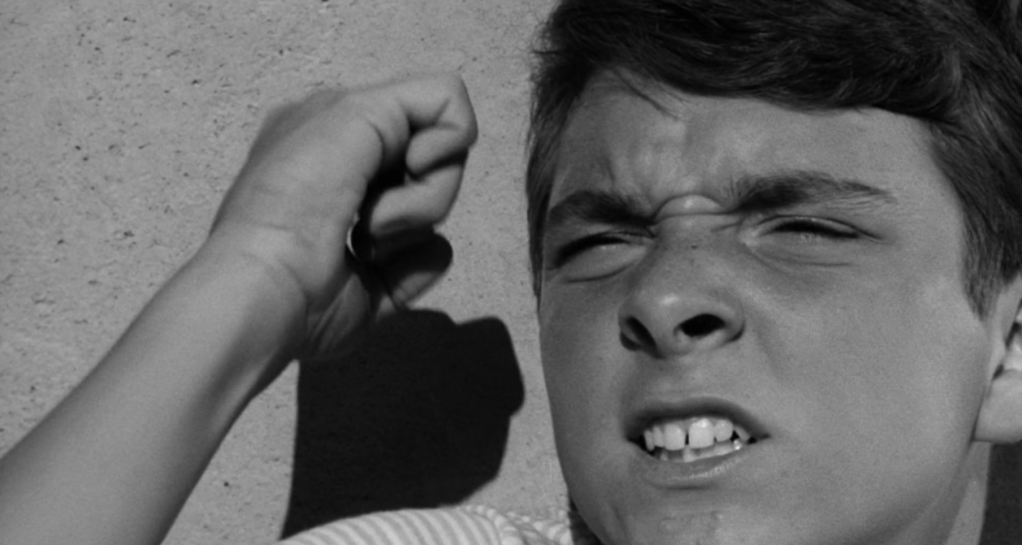
Christopher Howard in Ladybug Ladybug.
It wouldn’t be fair to say all the adults in Ladybug Ladybug are useless. Your heart hurts for Mrs. Andrews, who’s palpably trying to keep it together, even when the spike in one of her heels fails to, in front of the children she stoically leads on roadkill-littered roads. Ditto for the school’s cafeteria manager (Jane Connell) and its heavily pregnant secretary (Kathryn Hays), who respectively try lightheartedly preparing food amid the scary uncertainty and wander around an empty classroom like a ghost, pregrieving the student body responsible for its clutter and her own mortality.
But Ladybug Ladybug, in addition to (and of a piece with) its contempt for nuclear capabilities, also progressively interrogates the automatic authority given to adults and how it routinely fails the societally built-in helplessness of children. One girl, JoAnn (Linda Meyer), begs her mother upon arriving home to hide in the basement, but the patronizingly disbelieving latter refuses to let her, clucking that there’s too much loose water and it would create a mess. (JoAnn has to settle for stowing away under her bed, her brought-along goldfish its own kind of teddy bear.) It could be argued that not nearly enough is done by the school’s principal, Mr. Calkins (William Daniels), either. If it’s so difficult to get in touch with official channels, why not try, in the meantime, to call one’s personal contacts to gauge if they’ve heard any news reports? But even that possibility couldn’t reverse the psychic damage that’s already been done.
Children, the film incredulously and still-pertinently concludes, are consistently failed both personally and by the larger forces able to determine their future. Late in the movie, some of the kids take an informal poll whether they’re for or against war. They’re unanimously against it; they know that won’t change anything. “It’s all silly,” one of them says. “Who’s going to ask us?”

