Our Land wasn’t always the official translated title of the Argentine filmmaker Lucrecia Martel’s first documentary. Presented as Nuestra Tierra in its native tongue, the movie follows the trial of Dario Luís Amín, the land-hungry murderer of the Indigenous-rights activist Javier Chocobar. The project was originally given the moniker Landmarks for the English-speaking market. Then festival-circuit feedback elucidated something that hadn’t initially been clear to Martel. “We were told that it was not a good translation,” she recounted in April in an In Review Online interview, before qualifying, “I don’t think ‘Our land’ quite captures the title in Spanish [either], because you lose the double sense: ‘Nuestra tierra’ means both ‘our land’ and ‘our Earth’ — the planet Earth. So it’s one of those times where there is a lack in the translation.”
Martel’s movie merits its title’s capaciousness from the moment we see its provocative first image: a satellite camera eerily drifting outside the planet’s bounds. It uses tense scenes from the trial as a springboard, rather than an all-consuming narrative focus, to scrutinize Argentina’s long-ingrained and still-ongoing colonialist damage. Fittingly for a director whose work has never settled for easy explanation, Our Land eschews conventional documentary practices — talking-head interviews, long-winded historical explanation designed to catch those unfamiliar with its presented topic up to speed — in favor of subtly loaded imagery and testimonials from members of Chocobar’s Chuschagasta community.
The majority of their related memories, many of which bring additional dimension to Chocobar’s cut-short life, soundtrack a succession of images that have been printed, collected, and assiduously kept in pristine condition over the years. (Several of them were taken by chronic shutterbug Chocobar himself.) With Our Land, Martel potently indicts her country’s systemic undercutting of Native humanity. The trial, for instance, didn’t happen until nearly a decade after Chocobar’s 2009 killing, finally brought about in part because of relentless public protestation from advocates and his own community. But it additionally places at the forefront a marginalized history that deserves to be heard on a broader scale, not just relegated to the people who continue to share it among themselves and with future generations they hope will maintain the stories they know could otherwise be lost.
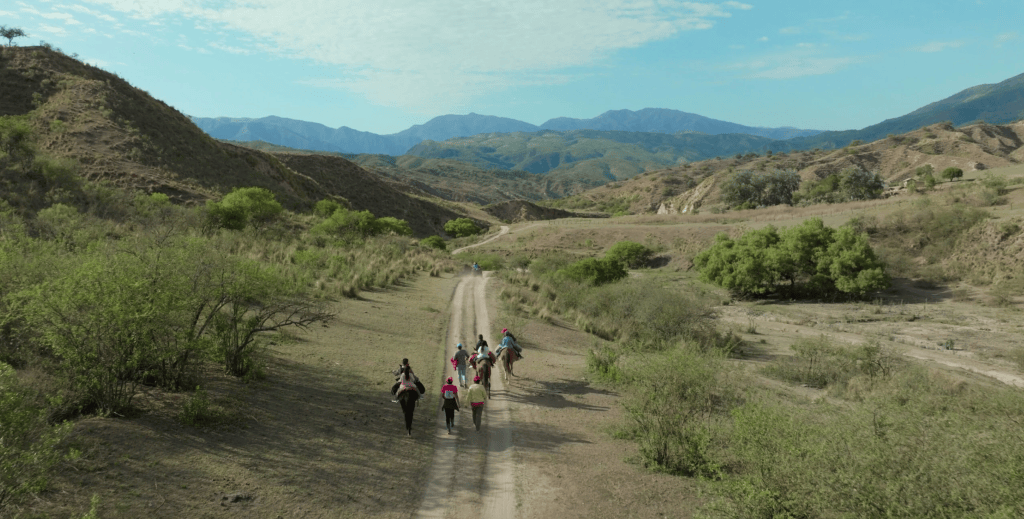
Besides its reliance on extended slide shows and archival cell phone footage, another of Our Land’s most inspired formal choices comes from Martel’s extensive use of drones to survey the expansive land on which Chuschagasta people have generationally built their lives. The effect can be beatific, capturing the territory’s vastness and the continuing history it contains. But more frequently it’s creepy, subversively evoking the arrogant, predatory gaze of colonizers convinced of their right to intrude on a populace they see as subhuman at any moment — colonizer-signed, -sealed, and -delivered paperwork is an oft-used example of land-related entitlement — and leave, with impunity, the moment things start to get too uncomfortable.
Contradicting a callous conclusion made by one of the perpetrators in some late-aughts cell-phone footage seen by the jury — “no one in the courts listens to them anymore” — the trial’s outcome did not totally fortify colonial invincibility. Though there was an infuriating temporary appeal, justice ultimately came for Amín and his well-documentedly corrupt former-police-officer co-conspirators. (Pre-closing credits title cards inform us that while Amín — who died of COVID in 2021 — and co. successfully appealed the guilty verdict in 2020, the sentence was upheld in 2025, his accomplices again made to face their original prison sentence.) But Martel’s meditative, coolly exasperated film knows a step in the right direction hardly rectifies history’s ugliness or precludes future harm.

