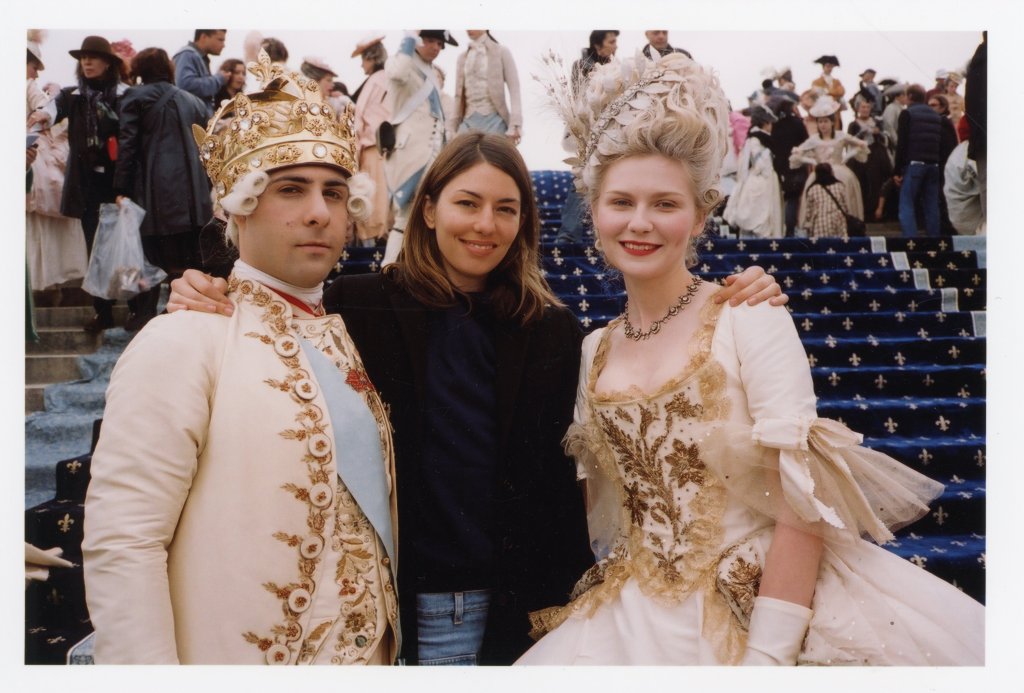
The air is oppressive in Sofia Coppola’s Marie Antoinette (2006), an anachronistic biography of the tall-haired royal that looked for the probable emotional truth beneath her life’s infamously punished rococo decadence. The air of Eleanor Coppola’s newly and posthumously released account of the movie’s production, Making Marie Antoinette, is oppressive, too; its fought-through heaviness only enriches the resulting film’s astounding achievements. Marie Antoinette’s convincing world-shunning claustrophobia, the elder Coppola’s movie shows us, was a consequence of tireless attention to extravagant detail and brutally long, anxiety-wracked working hours that made sure the movie — Sofia’s still-highest-budgeted at $40 million — stayed on schedule and never had to request additional funding.
Eleanor, the self-professedly shy Coppola matriarch who also notably chronicled the haywire making of her husband Francis’ war epic Apocalypse Now (1979), caught about 80 hours of footage during Marie Antoinette’s shoot. Excluding a tasty, condensed featurette included with the film’s DVD, Eleanor didn’t do anything with it until the COVID lockdown. Trapped indoors with no place to go, she and bubble-mate Sofia started again looking at the footage and puzzling over how to shape it. Eleanor, though, passed away in 2024 after some long-fought health issues, her glut of fly-on-the-wall mementos still not yet whittled into a finished product. With Making Marie Antoinette, what began as a loving gesture to a daughter from a mother becomes the reverse, with Sofia recently putting on finishing touches that include readings from Eleanor’s journals by actress Diane Lane.
The latter stack among Making Marie Antoinette’s most moving revelations. Eleanor worries on the page about whether her daughter can handle an undertaking that in her oeuvre remains anomalously massive in scope; a chronic case of bronchitis is suggested to be a physical manifestation of the pressure Sofia’s equanimous exterior and monotone affect would never show. But Eleanor is concurrently inspired by her offspring’s unwavering commitment to her vision no matter what her all-male crew (and visiting dad) thinks. Eleanor also confesses to harboring a little resentment about not being the person leading the charge; she’s elsewhere written about craving more visibility in a life where she’s seen as peripheral to the main-character types filling her family tree.
Unlike many other making-of documentaries, Making Marie Antoinette’s impulse isn’t to string together a narrative out of on-set conflicts, homed-in-on actorly dramas, and other fonts of possible tension. It isn’t its style, either, to tell us how an elephant was wrangled for one of the film’s scenes or how groups of dogs were directed during faux countryside hunts. Instead it testifies, mostly via indoor shoots and without any major setbacks that we see, to the extraordinary sensitivity of a production, where even the slightest coddling of bad energy can instantaneously poison the atmosphere. The grain of Eleanor’s toted-around camcorder symbolizes the self-doubting humanity that an audience can forget about when confronted with a prodigious artistic accomplishment in its final form. Marie Antoinette today feels like the work of an auteur completely in control of her aims. Making Marie Antoinette makes you acutely feel how susceptible to compromise those aims are, with a minute-to-minute influx of new questions and problems to field more than capable of setting things off track. The art of saying no — and Sofia is virtuosic at doing it without invalidating her crew’s unsolicited notes — becomes an unseen crucial part of the creative process.
The predominant mood on Marie Antoinette’s set seemed to be of utter exhaustion. The only people extensively shown to be actively having fun are perpetual jokester Jason Schwartzman, who’ll spend much time between takes dallying on a gilded harpsichord, and the cameoing Marianne Faithfull, who raspily speaks to Coppola with the fondness of a wizened aunt who has a bottomless cache of cool stories to reach into. In some off-the-cuff interview footage, star and muse Kirsten Dunst cops to not realizing she’d be in almost every second of the movie until she strolled into the Palace of Versailles, where the French government allowed Coppola to shoot on location. Costume designer Milena Canonero’s no-holds-barred perfectionism can be detected in the fatigue ringing her eyes. (She made 72 costumes for Dunst alone; her lineup of towering powdered wigs had to be pampered no differently than human hair.) But the production’s weariness was braved through because of a clear communal faith that Sofia would pull off her audacious vision. Despite some vocalized rustiness during the first few days of shooting and some professed insecurity — Sofia frets, early in the production, about the possibility of the movie seeming too much like an episode of the stuffy Masterpiece Theatre — she would.
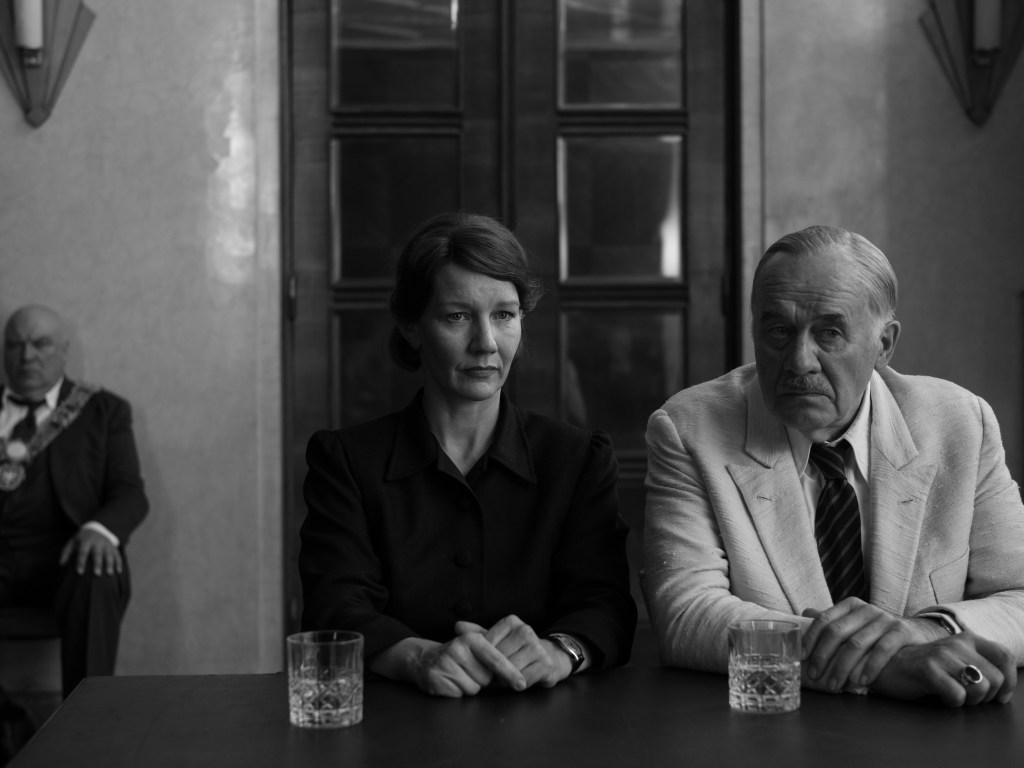
Sandra Hüller and Hanns Zischler in Fatherland. Photo by Agata Grzybowska. Header image: Jason Schwartzman, Sofia Coppola, and Kirsten Dunst on the set of Marie Antoinette. Photo by Sofia Coppola.
For his first movie since 2018’s Cold War, a dramatization of his parents’ relationship, Poland’s Paweł Pawlikowski again extracts from the past. Epigrammatic but modestly potent, the 1949-set Fatherland, touted as the finale of a historically minded trilogy, too has a familial bent, this time angled toward an internationally renowned literary family: Thomas Mann (Hanns Zischler) and his two adult children, Erika and Klaus (Sandra Hüller and August Diehl). Now living full time in California, the esteemed Thomas is on the oratory circuit in his native Germany, giving progressive speeches that prompt dutiful standing ovations in a post-Hitler nation. Erika serves as his assistant, accompanying him at his engagements and acting as a multilingual translator during press conferences.
As much as Thomas would like to comfortably rest on his laurels, Fatherland meets him at a tricky (and thornily fictionalized) juncture. He’s due to receive the vaunted Goethe Prize, which he’s being gifted, and intends to collect in person, in both West and East Germany. Given the latter’s Soviet occupation, his friendliness to the enemy could trigger his persecution in the U.S., to which he fled amid Hitler’s rise. (Some of the film’s sharpest moments understatedly depict the cynical co-opting — or attempted co-opting — of Thomas’ reputation as a means to obtain cultural legitimacy, his words self-consciously applauded rather than embodied by his benefactors.) Then Klaus, tormented by his homosexuality and his general hopelessness over the state of the world, kills himself. Erika would like Thomas to stop and reconsider his trek. She’d rather he not jeopardize his livelihood over his art-comes-first view on borders. She wants him to put the kibosh on his planned literary tour in order to deal with the immediate ramifications of Klaus’ death. But Thomas stubbornly wants to proceed, downplaying the possible political aftermath and dismissively framing his son’s demise as a what-can-you-do inevitability to do nothing more than shrug at.
Stylish without drawing attention to it, like a series of laminated historical photographs, Fatherland is sympathetic to both parties. The movie’s haughty version of the stateless Thomas can’t help but cling to an unsustainable situation over which he feels he has some dominance. Erika is bewildered over her dad’s denial-suffused lease on life, increasingly angered by his apparent commitment to morally affirming and spiritually enlivening words more than he is action. (One especially explosive monologue recalls Hüller’s now rather famous tirade — the one favored as an awards-show clip where she fumes at her husband’s self-victimizing sullenness — in 2023’s Anatomy of a Fall.) These people, differently struggling to accept their respective realities, will come to what seems to be something like reciprocal understanding. The hushed, decorous Fatherland lets that on not with an exchange of words but some tears shed beautifully and silently while seated side by side.
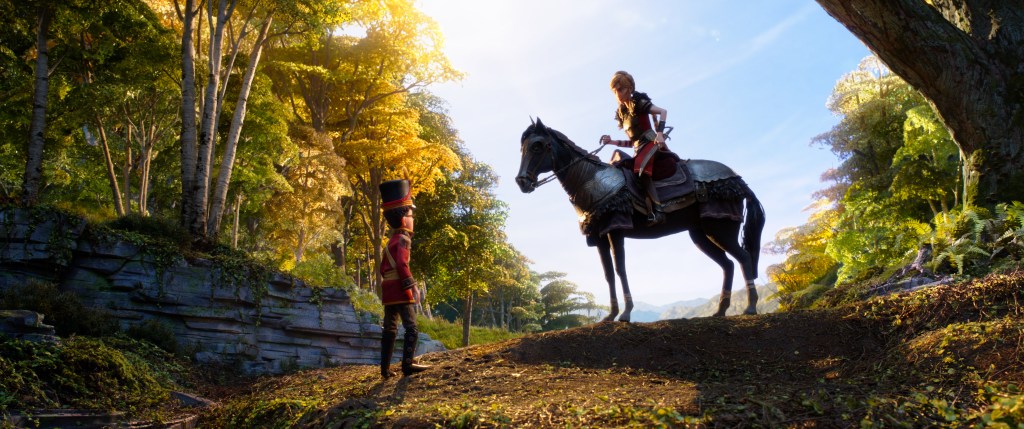
From Wildwood. Courtesy of Laika.
In 2026, watching something like Travis Knight’s Wildwood, the latest stop-motion-animated fantasy film from Laika (2009’s Coraline; 2016’s Kubo and the Two Strings), promises to feel like slipping into a warm bath irrespective of its narrative quality. Any at-length celebration of abnormally laborious craftsmanship is bound to feel good as AI carries on sucking the life out of everything in the name of slipshod productivity. So it’s a plus that Wildwood, whose production lasted about five years, doesn’t rely too heavily on sheer visual magnificence and technical bravura to get by. It tells a chosen one-style fantasy story in Portland, Oregon’s wandered-into backwoods — a mystical, nearly impossible-to-get-into place where humans and anthropomorphic animals in cozy knitwear coexist and have to deal with the power madness of a grief-crazed witch (voiced by an American-accented Carey Mulligan) — with humor, immersive world-building, and a steady trickle of dazzlingly executed chase sequences.
Wildwood admittedly strikes too many familiar YA beats to feel especially original story-wise; it has some third-act difficulty landing the proverbial plane, padded out by a spate of stunningly visualized — and startlingly violent — war set pieces. But in a human ingenuity-saluting movie like Wildwood, where throwaway sights like a character munching on a cracker or slippery mud squelching underfoot have a twinge of the miraculous, creative imperfections are recast into a collective badge of honor. “Enjoy handmade art,” some signage at a passed-by farmers market winkingly and forebodingly reads, “before it’s gone for good.” I promise I’m doing my best.

