
Knowing nothing going into Mouse, I expected it, judging by its first few minutes, to be a keenly observed coming-of-age drama that would weave braided, sensitively told narratives about rising-senior best friends Minnie and Callie (Katherine Mallen Kupferer and Chloe Coleman). The pair invigorate old stock types: Callie, a conventionally pretty extrovert, is a genuinely talented singer and actress with her eyes dead-set on Broadway; Minnie is a gangly, self-effacing introvert whose main gift in her 17-year-old life is her unglamorous but nothing-to-sniff-at faculties with math. But Kupferer’s and Coleman’s performances and chemistry feel so immediately broken in that they made me think of classmates I would have gotten along with in my now-decade-gone high-school years. “I love these girls,” goes one of my notes’ first few bullet points, for no reason besides, I assume now, wanting to remind myself how quickly I felt enmeshed in their lives, absorbed by their well-being and the probably soon-to-be-tested sturdiness of their longtime friendship.
Directed by Alex Thompson and co-screenwriter Kelly O’Sullivan, Mouse rips the rug from underneath its characters’ lives not long after we’ve decided we’d be willing to spend more time with them than a movie’s running time permits. The first suggestion that something is amiss — some tossed-off condolences from a running-by jogger while Minnie strolls home from work — turns one’s blood cold. Mouse does indeed stay on track as the sensitive, finely observed coming-of-age movie I’d at first blush deduced it would be. But its noxious first-act dose of loss makes it feel unflaggingly and devastatingly knock-kneed thereafter, its ensemble pushed into a new world where every step taken feels wrong, like it belonged to somebody else.
Mouse’s intense, delicate empathy isn’t just proffered to Minnie, who’d counted Callie as her one true friend in a sea of purity-obsessed follower types (the film takes place in 2002, in ultra-Christian Little Rock, Arkansas) and can’t square dealing with her common-for-her-age existential uncertainty alone, something augmented by her now-impossible-to-ignore, still-under-wraps gayness. Mouse does introduce a possibility-widening love interest — a witty video-store clerk (an affable Iman Vellani) whose sense of humor veils her ever-present sorrow over her mother’s death a year ago — but it does not inculcate this budding romance with salvation-like all-importance.
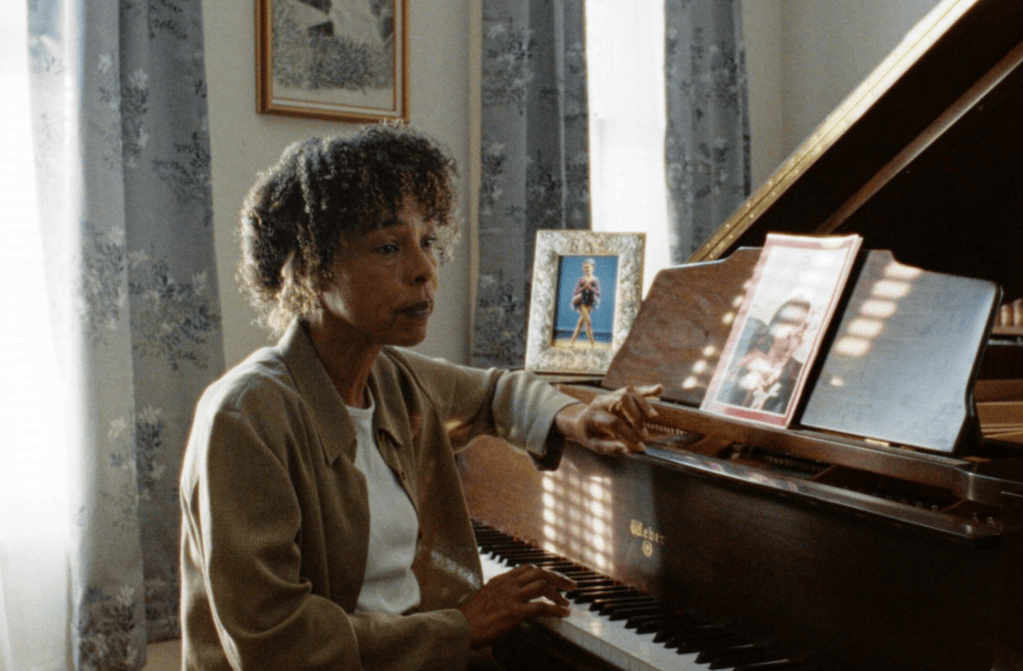
Sophie Okonedo in Mouse. Mouse photography by Nate Hurtsellers and Luke Dyra/Independent Film Company. Header image of Katherine Mallen Kupferer and Chloe Coleman.
The movie’s much-felt-for co-lead, portrayed by the wonderful, characteristically graceful Sophie Okonedo, is Callie’s mother Helen, who aches for a snatched-away future and is newly contemplative of what she’d sacrificed to become a mom. It included a successful career and rather urbane life performing classical music professionally; it was abandoned when she met her army-veteran soon-to-be-ex-husband (Christopher R. Ellis), whose not-dwelled-on reprehensibility is summarized when he, with some of Callie’s peers, plays a game of “fuck, marry, kill” with female celebrities on the cusp of their 18th birthdays. Minnie and Helen forge a complex bond — beyond their relationships with Callie, they’re also unspokenly outsiders in a conservative, conformity-minded everybody-knows-everybody community — that becomes shakily rife with mutually unhealthy projection though never crosses the threshold into overt inappropriateness. They don’t know what else to do besides turning to each other for what’s missing from their lives.
On the sidelines is Minnie’s abidingly disrespected veterinarian-tech mom Barbara (Tara Mallen), who exemplifies what many realize later in life: that we were unnecessarily dismissive of our mothers as teens as an unconscious symptom of yearned-for self-images and independence. Barbara suffers through much of Mouse resented by the class-anxious Minnie because their house, always stinking like the greasy fur of the many pets she keeps around, is shambolic enough that she’s embarrassed to invite people over. TV-dinner-buying Barbara can’t cook; she has a knack for publicly saying things that to a fellow parent isn’t that big a deal but, to a self-conscious daughter, is catastrophic.
One of the movie’s most affecting scenes could easily have been off-key. A mix-up necessitates Barbara bringing Minnie to work, where the latter sees up close the unglamorous, compassion-demanding work her mom grins and bears, never feeling cared about enough by her offspring to discuss at home. Minnie seems to come closer to seeing her mother as a fuller person as she helps her gently oversee a senior dog’s last few moments; Mouse gingerly petitions its characters, and by proxy the viewer, to meet one another halfway. Life’s fragility, it posits, makes it too important not to.
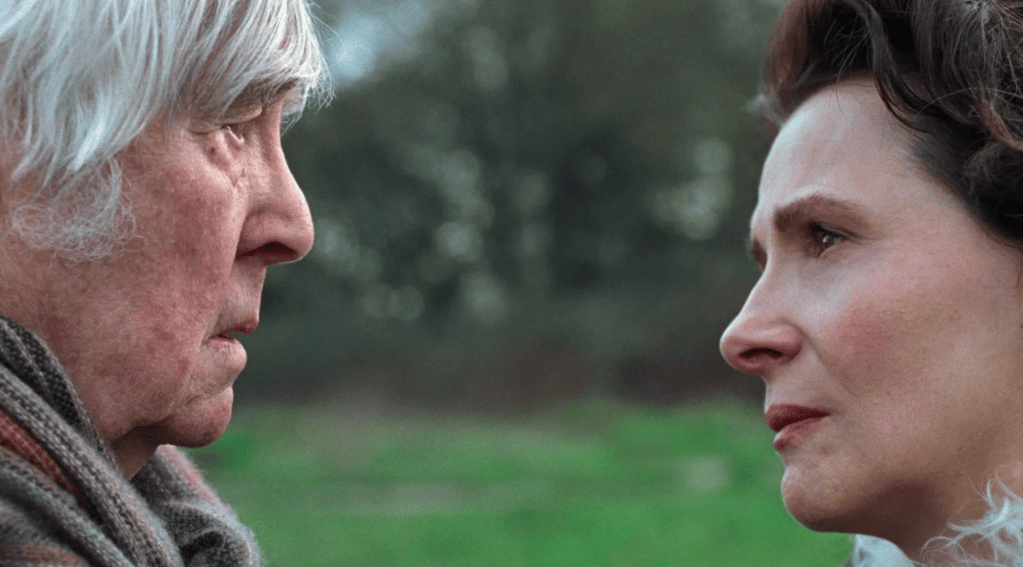
Tom Courtenay and Juliette Binoche in Queen at Sea. Courtesy of Greenwich Entertainment.
Queen at Sea begins with a writer and professor named Amanda (Juliette Binoche) walking in on her mom, Leslie (Anna Calder-Marshall), and stepfather, Martin (Tom Courtenay), having sex. She’s understandably mortified, but not for the usual reasons. Leslie has advanced dementia. Her disposition is not dissimilar from a shy toddler; her waking hours are most peaceful when she’s doodling at the kitchen table with over-ear headphones on. Her doctor has made it clear that continuing with the couple’s sex life as normal would be commensurate with assault, since Leslie, while still able to make her primal urges known, is not of sound enough mind to properly give consent. Amanda gets the police involved; Martin, however, is strenuous in his self-defense. Leslie, he reasons, was the instigator — something we’ll see evidence of while they’re half-asleep in bed later — and, after 18 years of marriage, how wrong is it to acquiesce?
For his first movie in 18 years, writer-director Lance Hammer doesn’t deign to definitively settle who’s in the right, clear-cut as it may instantly appear. Queen at Sea, much like Mouse, has a humanist, everybody’s-doing-what-they-think-is-right tenor that Hammer has professed to bristling against during the creative process, knowing while purging it onto the page that it could be a troublesome industry sell subject matter-wise. Amanda wants to protect her mother. Martin, not written as the sort of recalcitrant, traditional sex pest we initially think he could be, believes he’s obliging Leslie’s needs and helping preserve a degree of everyday normalcy, his decision-making also doubtlessly distorted by his own difficulty accepting the reality of his life. Aside from wanting to operate inside his marriage as though nothing has changed, he’s unbending that he and Leslie remain in their staircase-heavy flat, that she not move into an assisted-living home that could provide the round-the-clock care she evidently needs.
Hammer, who’d stepped away from filmmaking after the release of his debut, Ballast, attributes his long hiatus to simply not wanting to make a movie, in a world where landing financing as an independent creator is cumbersome, in which he wasn’t emotionally invested. He was roused to make Queen at Sea not because of any personal ties to the disease it’s rattled by but because he had been reading about cases not dissimilar from Leslie and Martin’s and was struck by the knottiness of trying to land on a moral position that wasn’t cluttered with caveats. Unsentimental but made with deep care for its leads, Queen at Sea pensively resides only in thoughtfully distressing gray areas, hindered by no missteps apart from its growing-in-number juxtapositions between Leslie and Martin’s morality-cracked marriage and the nascent romance between Amanda’s teenage daughter (Florence Hunt) and a floppy-haired schoolmate (Cody Molko). While not proposing anything invalid about time’s preordained bulldozing of all relationships, they feel too obvious for a movie where nothing is uncomplicated, where no conclusions last.
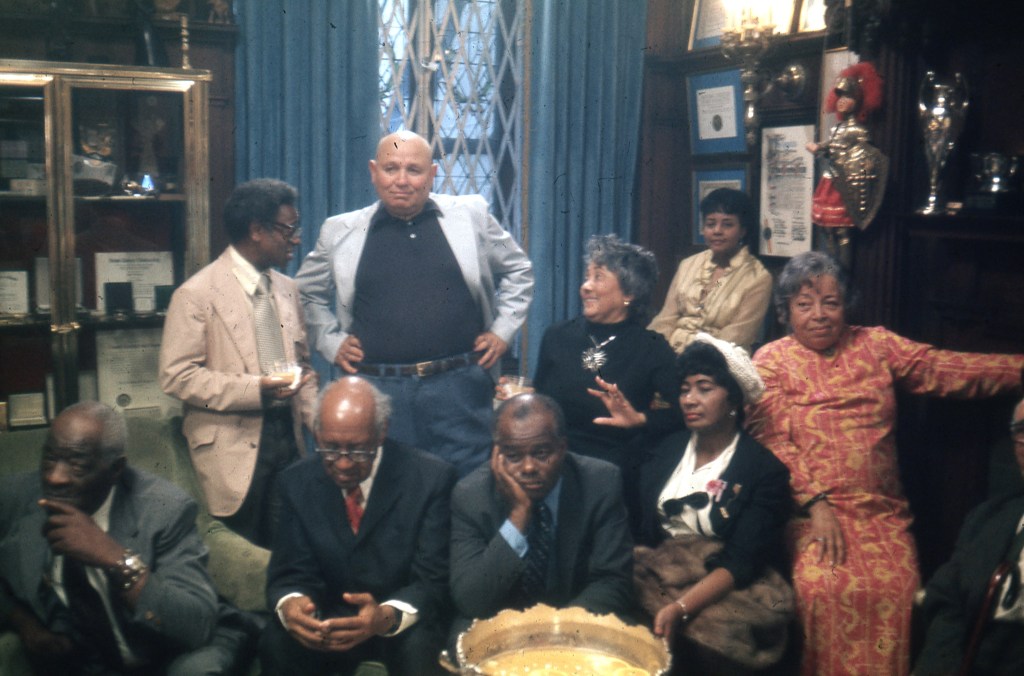
A scene from Once Upon a Time in Harlem. Courtesy of Neon.
In August 1972, the documentarian William Greaves organized at the townhouse of Duke Ellington a to-be-filmed cocktail-party reunion of sundry Harlem Renaissance giants as part of an effort to make, he once said, “great films on great people, all of whom are metaphors, creations of the godhead.” The prolific Greaves, whose name would be affiliated with 200 documentaries before his passing, in 2014, at age 87, certainly made good on his aspiration to make vital works about culturally significant figures. Yet the footage he amassed on that historical afternoon nearly 55 years ago sat unreleased in the interim, despite him considering it his most meaningful achievement. His son David, among the day’s camera operators, has chalked up the stagnation to unrealized ambition. His father envisioned what was recorded as part of a larger, headier presentation, padded out by additional interviews and footage, about the Harlem Renaissance and its lingering effects on its namesake neighborhood’s identity.
This January, after taking another look at what had been shot in 1972, David Greaves premiered at the Sundance Film Festival Once Upon a Time in Harlem, a finished, polished product for which he’s credited as a co-director and splits the difference between what his late father had in mind for the project and what he himself saw as sensible for a final version. The movie jettisons the elder Greaves’ broader objectives to stay self-contained, compactly appreciating the conversations, arguments, and first-person testimonials of creatively world-altering people who at that time, and still now, had primarily been known on the page.
Though now variously grey-haired, hunched, and weathered, those who appeared at Ellington’s home that afternoon — musician Eubie Blake, poet Frank Smith Horne, painter Aaron Douglas, editor Gerrie Major, photographer James Van Der Zee (whose many portraits are interspersed throughout the movie to show several of these literati in their prime), and many others — remain just as vibrant and engaged with the surrounding world. It’s almost surreal to see so many titans in the same room. It’s also poignant to see a community which history has deservedly immortalized as near god-like be made out of flesh and blood, just as susceptible as anyone to the physical tolls of aging. Adding to that pathos is Once Upon a Time in Harlem’s coda, which shows its guests departing the party and milling back to their homes, going unrecognized by the young people that pass them on the streets. The movie is dinged, however, by some last-minute voiceover from, through the use of AI recreation, “William Greaves” — a contradiction in a movie whose overarching purpose is to commemorate the generationally influential possibilities of creative ingenuity.
Toward the end of Once Upon a Time in Harlem, Ida Mae Cullen, the widow of the writer Countee Cullen, openly praises Greaves’ filmic effort to renew value in and attention to the era, extolling it as “one of the most tremendous things that has ever been done for us — Black people.” It’s bittersweet to know, in 2026, that that effort would go unseen by a wider audience for decades, its unveiling drawn out not by a crisis of confidence but a good-hearted determination to sufficiently do justice to its venerable subjects. But it’s ultimately a cause for celebration that something like Once Upon a Time in Harlem, epitomizing the idea of a wait being worth it, is here at all.

