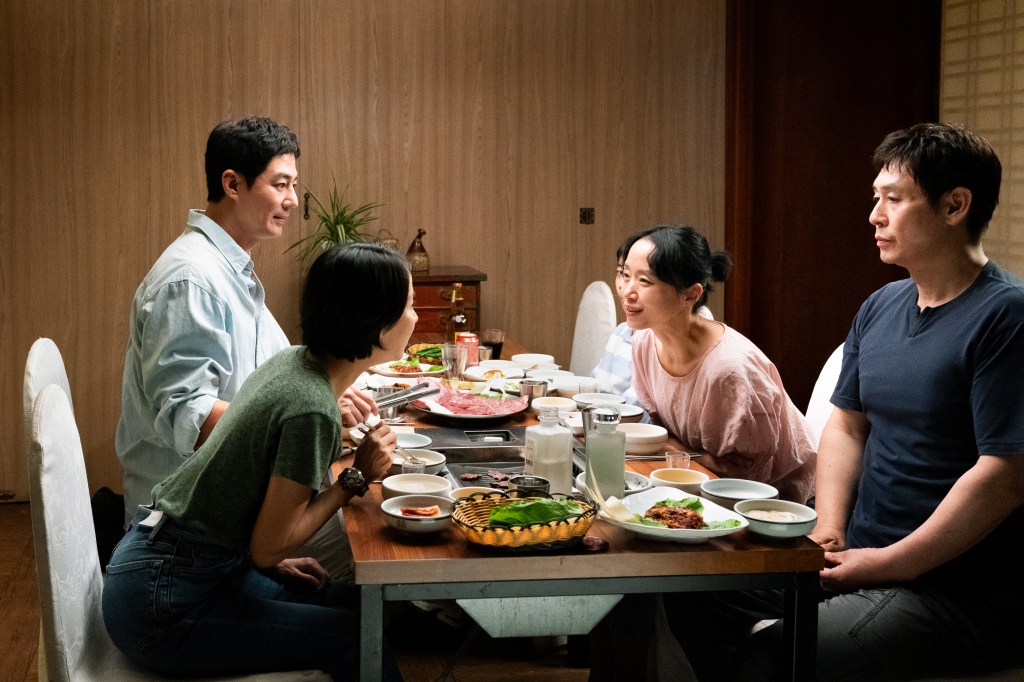
Possible Love, Lee Chang-dong’s first movie in eight years, is, in part, about a shifty documentarian circling a beleaguered subject, hunting for revelatory truths. Its early-November Netflix release has helped open up inevitable and not overreaching comparisons to Nathan Fielder and Lance Oppenheim’s expectations-melding, Elizabeth Holmes-centric not-quite-exposé You Can See Everything. Possible Love doesn’t arrive at Everything’s same slightly stoner-scented “everyone is, to a degree, unknowable” touchpoints. But the films have in common a productively inconclusive, rigidly spellbound captivation with the dynamic between a documentarian and the people onto whom they’re hitching a crew, which can as much foster insight as cast some dubiousness, given the camera’s room-altering power and the surgeries performed in the editing room, onto the reality of what, exactly, we’re looking at.
Also nearly three hours long, Possible Love features a filmmaker character who, contrary to the ostensibly candor-seeking Fielder and Oppenheim, seems most of all steered by a need to feed her self-importance. Moving around the world in minimalist but conspicuously designer clothing and a luxurious car, her well-heeled tech-entrepreneur husband (Zo In-sung) often by her side, Ye-ji (Cho Yeo-jeong) is in the process of making a movie about laid-off factory workers once employed by a corporation called SP Heavy Industries. Because of the company’s major presence in the area in which the film is set, and because the firings affected a whopping 40 percent of its workforce, Ye-ji believes homing in on a modicum of the newly axed would be representative of the average blue-collar worker. She’s looking to paint a portrait not merely of the immediate ramifications of that sort of dismissal but also of what it might take to pick oneself back up in the aftermath.
Ye-ji’s intentions beget skepticism from the start. Over the course of Possible Love, we watch her unapologetically stage scenes. She too closely buddies up with the people she’s observing — a move she thinks is necessary for those in front of her camera to spill their guts. When we hear her explain mid-movie her inspiration for making the documentary in the first place, the reason is so out of touch that it’s best not to reveal it here to preserve one’s inexorable aghastness. A successor to Barbara Kopple she decidedly is not. With a jovial smile good at lending itself to pretty-faced villainy depending on the role, Cho is great in this part that understatedly reviles but does not caricaturize monied unself-awareness.

From left to right: Zo In-sung, Jeon Do-yeon, and Sul Kyung-gu in Possible Love. Header image is of, from left to right, Zo In-sung, Cho Yeo-jeong, Jeon Do-yeon, and Sul Kyung-gu . All photography by Joo Jae-bum/Netflix © 2026
Possible Love concentrates on the relationship Ye-ji strikes with one of SP’s former welders, Ho-seok (Sul Kyung-gu), and his fellow factory worker wife, Mi-ok (Jeon Do-yeon). Ho-seok, however, is so button-lipped and invariably glum — his inner ferment, Mi-ok explains, is so strong that he’s rejected therapy, fearful of what it could unleash — that Mi-ok becomes a de facto subject while Ye-ji attempts to get Ho-seok to warm up. Possible Love’s first few hours are filled with exposition — documentary cameras are a convenient device to have people talk at length about their backgrounds’ minutiae — that’s pointedly and smartly tinted with telling-someone-what-they-want-to-hear carefulness that’s excellently performed by the movie’s central foursome. Imbued with flares of mutual envy and contempt, Mi-ok and Ye-ji’s superficially cheerful rapport puts you on edge. Much of Ye-ji’s engaged listening is an obvious ploy to get the hard-to-crack Ho-seok to open up. Mi-ok, who repeatedly brings up her and her husband’s friendlessness, enjoys the attention and newfound companionship, and knows she needs to be amenable to Ye-ji’s presence and cameras in order for them not to move on.
Possible Love unforcefully demands you deduce what’s going unspoken beneath its loquacious first couple hours, a copious amount of time it arguably doesn’t require to achieve the same effect it accomplishes. (It’s also fitfully decorated with reenactment-like flashbacks that don’t do much more than what our imaginations could have.) Its final act — during which the action moves from the characters’ everyday lives to Ye-ji and her husband’s disquietingly tranquil beachside vacation home — is where the movie most fully comes to life, where all the tactful dancing-around is, at last, ruptured by Ho-seok.
He is not quite, Ye-ji finds, the straightforwardly cheers-rousing working-class hero she’d wanted him to be, which also means Possible Love reveals itself, after its patient set-up, as one of recent years’ most clear-eyed portrayals of working-class demoralization. Accustomed to her charmed, friction-free life, Ye-ji isn’t prepared for the ugly truth she putatively seeks — to recognize the degree to which she has more in common with the people responsible for Ho-seok’s utter dejection than Ho-seok himself. No doubt clarifying its maker’s patronizing biases more than the realities of the people onto whom she’s directing her camera, I wish I could see Ye-ji’s documentary in its final form. I could see her not getting around to finishing it, either.
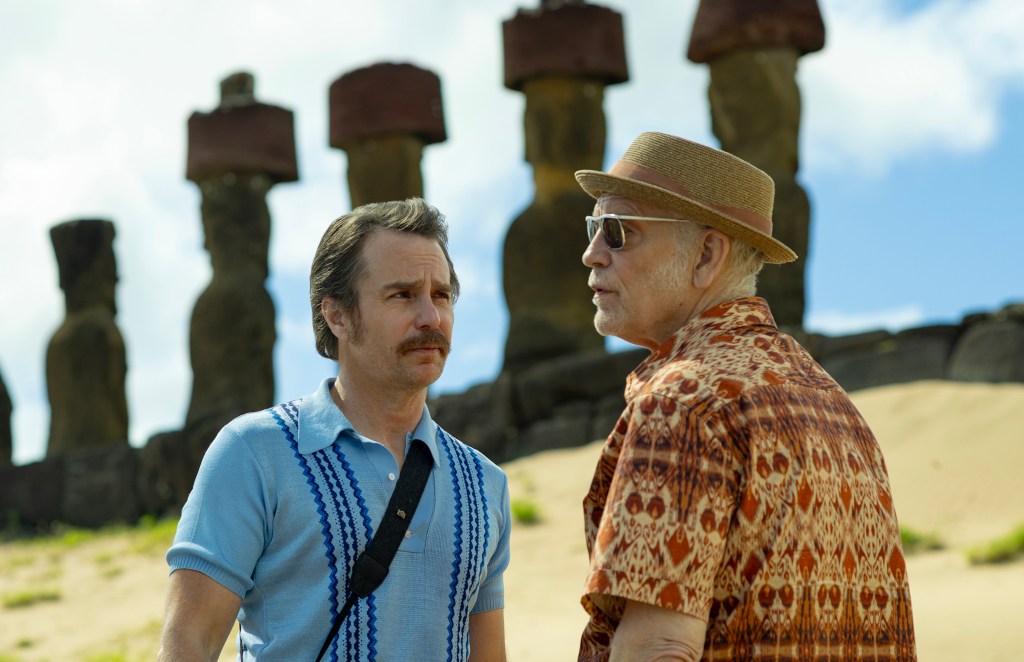
Sam Rockwell and John Malkovich in Wild Horse Nine. Photo by Searchlight Pictures/Diego Araya Corvalán, courtesy of Searchlight Pictures.
If I ever felt pangs of emotion during Wild Horse Nine, they didn’t have too much to do with its loathsome protagonists. CIA agents Chris and Lee (John Malkovich and Sam Rockwell) are experts in matters of killing and international disruptions of democracy. In this 1973-set film, their latest project is helping the U.S. orchestrate the conditions for Chile’s soon-to-be-infamous and generationally defining coup d’état resulting in the violent ousting of left-wing president Salvador Allende.
The movie’s writer and director, Martin McDonagh, who’s long exhibited a darkly comic fondness for going-through-it killers and misanthropes, wants you to reserve at least a little sympathy for this amoral, believably father-and-son-like duo. Dementia-riddled, blood-vomiting Chris has terminal cancer that will probably kill him in the matter of a week. Lee, whom Chris considers his only friend and the sole person he can actually trust, is tortured by Chris’ already-forgotten-about request to put him out of his misery. (Most of Wild Horse Nine takes place on the picturesque, horse-overrun Easter Island, where the deed is to be done and which conveniently has a short direct flight from the country Chris and Lee are actively working to undermine.)
The pangs of emotion have more to do with the realization that Malkovich, for decades a specialist at playing articulate scoundrels, is in the latter stretch of his career and will probably not star in many more movies in which I’ll get to detest him. He’s so good at it that over the years I’ve gotten used to thinking I don’t like the man himself. In Wild Horse Nine, which he’s wonderful in, it’s easy to conflate Chris’ frailty with his own.
I could see this all earning Malkovich the sort of late-career Oscar that ulteriorly recognizes a near-lifetime of consistent professional excellence more than it does the movie itself. I’d like to see the same for Steve Buscemi, constantly apoplectic and drugged-out as Chris and Lee’s heroin-addicted supervisor, and for the blue-eyeshadowed, cheetah-print robe-wearing Parker Posey. She’s fabulous, in a couple of scenes where she’s at the other end of a phone call, as Lee’s restless, openly unfaithful stay-at-home wife forced to pay the price for her husband’s shady dealings. I could have, maybe even preferred to, watch a movie just about her.

