Margaret Brown’s Descendant (2022) grapples with the discovery of something whose story was, for generations, mostly maintained by trickled-down memories. Set in Africatown, Alabama, and shot across four years, the documentary begins just before the 2019 recovery of the Clotilda in the Mobile River. For the neighborhood’s majority-Black population, the slave ship’s existence had, before then, long served as an elusive key to their history. Although the United States abolished the international slave trade in 1808, a local white businessman, Timothy Meaher, cockily made a bet in 1860 that he could pull off a mission that, if caught, would result in a death sentence. His gambit was, unfortunately, seen through. Meaher and the Clotilda’s captain, William Foster, kidnapped about 110 people from Dahomey and brought them to Mobile, Alabama; they burned the ship and let it sink in about 20 feet of water. In interviews conducted in subsequent years, Meaher intentionally misled interlocutors about the vessel’s whereabouts when the all-but-open secret was inquired about.
Brown surveys a large swathe of present-day Africatown residents — all of them direct descendants of 32 Clotilda survivors who formed the north-of-downtown-Mobile community — and finds no consensus about their feelings about the ship’s emergence and, afterward, about what sorts of aftermath they’d like to see. It’s widely agreed that it’s a vital part of their history that could bring them more answers about the ancestors. But does the public spotlight on the ship, in a way, continue to eclipse the humanity of the people who were forced upon it? What would possible reparations look like, and how would they be determined? If the ship’s remains are displayed in a museum context, who will most financially benefit from ticket proceeds? And will visitors, after they’re done taking in the rotted physical remnants and reading accompanying historicizing text, meaningfully do something with what they’ve just learned, or will it become a to-be-forgotten blip in their lives?
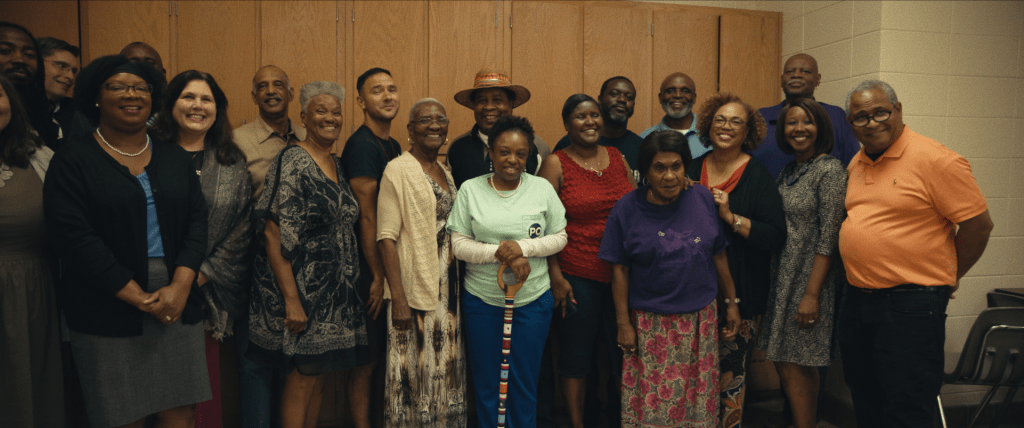
Those are among the many trains of thought posited in Descendant, a movie that honors the Africatown denizens it puts a spotlight on not only through the often beatific way cinematographers Justin Zweifach and Zac Manuels frequently shoot them, but also by giving ample room to their complex feelings without editorializing or trying to shape their varied testimony into a palatable narrative. What the movie will, without reservation, conclude is that the legacy of Meaher’s evil lives on with eerie symmetry in contemporary times. The namesake corporation his scions run is largely responsible for the relentless industrialization of Africatown, whose resulting pollution was eventually legally found to be related to the populace’s obscenely high rates of premature death by cancer. (Settlements stemming from that verdict engendered measly $200-ish payments to plaintiffs.)
None of Meaher’s living family agreed to participate in the documentary. The involvement of one of Foster’s male descendants evinces one way they might have feared coming across. Late in the movie, while flanked by two men in the Clotilda’s lineage en route to the wreckage site, he appallingly tries to characterize his relative as being fundamentally respectful, compared to other slaveowners, to the people he was forcibly bringing to the U.S. The relative gentleness with which his tone-deafness is met showcases incredible restraint from the people standing on the boat with him.
Descendant is unreserved in its admiration for Africatown’s residents, most of whom had, long before the Clotilda’s retrieval — something much community effort made happen in the first place — been meticulous about preserving ancestral narratives. (Brown, who is white, was raised in Mobile; she indirectly acknowledges that the spirit of her work is preceded by Zora Neale Hurston’s long-unreleased Barracoon: The Story of the Last Black Cargo, whose passages are read aloud by several of Descendant’s subjects and which itself relied on the recollections of Cudjoe Lewis, a man who once was the Clotilda’s only living survivor.) As someone notes at one point in the movie, the Clotilda’s discovery gives new credence and depth to a history conserved by word of mouth, bringing the community and its past to wider, national attention. Testifying to the importance of never letting unseemly history fade, Descendant attentively and solicitously builds on that idea.
Header image courtesy of Netflix

